How to identify a northern cardinal
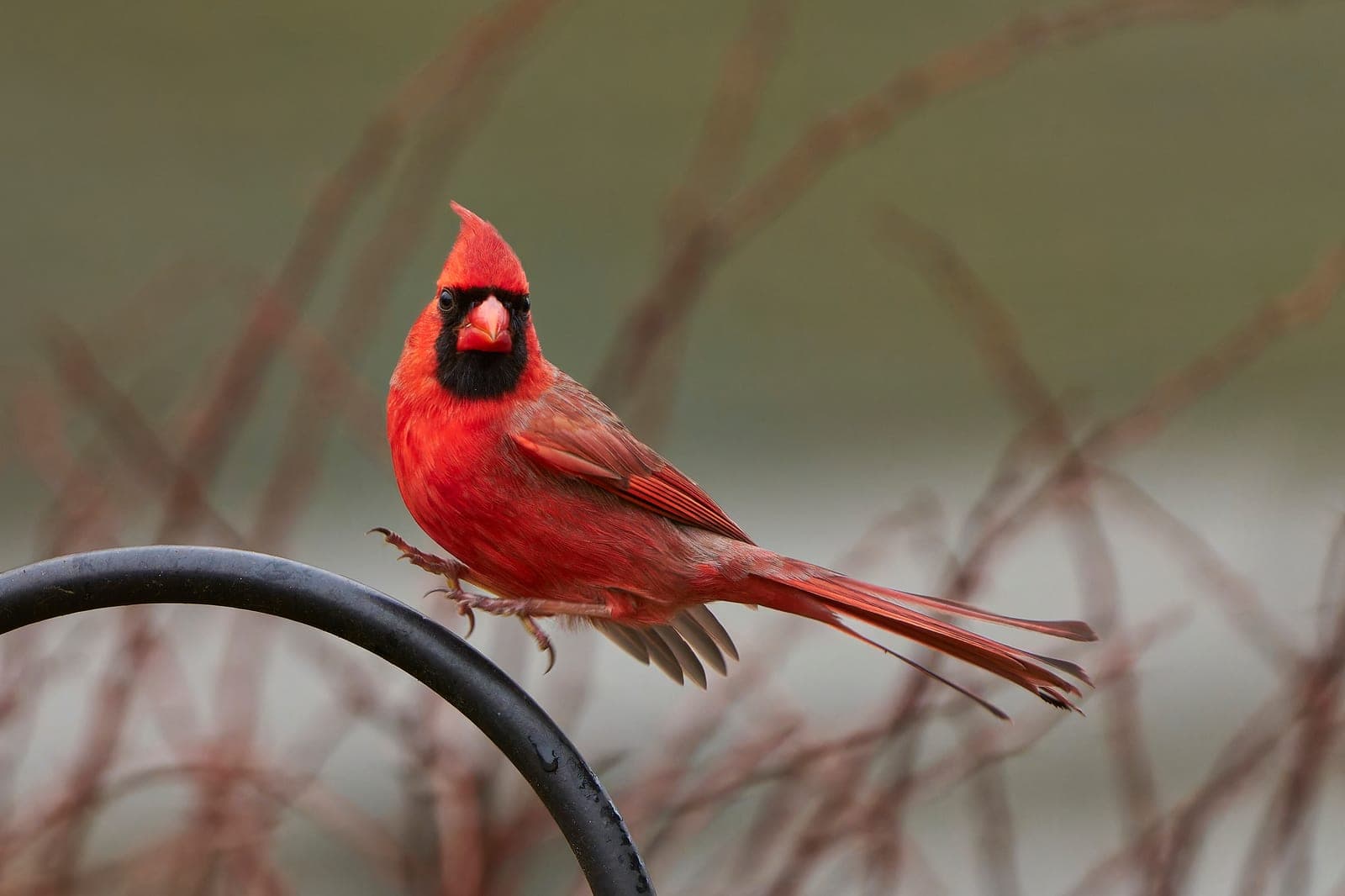
Cardinals are stocky, long-tailed songbirds with a pointed crest and a thick, cone-shaped bill built for cracking seeds. The adult male is brilliant red all over, darkest on the back and wings, with a black mask around the base of the bill that runs onto the chin. The female is warm tan to gray-brown with red edging on the crest, wings and tail, a grayish face mask and the same bright orange-red bill. Juveniles look like dull females with a dark bill, which turns orange by fall. Both sexes can raise the crest high or lay it flat.
- Pointed crest on both sexes
- Thick, coral-red cone-shaped bill
- Male: all-red body with a black face mask
- Female: tan-brown with red tinges on crest, wings and tail
- Loud, clear whistles: 'cheer-cheer-cheer' or 'birdie-birdie-birdie'
Look-alikes
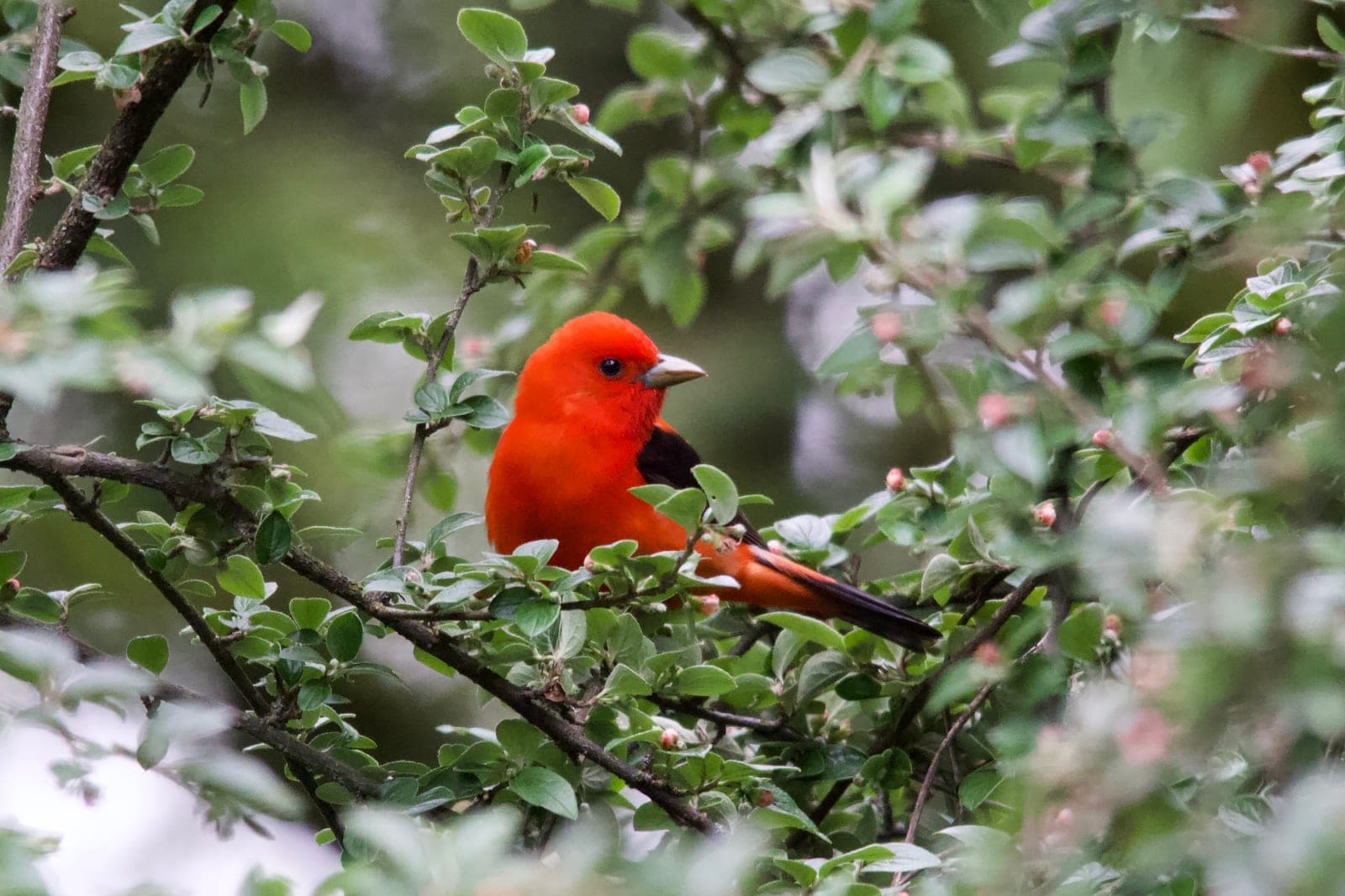
Scarlet Tanager
Male scarlet tanagers are red with jet-black wings and tail, no crest and no face mask, and they stay high in forest canopy from May to September. A cardinal's wings are red and it has a crest year-round.
Full comparison →Summer Tanager
Male summer tanagers are rosy red from head to tail like a cardinal, but they have no crest, no black mask and a long, pale bill. They are migrants of southern woodlands that rarely visit seed feeders.
Pyrrhuloxia
This desert cousin of the Southwest has a crest too, but it is gray with red on the face, crest and breast, and its stubby bill is yellow and curved like a parrot's. Female cardinals are browner and have an orange bill.
House Finch
Male house finches are much smaller, with red only on the head, breast and rump, brown streaks on the flanks and no crest. They usually arrive at feeders in chattering groups.
Range & habitat
Cardinals live across the eastern and central United States from southern Maine and Minnesota to the Gulf Coast and Florida, and west to the edge of the Great Plains and the Texas–Mexico border. In Canada they reach southern Ontario, southern Quebec, New Brunswick and Nova Scotia. A separate population inhabits the desert Southwest in Arizona and New Mexico, and the range continues south through much of Mexico to northern Guatemala and Belize. People introduced cardinals to Bermuda around 1700 and later to Hawaii. In 1929 they were still rare in New England; backyard feeding is thought to have helped them push north since.
Cardinals need dense, low cover for nesting and nearby open ground for feeding. In the East that means woodland edges, thickets, overgrown fields, hedgerows, swamps, parks and above all suburban yards with shrubs and feeders. They avoid the interior of unbroken forest. In the Southwest they are more local, living in mesquite groves, desert washes and thick streamside brush.
Through the seasons
Spring
Males start singing on mild days in late winter, and by early spring pairs are courting, with the male feeding the female seed beak to beak. Territorial males fight their reflections in windows and car mirrors, and nesting begins as early as March in the South.
Summer
Pairs raise two or three broods, rarely four. The male often takes over feeding the fledglings while the female starts the next nest. Late-summer molt can leave some birds patchy or even bald-headed for a few weeks.
Fall
Territories loosen and cardinals start traveling in small family groups and flocks. Young males molt into red, juveniles' dark bills turn orange, and feeder visits climb as wild seed and fruit become the main foods.
Winter
Loose flocks, sometimes a dozen birds or more, work feeders and brushy edges together. Cardinals fluff their feathers against the cold and are often the first birds at the feeder in the morning and the last at dusk.
How to find and attract northern cardinals
Cardinals are one of the easiest birds to bring to a yard: offer the right seed near good cover and they will visit year-round. Listen for their ringing whistles, which carry across neighborhoods from late winter through summer.
- Offer black-oil sunflower and safflower seed; safflower is less popular with squirrels, grackles and starlings.
- Use a tray or platform feeder, a hopper with a wide ledge, or scatter seed on the ground near shrubs: cardinals prefer solid footing to small perches.
- Plant dense shrubs and tangles for nesting and cover, such as native viburnums, dogwoods, hawthorn, grapevine and evergreen hedges.
- Keep a brush pile or thicket near the feeder so birds can dart to safety from Cooper's hawks and cats.
- Check feeders at first light and dusk, when cardinals are most active at them.
- If a male keeps attacking a window, break up the reflection on the outside of the glass with screening or decals.
- Learn the songs, 'cheer-cheer-cheer' and 'birdie-birdie-birdie', plus the sharp, metallic 'chip' call both sexes use.
Diet & life cycle
What it eats
Adult cardinals live mostly on plant food, which can make up as much as 90 percent of the diet: weed and grass seeds, waste grain, wild fruit, buds and flowers, plus sunflower seed wherever people put it out. They also eat beetles, cicadas, grasshoppers, caterpillars, snails and spiders, and the young are raised almost entirely on insects. Cardinals forage by hopping on the ground and through low shrubs, and they have been seen sipping maple sap from holes drilled by sapsuckers.
Life cycle
The female builds a cup nest of twigs, bark strips, grass and leaves, usually 3 to 10 feet up and well hidden in a dense shrub, vine tangle or small tree. She lays three or four whitish eggs blotched with brown, gray and lavender, and incubates them for 12 to 13 days. The young leave the nest just 9 to 11 days after hatching, before they can fly well. Pairs often stay together through the year and across seasons, though DNA studies show some young are sired by other males. Adults survive from one year to the next at roughly 60 to 65 percent, and a captive cardinal lived 28.5 years.
Oldest on record
The oldest northern cardinal in the USGS Bird Banding Laboratory longevity table was a female at least 15 years and 9 months old. She was banded as an adult in Pennsylvania in March 1956 and caught by hand in Pennsylvania in March 1971.
SourceAttracting & watching
Cardinals are feeder regulars all year. Black-oil sunflower and safflower in a tray or hopper, dense shrubs within a short flight of the feeder, and a heated birdbath in winter will keep a pair or a winter flock coming back. They are protected under the Migratory Bird Treaty Act, which also ended their sale as cage birds; enjoy them from the window and leave nests and fledglings alone.
Conservation
Least Concern (IUCN). Cardinals are abundant, with estimates ranging from about 100 million to 130 million birds, and the Breeding Bird Survey shows a slight long-term increase since 1966. Their range has expanded north for more than a century, helped by suburban shrubs and bird feeders. Once trapped and sold for their color and song, they have been protected under the Migratory Bird Treaty Act since 1918. Outdoor cats, window strikes and pesticides are the main human-caused threats.