How to identify a house finch
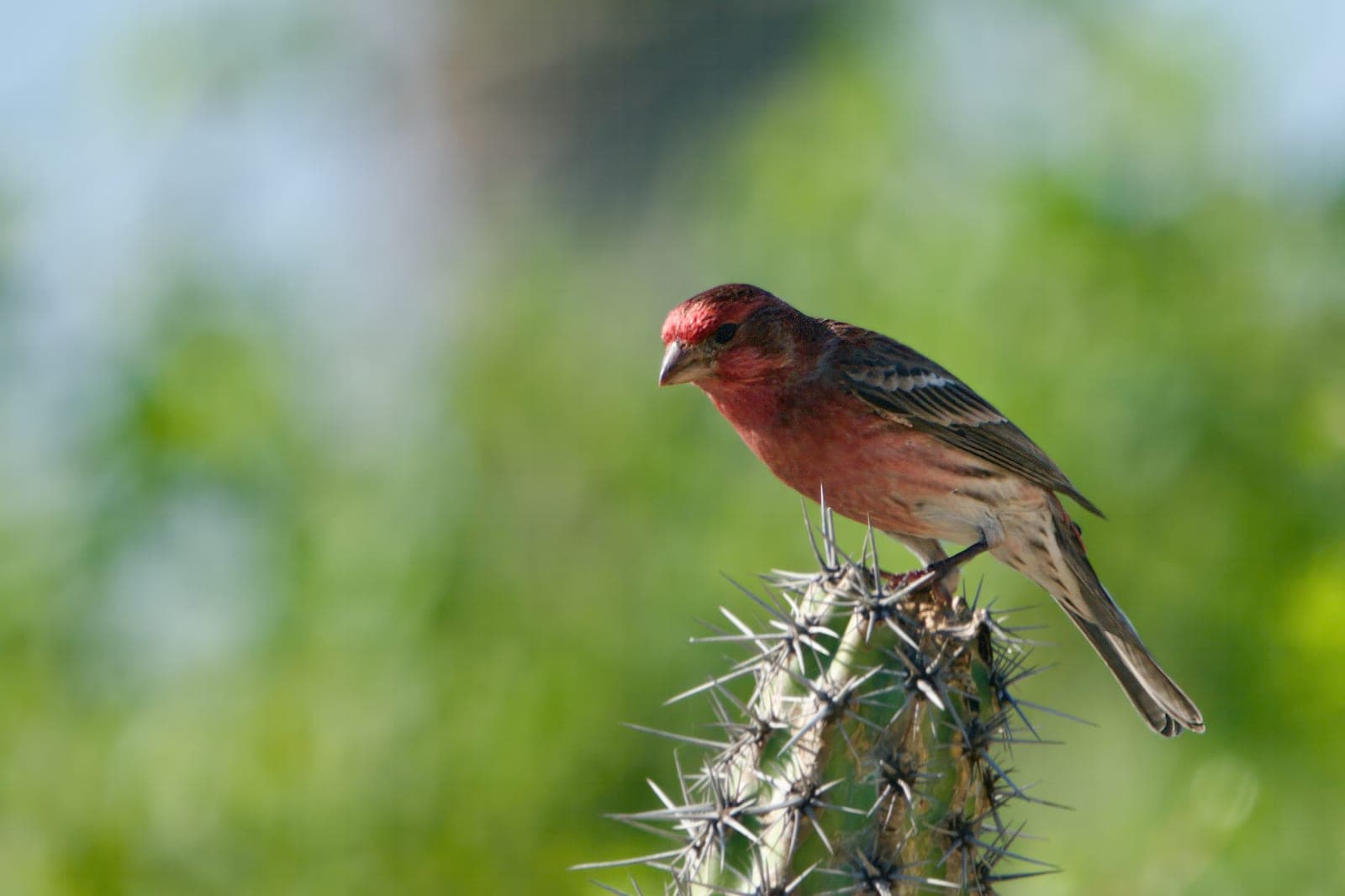
Adult males have a red forehead, eyebrow, throat and breast, often with red on the rump too, set against a brown cap, a brown back and blurry brown streaks along a pale belly. The red comes from carotenoid pigments in the food a male eats while he molts, so some males are orange or even yellow. Females and young are plain gray-brown with blurry streaks below and an unmarked face, with no eye stripe or cheek patch. The bill is short and stubby with a curved upper edge, and the tail is fairly long with a shallow notch. Males sing a long, cheerful warble that often ends in a rough, buzzy note.
- Male's red is limited to the head, breast and rump, under a brown cap
- Blurry brown streaks along the flanks and belly
- Female has a plain face with no eyebrow or cheek patch
- Short, stubby bill with a curved upper edge
- Long, warbling song that often ends in a buzzy 'zeee'
Look-alikes
Purple Finch
A male Purple Finch looks dipped in raspberry juice: the rosy color washes the whole head, back and wings, and the flanks are clean rather than streaked. Females have a bold white eyebrow and a dark cheek, and the tail is more deeply notched.
Cassin's Finch
A bird of western mountain forests. Males have a bright red crown that contrasts with a brown, streaky nape, and both sexes have a longer, straight-edged bill and crisp dark streaks under the tail.
House Sparrow
Female House Sparrows share yards and feeders with female House Finches, but they have a clear buff eyebrow, a striped back and a plain, unstreaked gray-buff breast. Female House Finches are streaked below and plain on the face.
Range & habitat
House finches are native to the western United States and Mexico. Birds sold illegally in New York as 'Hollywood finches' were released on Long Island in 1940, and their descendants spread across the eastern United States and southern Canada in about 50 years, meeting the western population on the Great Plains. Today house finches live across nearly all of the lower 48 states and southern Canada and through much of Mexico. They were also introduced to Hawaii before 1870 and now live on most of the main islands.
In the East, house finches are town and suburb birds: lawns, feeders, small ornamental evergreens, porches and the eaves of buildings. In the West they also live in wilder country, including desert grassland, oak savanna, streamside woods, open lowland conifer forest and canyons. They avoid unbroken forest and big, treeless grasslands, and wherever they live they like a mix of open ground, shrubs and buildings.
Through the seasons
Spring
Nest building can start in early March, earlier than most backyard birds. Males sing from wires and rooftops and feed their mates, and nests turn up in hanging planters, door wreaths, ivy, porch lights and dense ornamental conifers.
Summer
Pairs raise two or more broods from spring into August. Streaky, short-tailed juveniles follow their parents to feeders, begging with fluttering wings, and the young are fed almost entirely on seeds and other plant food.
Fall
Adults molt after nesting and young males get their first red feathers. Flocks form, and some eastern birds migrate south, while most western birds stay put or move only a short way downhill.
Winter
Flocks crowd sunflower feeders. Watch for birds with red, swollen or crusty eyes, a sign of house finch eye disease, and clean feeders promptly if you see them.
How to find and attract house finches
House finches usually find you: put up a sunflower feeder in a town or suburb and they tend to arrive within days. Learn the long, rambling song that ends in a buzzy note and the chirpy flight call, both heard from rooftops and wires all year.
- Offer black-oil sunflower seed in a tube or hopper feeder; they also take nyjer, millet and safflower.
- Clean feeders every week or two with a weak bleach solution (about one part bleach to nine parts water), rinse and let them dry, to slow the spread of eye disease.
- Expect nests in hanging baskets and wreaths in spring; if a pair moves in, leave it alone for about a month until the young fledge.
- Small evergreens near the house, such as arborvitae and junipers, give them nest sites and night roosts.
- Seeding sunflowers, dandelions and berry-producing shrubs feed them in summer and fall.
- Provide a birdbath; house finches drink and bathe often, especially in hot, dry weather.
Diet & life cycle
What it eats
House finches eat almost nothing but plant food: weed seeds such as dandelion and thistle, buds and flower parts in spring, and berries and small fruits in summer and fall, with only a few small insects like aphids. Unusually for a songbird, they raise their nestlings on regurgitated seeds rather than insects. At feeders they favor sunflower seed, and some even sip sugar water from hummingbird feeders.
Life cycle
Pairs often form within winter flocks, and some stay together all year. The female builds an open cup of grass, twigs, rootlets and debris, often including a bit of string or other white material, in a conifer, palm, cactus, ivy, building ledge or hanging planter. She lays four or five pale blue eggs dotted with black, sometimes two to six, and incubates them for 12 to 14 days while the male brings her food. Both parents feed the nestlings, which leave the nest after about two weeks. Pairs may nest two or three times a season, from early spring into August.
Oldest on record
The oldest house finch in the USGS Bird Banding Laboratory longevity table was a male at least 11 years and 7 months old. He was banded in Maryland in January 1969 and found injured there in January 1980.
SourceAttracting & watching
Black-oil sunflower is the house finch staple, in tube, hopper or platform feeders, and nyjer and safflower also work. Because house finches feed in tight groups, feeder hygiene matters more for them than for most birds: clean feeders and trays often, rake up old hulls, and take feeders down for a week or two if sick birds appear. A birdbath and a few dense shrubs or small conifers complete a yard they will use all year.
Conservation
Least Concern (IUCN). House finches are abundant, with an estimated 40 million birds, and the Breeding Bird Survey shows a roughly stable continental trend from 1966 to 2019. The eastern population crashed in the 1990s after mycoplasmal conjunctivitis, a bacterial eye infection caused by Mycoplasma gallisepticum, was first noticed near Washington, D.C., in the winter of 1993–94; the disease has since spread west. House finches are native and protected under the Migratory Bird Treaty Act, which is why pet dealers dumped their illegal stock in 1940.