How to identify a rose-breasted grosbeak
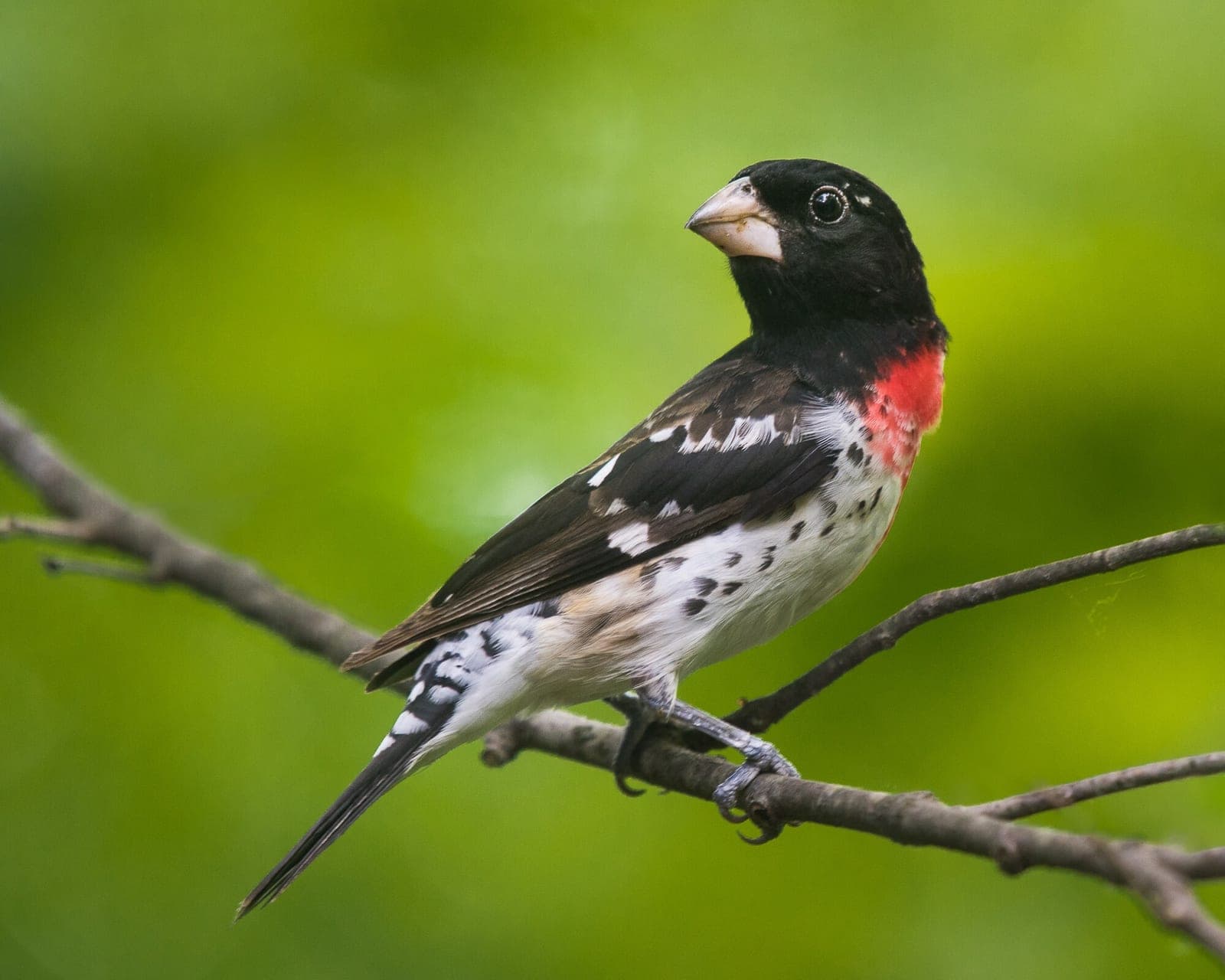
Rose-breasted grosbeaks are stocky songbirds with a huge, pale, triangular bill. The adult male in spring has a black head, back, wings and tail, a white belly and rump, two white wing patches and a rose-red bib that narrows to a point down the breast; the wing linings are rosy too. Females look like oversized sparrows: brown and streaky with a bold white eyebrow, a pale stripe on the crown, white wing bars and yellow wing linings. First-year males in spring are a mix of the two, and in fall adult males turn scaly brown above while keeping some pink.
- Very large, pale, cone-shaped bill
- Male: black hood and back with a rose-red triangle on a white breast
- Bold white wing patches, flashing in flight
- Female: streaked brown with a bold white eyebrow and crown stripe
- Call: a sharp, squeaky 'eek'
Look-alikes
Black-headed Grosbeak
The western counterpart's male has a black head but cinnamon-orange underparts and collar instead of white with a rose bib. Females are buffier with finer streaks and a two-toned bill. The two species hybridize on the Great Plains.
Purple Finch
Female purple finches share the streaky brown look and white eyebrow, but they are much smaller, with a slim bill, a notched tail and no white wing patches.
Eastern Towhee
Male towhees also mix black, white and red, but the red is rufous on the flanks, not a bib on the breast, and towhees scratch on the ground under shrubs rather than feeding in treetops.
White-throated Sparrow
This sparrow also has a striped head, but it is far smaller, with a small bill, a white throat patch and yellow in front of the eye. A female grosbeak has a massive bill and white wing patches.
Range & habitat
Rose-breasted grosbeaks breed across much of southern and central Canada, from Alberta and the southern Northwest Territories east to the Maritimes, and in the northeastern and north-central United States, south along the Appalachians. They migrate through the eastern and central United States and winter from southern Mexico through Central America and the Caribbean to Venezuela and Peru. Spring and fall strays turn up regularly in the West.
In summer this species uses open deciduous and mixed woods, especially edges and openings where tall trees meet thick shrubs, along with second growth, orchards, parks and leafy suburbs. It avoids unbroken deep forest. In migration it can appear in any wooded or semi-open area, including backyard feeders. On the wintering grounds it favors forest edges, second growth, plantations, parks and gardens from sea level into the foothills.
Through the seasons
Spring
Grosbeaks reach the United States in late April and early May, males a few days to a week ahead of females. This is the best time to see them, when migrants pile onto sunflower feeders and males sing from treetops, sometimes even before they reach the breeding grounds.
Summer
Pairs nest in deciduous trees and shrubs, and both parents share incubation and feeding. Most raise one brood, sometimes two. Birds stay high in leafy canopy, so the robin-like song and squeaky call are the best clues.
Fall
Adult males molt into a browner, scaly plumage, and grosbeaks fatten on berries and seeds before migrating, mostly in late September and October. Young birds in fall look like females with a pinkish or buffy wash on the breast.
Winter
The species winters in southern Mexico, Central America, the Caribbean and northern South America, usually in small groups at forest edges, gardens and plantations. Males start singing before they leave for the north.
How to find and attract rose-breasted grosbeaks
The easiest way to see one is to keep a sunflower feeder stocked in late April and May. In summer, walk deciduous woods and edges and follow the sweet, robin-like song up into the canopy.
- Fill hopper or platform feeders with black-oil sunflower and safflower during spring migration, when grosbeaks visit most.
- Listen for a rich, rolling song like a robin's but sweeter and more melodious, and for a sharp 'eek' often compared to a sneaker squeaking on a gym floor.
- Search open deciduous woods, forest edges, orchards and wooded parks from May through August.
- Plant native fruit such as serviceberry, elderberry, mulberry and blackberry, and keep tall trees beside dense shrubs.
- Look for the flash of white wing patches and, on males, rosy wing linings as birds fly between treetops.
- Treat nearby windows with decals or screens: grosbeaks are frequent window-strike victims.
Diet & life cycle
What it eats
About half of what a rose-breasted grosbeak eats is insects, especially beetles, plus caterpillars, grasshoppers, true bugs, spiders and snails. It also takes many seeds, from elm and other tree seeds to weed seeds such as smartweed and milkweed, along with buds, flowers and some cultivated grain. Wild and cultivated fruit becomes important in late summer and fall. Grosbeaks forage mostly in trees and shrubs, gleaning foliage, hovering and occasionally catching insects in flight, and the young are raised mostly on insects.
Life cycle
Nests sit in deciduous trees or large shrubs, usually 5 to 20 feet up near a woodland opening. The nest is a loose cup of twigs, weed stems and leaves, sometimes so flimsy that the eggs show through from below. The female lays three to five pale blue-green eggs spotted with reddish brown, typically four. Unusually for songbirds, the male takes roughly a third of the incubation, which lasts about 13 to 14 days. Young leave the nest 9 to 12 days after hatching and become independent about three weeks later. Captive grosbeaks have lived as long as 24 years.
Oldest on record
The oldest rose-breasted grosbeak in the USGS Bird Banding Laboratory longevity table was a male at least 13 years old. He was banded in his hatching year in Alberta in July 2011 and recaptured and released at an Alberta banding station in June 2024.
SourceAttracting & watching
In spring, black-oil sunflower and safflower in a sturdy feeder are the best way to get close looks; grosbeaks also use birdbaths and fruiting native shrubs. In summer, watch deciduous woods and edges, where pairs feed young in the treetops. The species is protected under the Migratory Bird Treaty Act, and window treatments near feeders save many of them.
Conservation
Least Concern (IUCN). Partners in Flight estimates about 4.7 million rose-breasted grosbeaks, and the species is not considered threatened. The Breeding Bird Survey shows a slow long-term decline, with losses concentrated in the eastern part of the breeding range and increases in the west. Collisions with buildings and vehicles are a leading recorded cause of death, and birds are still sometimes trapped as cage birds on the wintering grounds.