Birds · Side by side
Northern Cardinal vs Scarlet Tanager
How to tell them apart
Quick answer
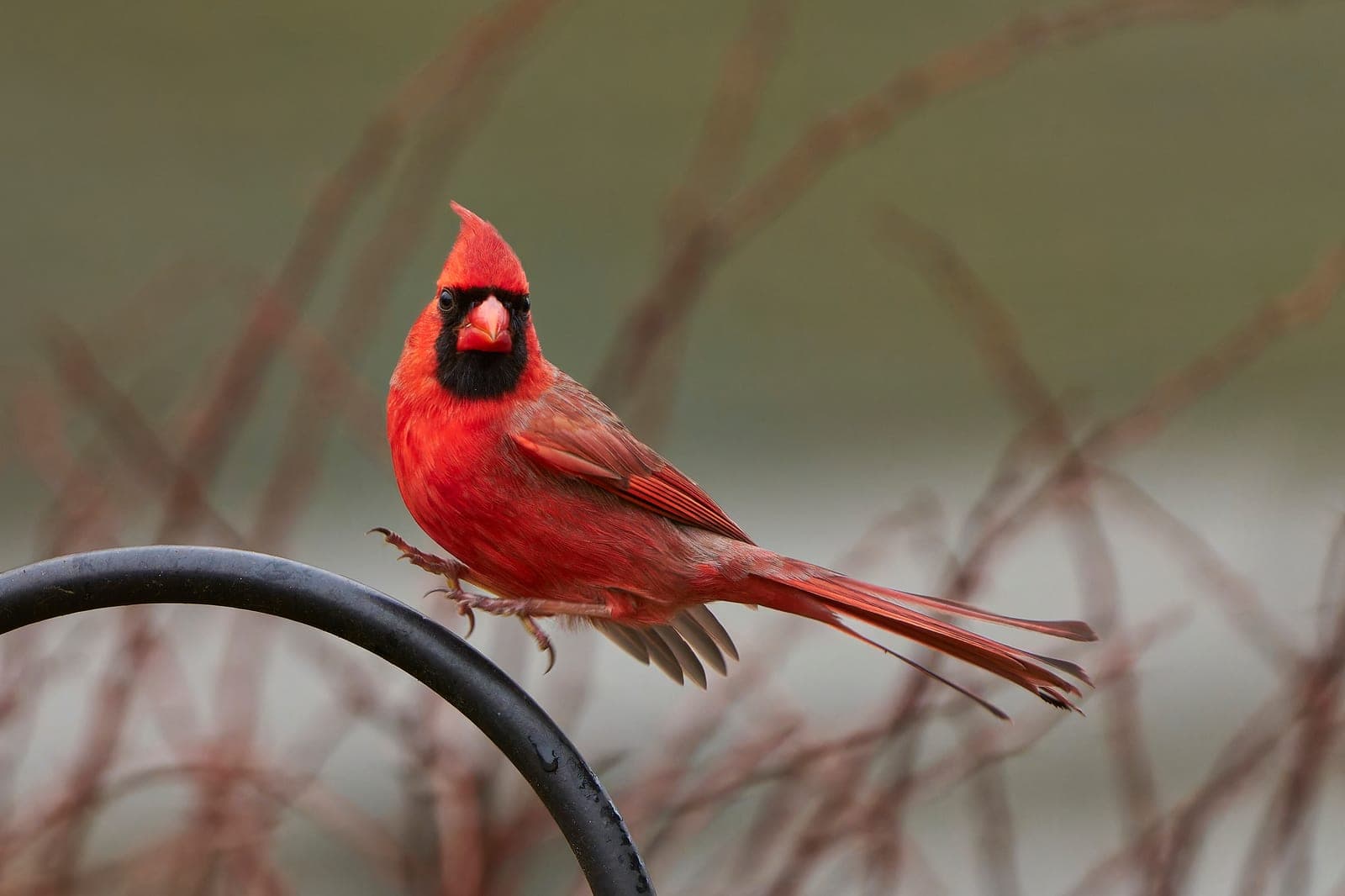
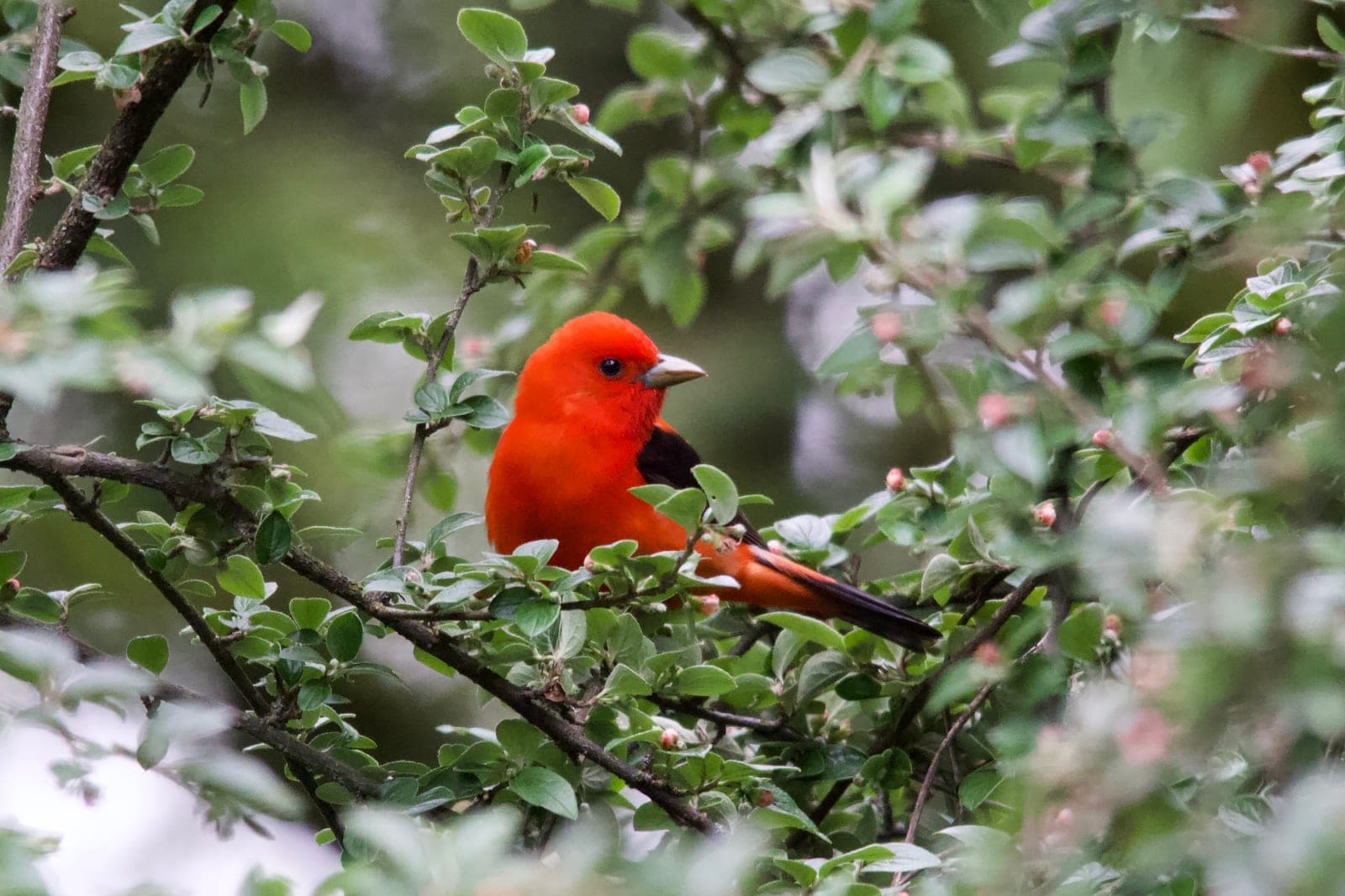
Look at the wings and the head: a male scarlet tanager has jet-black wings and tail and no crest, while a male cardinal is red all over, wings included, with a pointed crest and a black face around a thick red bill.
The northern cardinal and the scarlet tanager are the two classic red birds of the eastern woods, and both belong to the cardinal family. Beginners often call any red bird a cardinal, but these two differ in shape, color pattern, voice and lifestyle: one lives at your feeder all year, the other spends summer high in oak canopy and winters in South America.
Key differences
| Trait | Northern Cardinal | Scarlet Tanager |
|---|---|---|
| Head | Tall, pointed crest | No crest; smooth, rounded head |
| Wings and tail | Red, slightly duller on the back | Jet black on breeding males |
| Face and bill | Black mask; thick coral-red bill | No mask; stout, pale bill |
| Female | Tan-brown with red tinges and an orange bill | Olive-yellow with darker wings |
| Length | 8.3–9.3 in | 6.3–7.5 in |
| When present | All year; does not migrate | Late April to early October; winters in South America |
| Where it feeds | Ground, low shrubs and seed feeders | High forest canopy, mostly on insects |
| Voice | Clear whistles: 'cheer-cheer-cheer', 'birdie-birdie' | Hoarse, robin-like phrases; 'chip-burr' call |
Why you see one far more than the other
Cardinals are year-round residents of thickets, hedges and suburban yards, and they come readily to black-oil sunflower and safflower, so most people see them daily. Scarlet tanagers are forest birds that need large tracts of mature deciduous woods, especially oaks, and they forage slowly among the leaves high in the canopy. They rarely visit feeders. Most birders find their first tanager by learning its burry song and 'chip-burr' call in May and June, then searching the treetops for the singer.
The tanager's fall disguise
Male cardinals stay red all year. Male scarlet tanagers do not: after nesting they molt into yellow-green plumage like the females but keep black wings and tail, and birds caught mid-molt in late summer look blotched with red, yellow and green. So a yellowish bird with black wings in September is a tanager, not a mystery species. Female cardinals are also easy to separate from female tanagers: they are tan-brown with a crest and an orange bill, while female tanagers are olive-yellow, uncrested and pale-billed.
Other red birds to rule out
Summer tanagers of the South are red all over, wings included, but have no crest or black face and a long pale bill. House finches are much smaller, with red limited to the head, breast and rump and streaked brown flanks. In the desert Southwest, the crested pyrrhuloxia is gray with red trim and a stubby yellow bill. Red crossbills, brick-red with dark wings, flock in conifers and have crossed bill tips.
By the numbers
The traits the daily bird game compares for each.
| Clue | Northern Cardinal | Scarlet Tanager |
|---|---|---|
| Group | Cardinals & allies | Cardinals & allies |
| Colors | Red, Black | Red, Black |
| Habitat | Backyards | Forest |
| Region | Eastern | Eastern |
| Length | 9 in | 7 in |
| Wingspan | 11 in | 11 in |
| Diet | Seeds | Insects |
FAQ
Is a scarlet tanager a kind of cardinal?
In a sense, yes. Scarlet tanagers and other Piranga species were moved from the tanager family into the cardinal family, Cardinalidae, after genetic studies, so they are relatives of the northern cardinal.
Do scarlet tanagers come to feeders like cardinals?
Rarely. Tanagers eat mostly insects and wild fruit in the forest canopy, so native fruiting trees and moving water are better bets than a seed feeder.
Are female scarlet tanagers red?
No. Females are olive above and yellowish below with darker wings, while female cardinals are tan-brown with red tinges, a crest and an orange-red bill.
Which is bigger, a cardinal or a scarlet tanager?
The cardinal. It is about 8.3 to 9.3 inches long with a longer tail, while the scarlet tanager runs about 6.3 to 7.5 inches and looks chunkier and shorter-tailed.
Could you tell them apart from a few clues? Test yourself in today's puzzle.
Play the daily bird game