How to identify a indigo bunting
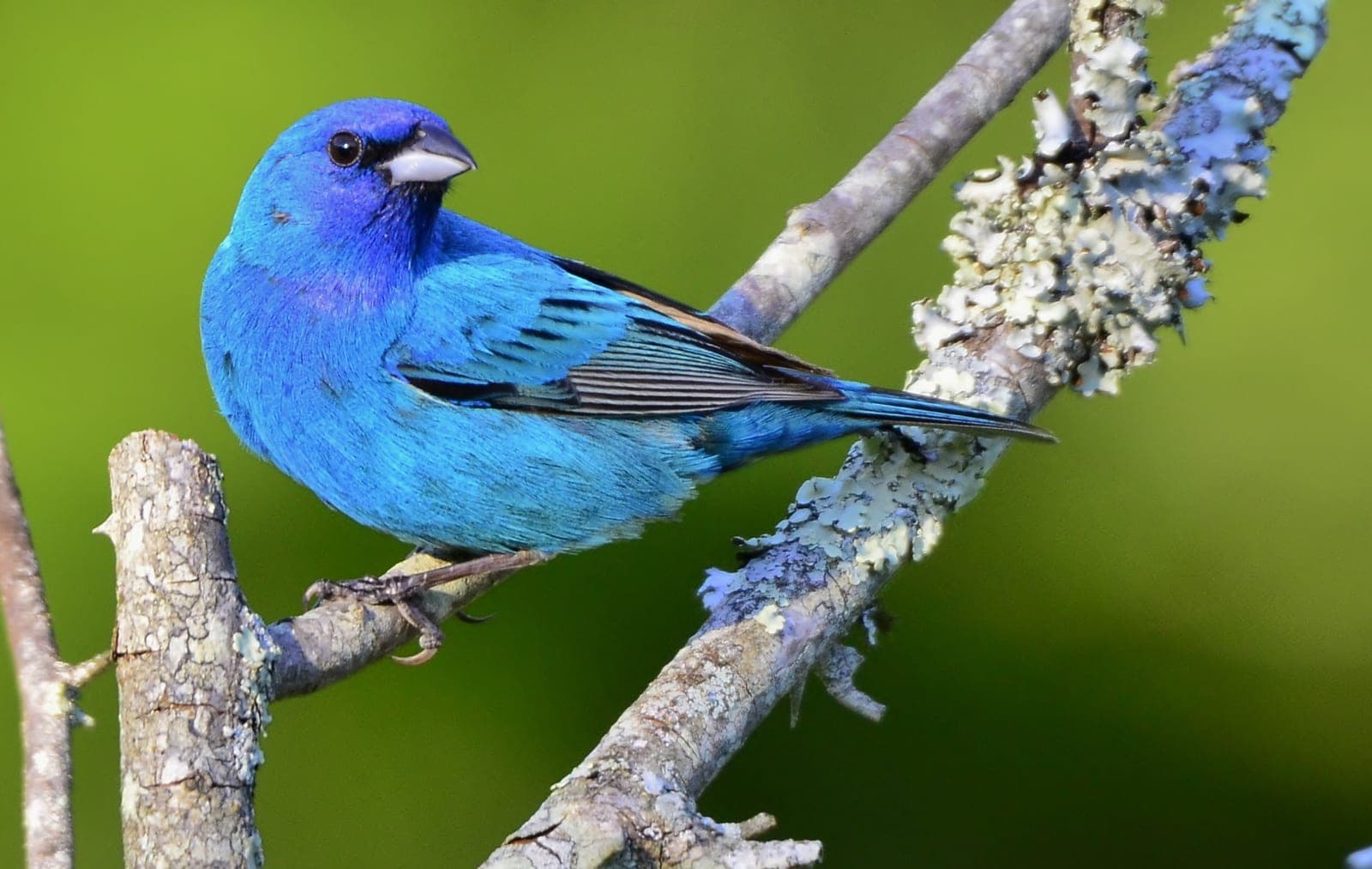
Indigo buntings are small, compact finch-like birds with a short, conical bill and a fairly short tail. A breeding male is blue all over, deepest on the head, with blackish wings and tail edged in blue and a two-toned bill, dark above and pale bluish below. In poor light the same bird can look almost black. Females are plain warm brown, paler below with faint blurry streaks on the breast, a hint of a wing bar and often a blue tinge in the tail. After breeding, males molt into a brown plumage patched with blue, and first-year males in spring look like a blue and brown mosaic.
- Male: entirely blue, with no orange, white or wing bars
- Short, thick, cone-shaped seed-eater's bill
- Female: plain brown with faint breast streaks and a bluish tail
- Fall males are brown with scattered blue feathers
- Sings paired phrases from high, exposed perches
Look-alikes
Blue Grosbeak
Blue grosbeaks are larger and deeper-billed, with two chestnut wing bars and a black patch around the base of the bill. Females are cinnamon-brown with buffy wing bars, unlike plain female indigo buntings.
Lazuli Bunting
The western cousin has a turquoise-blue head and back but an orange breast band, white belly and bold white wing bars. The two species meet and hybridize on the Great Plains and in parts of the Southwest.
Eastern Bluebird
Bluebirds are bigger, with a thin insect-eater's bill, a rusty breast and a white belly. A male indigo bunting is solid blue below and has a stubby seed-cracking bill.
Range & habitat
Indigo buntings breed from southern Canada and Maine south to northern Florida and eastern Texas, west across the Plains, and locally in the Southwest as far as southern Nevada, usually along streams; since the 1940s the breeding range has spread into much of the Southwest. They winter in southern Florida, the Caribbean, and from central Mexico through Central America to northern South America. Many spring migrants fly straight across the Gulf of Mexico at night, though some take the longer route around it. Strays have turned up as far away as Iceland and Britain.
This is a bird of edges and second growth rather than deep forest. Indigo buntings nest along brushy roadsides, overgrown fields, woodland borders, power-line and railroad rights-of-way, clearings and swamp edges, and they do well in rural country with a patchwork of fields and woods. They avoid heavily urbanized areas and landscapes of intensive row-crop farming. In the West they stick to streamside thickets. In winter they gather in weedy fields, brushy farm edges and grassy openings in the tropics.
Through the seasons
Spring
Migrants reach the southern United States in April and the northern states in May, many after crossing the Gulf of Mexico at night. Males arrive first and start singing from treetops and wires almost as soon as they land.
Summer
Females build nests low in briars, saplings and shrubs and raise two broods, the second sometimes in tall weeds such as goldenrod. In parts of the East this may be the most abundant songbird, and in June a singing male seems to sit on every roadside wire.
Fall
Males molt into mottled brown, and buntings form flocks in weedy fields before leaving between September and October, again flying at night. Calls from overhead migrants and brown birds in seedy fields are the main clues.
Winter
Indigo buntings spend the winter in flocks in southern Florida, the West Indies and from Mexico to northern South America, feeding mostly on grass seeds around the brushy edges of farm fields.
How to find and attract indigo buntings
In late spring and summer, follow the song: walk or drive brushy country roads and old fields and listen for a bright, hurried song made of paired notes. In good sunlight, a singing male on a wire is unmistakable.
- Search brushy edges, overgrown fields, power-line cuts and woodland borders from May through August.
- Listen for the song, a run of high, buzzy notes mostly in pairs, often written 'sweet-sweet, chew-chew, sweet-sweet', and a sharp 'spit' call.
- View from the sunny side: the blue comes from feather structure, so a male in shade can look black.
- Offer small seeds such as nyjer and white millet in a tube or tray feeder, especially during spring migration.
- Let a corner of the yard grow into native grasses and seed-producing wildflowers like goldenrod, asters and coneflowers.
- Keep thickets of blackberry, raspberry and young saplings for nesting, and avoid insecticides during the nesting season.
Diet & life cycle
What it eats
In the breeding season indigo buntings eat mainly insects and spiders, including caterpillars, grasshoppers, beetles and true bugs, along with some seeds and berries, and nestlings are fed mostly insects. In fall and winter the diet shifts to grass and weed seeds, plus buds and berries. Buntings forage at every level, from picking seeds on the ground to gleaning caterpillars in shrubs and trees, and they feed alone in summer but in flocks in winter.
Life cycle
The female chooses a spot in a dense shrub or tangle, usually 1 to 3 feet off the ground, and builds an open cup of grass, leaves, weed stems and bark strips bound with spider silk. She lays three or four white eggs, occasionally with faint spots, incubates them alone for 12 to 13 days, and does most of the feeding. The young leave the nest 9 to 12 days after hatching. Males sometimes have two mates on a territory and may take over feeding fledglings while the female starts a second brood. Brown-headed cowbirds often lay eggs in bunting nests.
Oldest on record
The oldest indigo bunting in the USGS Bird Banding Laboratory longevity table was a male at least 13 years and 3 months old. He was banded as a second-year bird in Ohio in May 2001 and recaptured and released at an Ohio banding station in September 2013.
SourceAttracting & watching
Indigo buntings visit feeders less than cardinals or goldfinches, but nyjer and white millet bring them in, especially in spring. Brushy edges, native wildflowers that go to seed and bramble thickets matter more. For watching, rural roadsides and old fields from May to August are the best bet, early in the morning when males sing hardest. Indigo buntings are protected under the Migratory Bird Treaty Act.
Conservation
Least Concern (IUCN). Indigo buntings are abundant, with Partners in Flight estimating about 77 million birds, and they are probably more common today than before European settlement because they thrive in the edges people create. Breeding Bird Survey data nonetheless show a gradual long-term decline across much of the range, linked to habitat loss on the breeding and wintering grounds. They also suffer from cowbird parasitism and collisions during night migration.