How to identify a mountain bluebird
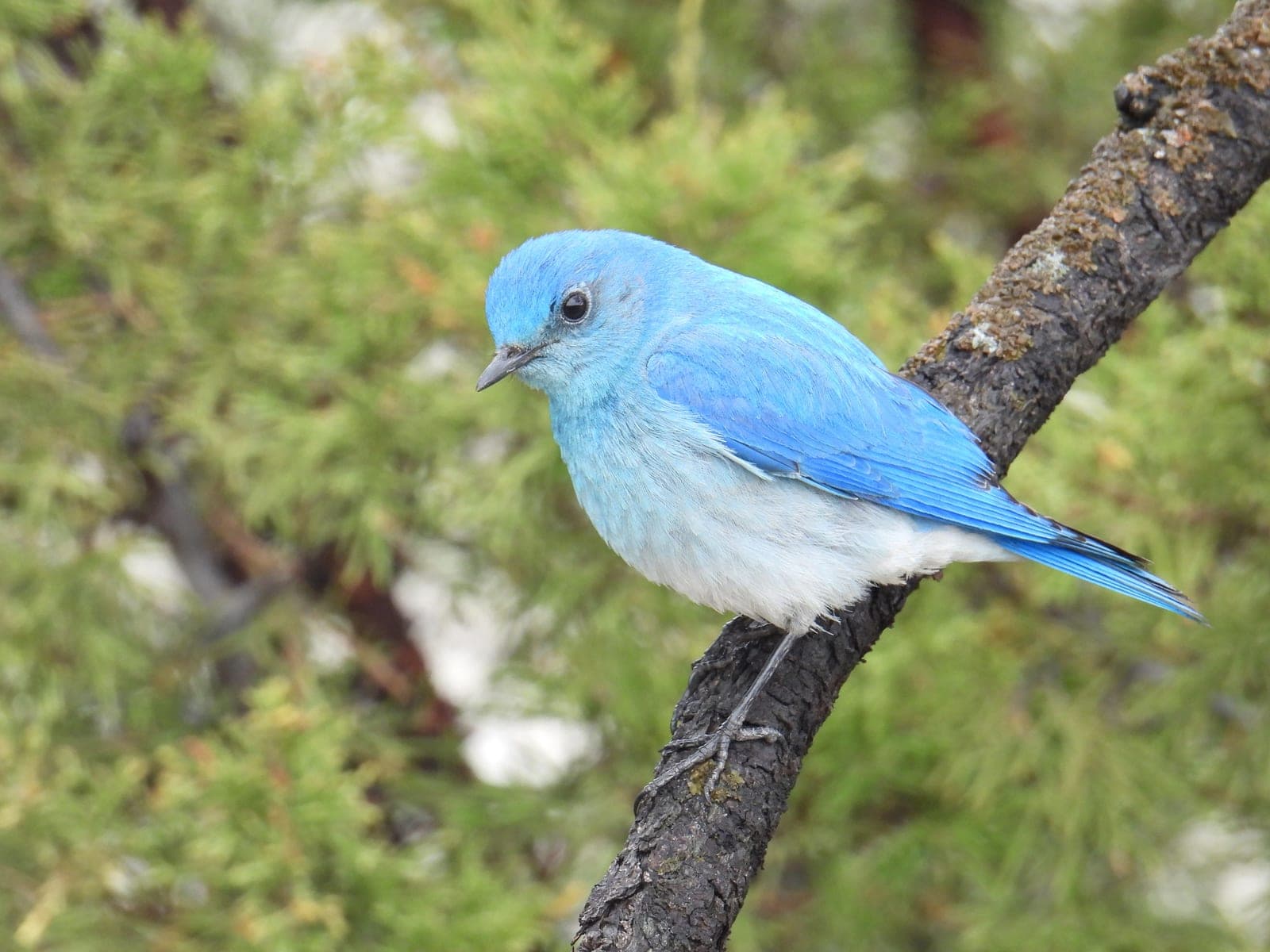
Mountain bluebirds are a little longer-winged and longer-tailed than the other two bluebirds, with a thin bill and an upright stance on fence posts and sage tops. Adult males are bright turquoise-blue above, a paler, softer blue on the throat and breast, and whitish on the lower belly, with no orange anywhere. Females are mostly gray-brown with a whitish eye ring and blue limited to the wings, rump and tail; in fresh fall plumage some show a faint orange tinge on the breast. Juveniles are gray with soft spotting below and blue in the flight feathers.
- Male: sky-blue all over, paler below, with no rusty breast
- Female: gray body with blue wings, rump and tail
- Long wings that reach well down the tail when perched
- Hovers a few feet above open ground before dropping on prey
- Thin, straight bill, unlike the thick bill of buntings
Look-alikes
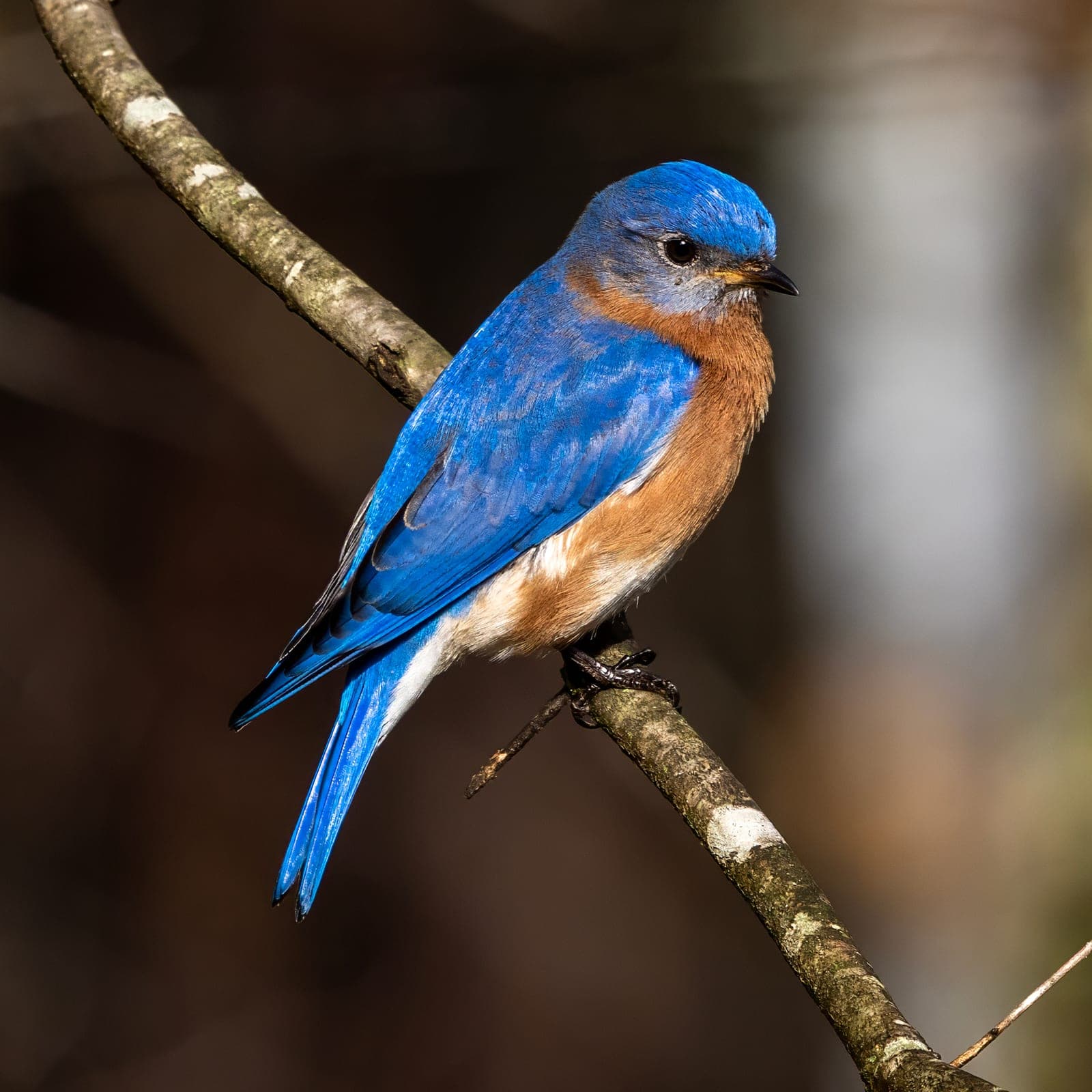
Eastern Bluebird
Eastern males are a deeper blue with a rusty throat and breast, and females carry a clear orange wash on the breast. Easterns live mainly east of the Rockies and hunt from perches rather than hovering.
Full comparison →Western Bluebird
Western males are deep blue with a rusty breast and often a rusty patch on the back. Females are grayer than eastern females but still show orange on the breast. Westerns favor open woodland more than wide-open sage.
Lazuli Bunting
Male lazuli buntings have a blue head and back like a mountain bluebird, but an orange breast band, white wing bars and a short, conical seed-eater's bill. They sing from brushy draws and streamside thickets.
Townsend's Solitaire
This gray western thrush can pass for a female mountain bluebird, but it shows white outer tail feathers, a buffy wing patch in flight and no blue at all.
Range & habitat
Mountain bluebirds breed through western North America from central Alaska and the Yukon south through the Rocky Mountains, the Great Basin, the Sierra Nevada and the Cascades to Arizona and New Mexico, and east onto the western Great Plains. Most leave the northern half of the range in winter for the southwestern United States and northern and central Mexico. Winter flocks follow berry crops, so the winter range shifts from year to year, and flocks sometimes wander east across the Plains; lone strays have reached the Atlantic Coast.
Despite the name, this species is about open ground more than altitude. It breeds in sagebrush flats, shortgrass prairie, ranchland, burns and clearcuts, aspen and pine edges, and alpine meadows above timberline, anywhere with short vegetation for hunting and a few cavities for nesting. It uses more open, treeless country than the eastern or western bluebird. In winter it spreads into pinyon-juniper woodland, grassland, desert scrub and even plowed farm fields.
Through the seasons
Spring
Mountain bluebirds are among the first migrants back in the northern Rockies and on the Canadian Prairies, often while snow still lingers. Pairs move fast to claim holes and boxes, and the female chooses the site, sometimes in a dirt bank or cliff crevice where trees are scarce.
Summer
Many pairs raise two broods. Watch open meadows for a pale blue bird hanging in the air on beating wings, then plunging into the grass after a grasshopper or beetle. Fledglings are fed by both parents for three to four weeks after leaving the nest.
Fall
Families join into flocks that drift downslope and south fairly late in the season. Birds turn increasingly to berries, and loose groups often travel with western bluebirds, juncos and sparrows.
Winter
Flocks of dozens, and sometimes hundreds, roam the Southwest and Mexico in search of juniper berries and mistletoe. Where they settle depends on the fruit crop, so a valley full of bluebirds one winter may be empty the next.
How to find and attract mountain bluebirds
Drive or walk open country in the West and scan fence lines, sage tops and the air just above the grass. Where natural cavities are scarce, a nest box in the right spot is often claimed within days of the birds' return.
- Search sagebrush flats, high meadows, burns and ranchland fence lines from spring through fall, and pinyon-juniper hills in winter.
- Watch for hovering: no other North American bluebird hangs in the air over the grass as often.
- Put up a box with a 1 9/16-inch round entrance, the size the North American Bluebird Society recommends wherever mountain bluebirds nest.
- Mount boxes on posts in open grassland or sage, about five feet up with a predator guard, and keep them away from buildings that attract house sparrows.
- Offer mealworms in a shallow dish; mountain bluebirds do not eat seed.
- Keep native junipers, elderberry and hackberry for winter fruit, and offer open water during freezes.
- Listen at dawn for soft, low warbling and a thin 'few' call, often given in flight.
Diet & life cycle
What it eats
In the breeding season mountain bluebirds eat mostly insects: grasshoppers, beetles, caterpillars, crickets, ants, bees, flies and cicadas, plus spiders. More than other bluebirds, they find prey by hovering a few feet off the ground, and they also fly out from low perches to catch insects in the air. In fall and winter, fruit takes over, especially juniper berries, mistletoe, hackberry, elderberry, grapes and Russian olive. They do not eat seeds, though they will take mealworms and fruit at feeders.
Life cycle
Mountain bluebirds are secondary cavity nesters: they cannot dig holes, so they use old woodpecker cavities, natural tree hollows, nest boxes, crevices in cliffs and rock piles, holes in dirt banks, gaps in buildings and even old cliff swallow nests. The nest is a loose cup of grass, stems, rootlets and pine needles, often lined with hair or feathers. The female lays four to six pale blue eggs, occasionally up to eight, and incubates them for 13 to 17 days. Young leave the nest 17 to 23 days after hatching, and pairs often raise a second brood.
Oldest on record
The oldest mountain bluebird in the USGS Bird Banding Laboratory longevity table was at least 9 years old. It was banded as an adult female in Alberta in June 1997 and recaptured and released at the same banding operation in Alberta in June 2005.
SourceAttracting & watching
Nest boxes with the right entrance size are the best way to attract mountain bluebirds, followed by mealworms, native fruiting shrubs and winter water. For watching, open sage and meadow country in late spring and summer gives the best looks at hovering males; in winter, check juniper-covered hills and desert grasslands in the Southwest for roaming flocks. The species is protected under the Migratory Bird Treaty Act, so keep a respectful distance from active nests.
Conservation
Least Concern (IUCN). Mountain bluebirds remain fairly common, but the North American Breeding Bird Survey recorded a decline of roughly a quarter between 1966 and 2014, and Partners in Flight estimates the population at about 4.6 to 5.6 million. Logging and grazing opened habitat in the late 1800s and early 1900s; fire suppression later let forests close in again. Nest-box trails have helped, while competition with starlings, house sparrows and house wrens, loss of snags and noise from natural gas fields, which lowers nesting success, all work against them. Open vertical pipes, such as old PVC mining-claim markers, are a hidden killer: bluebirds investigate them as nest holes and become trapped.