How to identify a scarlet tanager
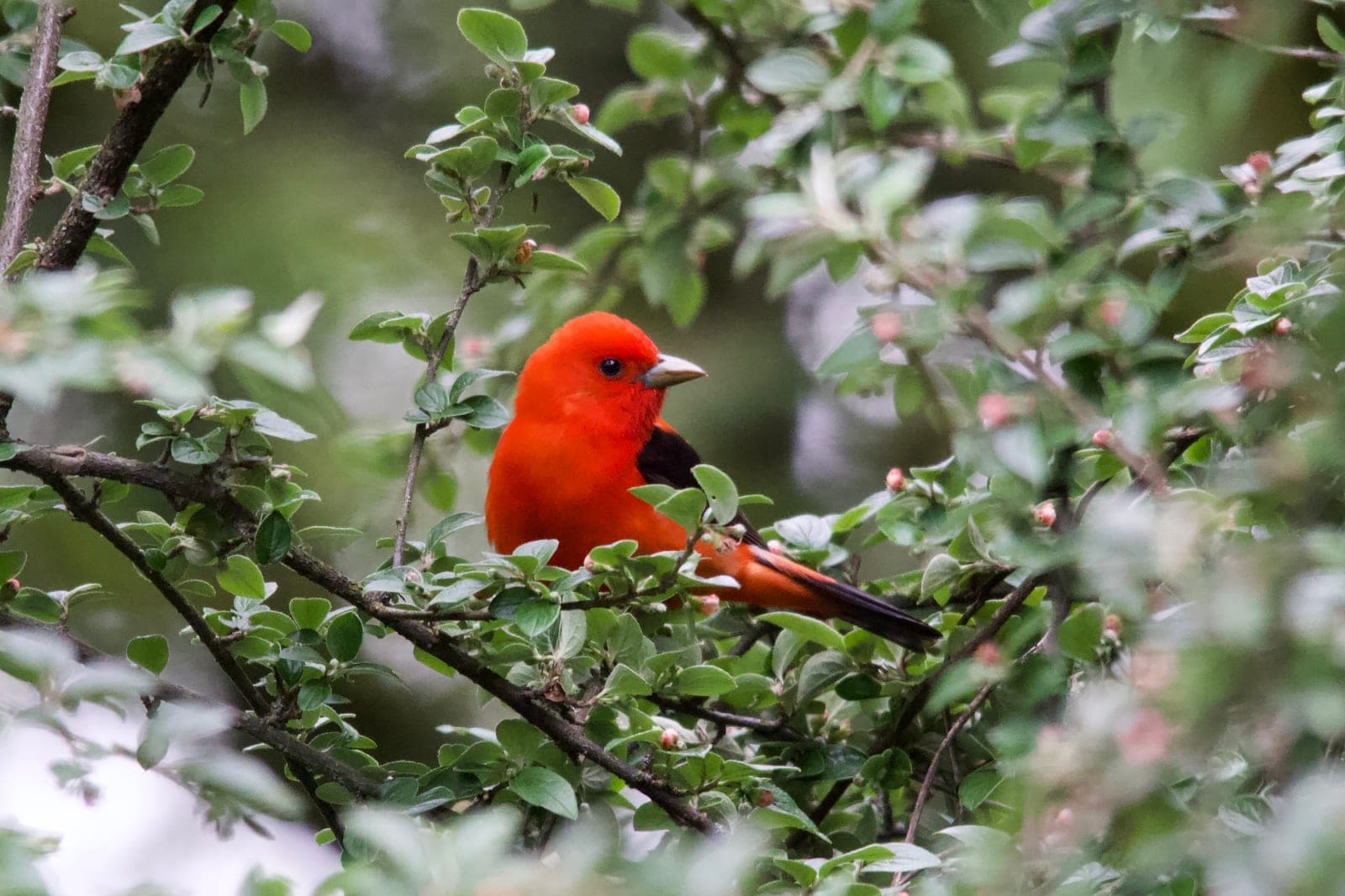
Scarlet tanagers are medium-sized, chunky songbirds with a fairly short tail and a stout, pale, horn-colored bill. A breeding male is unmistakable: brilliant scarlet body with solid black wings and tail. Females are olive above and yellowish below, with darker olive-gray wings and no wing bars. After nesting, males molt into a female-like yellow-green plumage but keep their black wings and tail, and birds caught mid-molt look patched with red, yellow and green. Tanagers move slowly and deliberately through the leaves, which makes them easy to overlook.
- Male: scarlet body with jet-black wings and tail
- No crest and no black face mask
- Female: olive-yellow with darker wings and no wing bars
- Stout, pale bill, thicker than an oriole's or warbler's
- Call: a husky 'chip-burr'
Look-alikes
Northern Cardinal
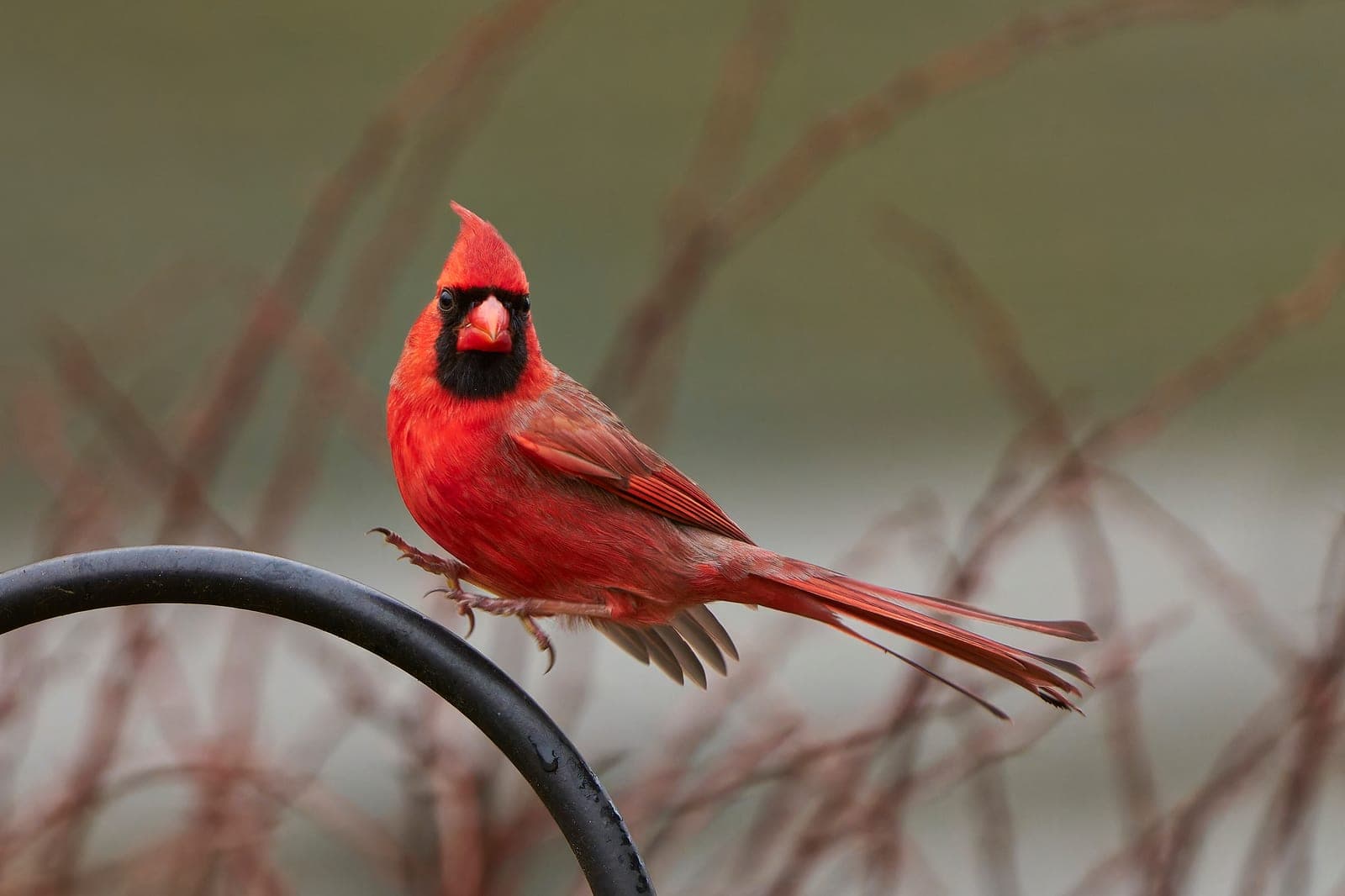
Male cardinals are red including the wings, with a tall crest, a black face mask and a heavy red bill. They live in shrubs and yards all year rather than high in forest canopy for the summer.
Full comparison →Summer Tanager
Male summer tanagers are rosy red all over, wings included, with a longer, paler bill. Females are mustard or orange-yellow and lack the scarlet female's darker, contrasting wings.
Western Tanager
Western tanagers of the West always show bold wing bars; males have a yellow body and red-orange head, and females are yellower below than female scarlets.
Baltimore Oriole
Female orioles can be olive-yellow, but they have white wing bars, a longer tail and a slender, sharply pointed bill, and they are usually more orange than a female tanager.
Range & habitat
Scarlet tanagers breed across southeastern Canada and the eastern half of the United States, from the Great Lakes and New England south through the Appalachians, reaching only the northernmost parts of Louisiana, Mississippi, Alabama and Georgia, and west to the edge of the Plains. They migrate through Central America and spend the winter in forests along the eastern foothills of the Andes in northwestern South America. They are very rare strays to western Europe.
This is a forest-interior bird. Scarlet tanagers breed mostly in large tracts of mature deciduous forest, especially where oaks dominate, and also in maple, beech and mixed pine-oak or hemlock woods. They can turn up in big shade trees in older suburbs, parks and cemeteries, but they nest most successfully where forest is extensive and unbroken. Small, fragmented woodlots expose them to more nest predators and cowbirds, and the smallest patches often have no tanagers at all.
Through the seasons
Spring
Most migrants cross the Gulf of Mexico at night and arrive on the breeding grounds from mid-May to early June, males a few days ahead of females. A late cold snap can force hungry tanagers out of the canopy onto lawns and roadsides, giving rare eye-level looks.
Summer
Pairs raise a single brood high in the canopy. Males sing from treetops through June and July, and fledglings appear from late June in the South to August in the North.
Fall
Males molt into yellow-green plumage with black wings in late summer, so autumn tanagers look nothing like the spring birds. Many start south in August, and by early October nearly all have left the United States.
Winter
Scarlet tanagers spend the northern winter in humid forests of northwestern South America, on the eastern slope of the Andes. Their winter habits and diet are still poorly known.
How to find and attract scarlet tanagers
Learn the song and the call first: a singing male can sit motionless in the canopy for minutes. Then look up into the tops of oaks in mature woods, where a flash of red against green leaves gives him away.
- Visit mature oak and mixed hardwood forest from mid-May through July, early in the morning when males sing most.
- Listen for a hurried, hoarse, robin-like song of short phrases, often likened to a robin with a sore throat, and the distinctive 'chip-burr' call.
- Bird migration hot spots in early to mid-May, when leaves are still small and tanagers feed lower in the trees.
- Keep large native oaks and let woodlots stay big and connected; tanagers need extensive forest to nest successfully.
- Plant native fruit such as serviceberry, mulberry, blackberry and elderberry, which tanagers eat in summer and before migration.
- Add a birdbath with a dripper or moving water, which draws canopy birds down during migration.
Diet & life cycle
What it eats
Scarlet tanagers eat mostly insects, gleaned slowly from leaves and twigs in the upper canopy or snapped up in short flights. Caterpillars, moths, beetles, bees, wasps, ants, cicadas and leafhoppers are all on the menu, along with spiders, snails and earthworms. They rub stinging insects against a branch to remove the stinger before swallowing. When insects run short, and especially in late summer, they eat wild fruit including mulberries, blackberries, raspberries, huckleberries, serviceberries and wild strawberries.
Life cycle
The female builds a shallow, rather flimsy cup of twigs, grass and weed stems on a horizontal branch, usually 20 to 30 feet up and well out from the trunk. She lays about four pale blue-green eggs speckled with reddish brown and incubates them for 12 to 14 days. Both parents feed the young, which leave the nest 9 to 15 days after hatching and are tended for about two more weeks. Pairs raise one brood a year. Nest predation is the main cause of failure, and in fragmented woods fledging success can be far lower than in large, undisturbed forest.
Oldest on record
The oldest scarlet tanager in the USGS Bird Banding Laboratory longevity table was a male at least 11 years and 11 months old. He was banded as a second-year bird in Pennsylvania in June 1990 and found dead in Texas in May 2001.
SourceAttracting & watching
Scarlet tanagers rarely visit feeders, so watching them means going to the forest: mature oak woods in May and June, when males sing from the treetops. In yards near large woods, native fruiting trees and moving water are the best draws during migration. The species is protected under the Migratory Bird Treaty Act.
Conservation
Least Concern (IUCN). Partners in Flight estimates about 2.6 million scarlet tanagers. The Breeding Bird Survey shows a slight but significant long-term decline of about 0.27 percent a year from 1966 to 2022, steepening to about 1 percent a year over 2012 to 2022, and New York lists it as a Species of Greatest Conservation Need. Forest fragmentation is the main concern: small woodlots mean more nest predators and cowbird parasitism. Loss of Andean forest on the wintering grounds, collisions with towers and buildings, and late spring freezes add to the losses.