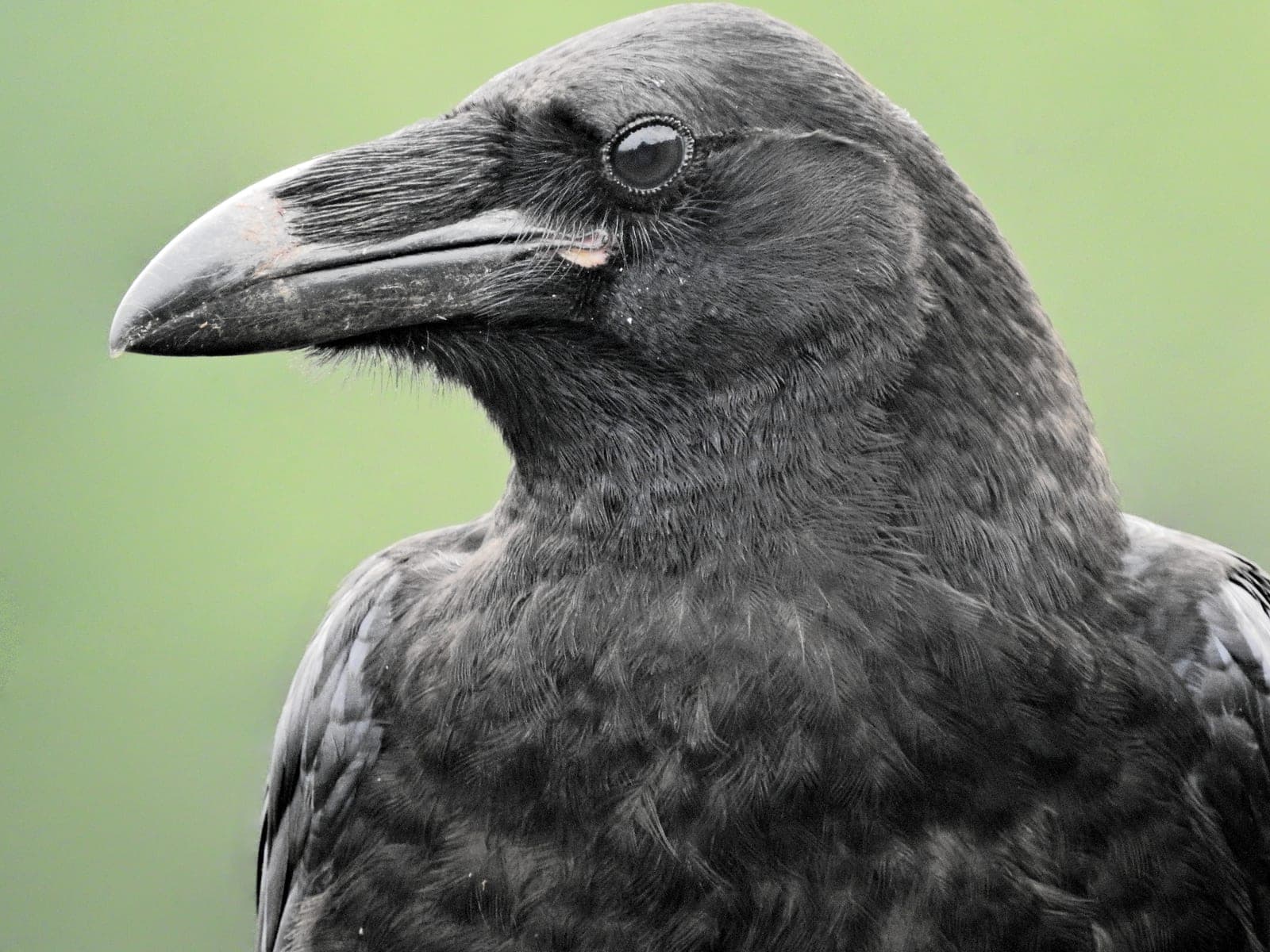
How to identify a common raven
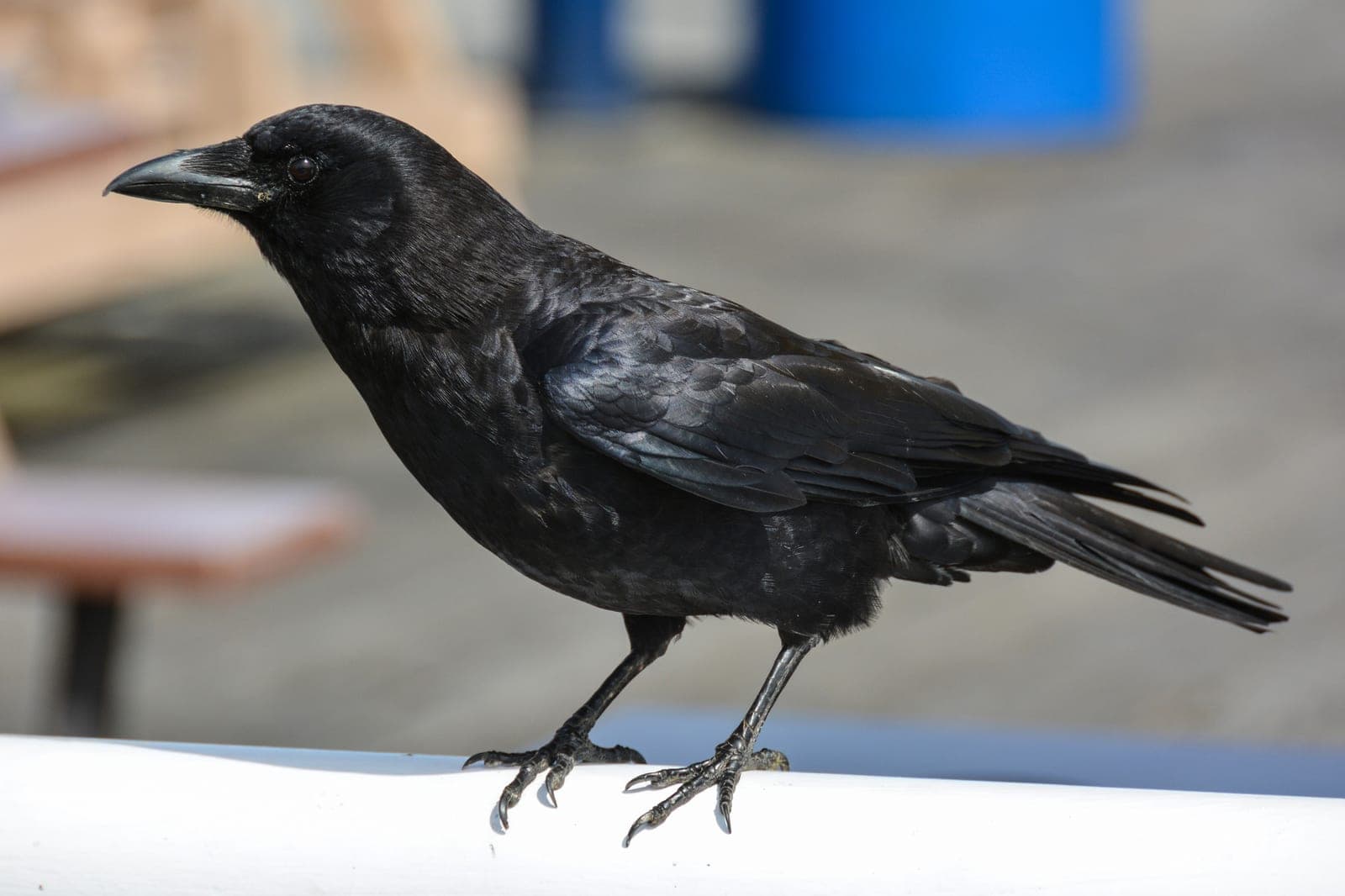
Ravens are all black with a blue or purple gloss, and they are big, about the length of a Red-tailed Hawk. The bill is long, deep and slightly curved, with bristly feathers over the nostrils at its base. Long, pointed throat feathers give the head a shaggy, bearded look, especially when the bird calls. In flight the wings are long and narrow with fingered tips, and the tail is long and wedge-shaped, coming to a blunt point in the middle. Ravens soar and glide on flat wings far more than crows do, often riding ridge winds and doing rolls and dives.
- Wedge-shaped tail in flight, longest in the center
- Massive, deep bill with bristles at the base
- Shaggy throat feathers, often puffed out when calling
- Soars on long, flat wings and tumbles in the air
- Deep, croaking 'gronk' or 'kraaack', never a crow's caw
Look-alikes
American Crow
Crows are clearly smaller with a slimmer bill, smooth throat and a short, fan-shaped tail. They flap steadily, rarely soar for long, and say 'caw' rather than croak.
Full comparison →Chihuahuan Raven
The Chihuahuan Raven of the southwestern grasslands and deserts is smaller, between a crow and a Common Raven, with a shorter bill. The bases of its neck feathers are white, which shows when wind ruffles them.
Turkey Vulture
A soaring vulture holds its wings in a shallow V and teeters side to side, shows silvery flight feathers under the wing, and has a small, bare red head. A raven soars on flat wings with a big black head and wedge tail.
Range & habitat
Common Ravens live across the Northern Hemisphere. In North America they range from the Arctic coasts of Alaska, Canada and Greenland south through the boreal forest and across the whole western half of the continent into Mexico and Central America. In the East they occupy northern New England, the Great Lakes forests and the Appalachians, and they are spreading back into lowland areas of the Northeast. They remain scarce across most of the Midwest and the Southeast.
Few birds use a wider range of habitats. Ravens live on Arctic tundra, in boreal and mountain forests, along rocky sea coasts, on prairies with nearby cliffs, and in hot deserts and canyons. They need a cliff, a tall tree or a human structure such as a power tower or bridge for nesting. They have adapted well to people, foraging at landfills, ranches, roadsides and towns, from Arctic villages to desert highways.
Through the seasons
Spring
Ravens are early nesters, often building or repairing a cliff or tree nest in late winter and laying eggs in late winter or early spring. Pairs stay close to the nest and chase off hawks and eagles.
Summer
Fledglings leave the nest at five to six weeks and stay with their parents for months, learning to forage. Look for families of noisy young ravens around cliffs, campgrounds and roadsides.
Fall
Young birds strike out on their own and join wandering flocks of nonbreeders. Some ravens wander south or downslope of their breeding range, and flocks gather wherever carcasses or garbage are easy to find.
Winter
Nonbreeders gather at carcasses and shared night roosts, and in wolf country they follow packs to scavenge kills. By late winter, paired ravens soar side by side, diving and tumbling in courtship flights.
How to find and see Common Ravens
Ravens seldom visit backyard feeders; you go to them. Listen for a deep croak overhead, then look for the wedge-shaped tail. Cliffs, canyon rims, mountain passes and remote highways are the classic places.
- Scan cliffs and canyon rims in western national parks, where ravens ride the updrafts for hours.
- In the North and the Rockies, check roadkill and carcasses; ravens are often the first scavengers to arrive.
- Watch for aerial play: rolls, upside-down flying and dives, especially on windy days along ridges.
- Learn the voice: a hollow, croaking 'gronk', plus knocks, gurgles and bell-like notes no crow makes.
- In late winter, look for pairs soaring close together; that often means a nest cliff nearby.
- Do not feed ravens; human food boosts raven numbers, which puts pressure on desert tortoises and sage-grouse.
Diet & life cycle
What it eats
Ravens are omnivores that lean toward animal food. They scavenge carrion of all sizes, from roadkill to winter-killed deer and wolf kills, and they hunt rodents, insects, lizards and frogs. They raid the nests of other birds for eggs and chicks, eat grain, berries and fruit, and pick through garbage at dumps and campgrounds. Pairs sometimes work together to flush prey. They cache surplus food and watch where other ravens hide theirs, then steal it.
Life cycle
Young ravens may take two or three years to pair up, and most pairs then stay together for life and hold a territory year-round. Both birds build a deep basket of large sticks lined with hair, bark and moss, on a cliff ledge, high in a tall tree or on a tower, and they often reuse and add to the same nest for years. The female lays four to six eggs and incubates them for about 18 to 21 days while the male feeds her. The young fly at about five to six weeks. Wild ravens typically live 10 to 15 years.
Oldest on record
The oldest Common Raven in the USGS Bird Banding Laboratory's longevity table was banded as a young bird of the year in Nova Scotia in July 1978 and found dead there in 2001, at least 22 years 6 months old.
SourceAttracting & watching
Ravens are birds to watch rather than attract, and they should not be fed. The best viewing is in open, rugged country: canyon rims and cliffs in western parks, mountain passes, desert highways, Arctic towns and rocky coasts. Late winter is a fine time to watch their paired courtship flights, and summer brings noisy family groups.
Conservation
Least Concern (IUCN). Ravens are abundant, with about 29 million birds, and Breeding Bird Survey data show increases across the continent since 1966. Persecution once drove them from much of the East and Midwest, and they are now recolonizing. In the West, food and nest sites provided by people have let raven numbers soar, and USGS studies link high raven densities to poor nest success in Greater Sage-Grouse. They are protected under the Migratory Bird Treaty Act.