How to identify a california scrub-jay
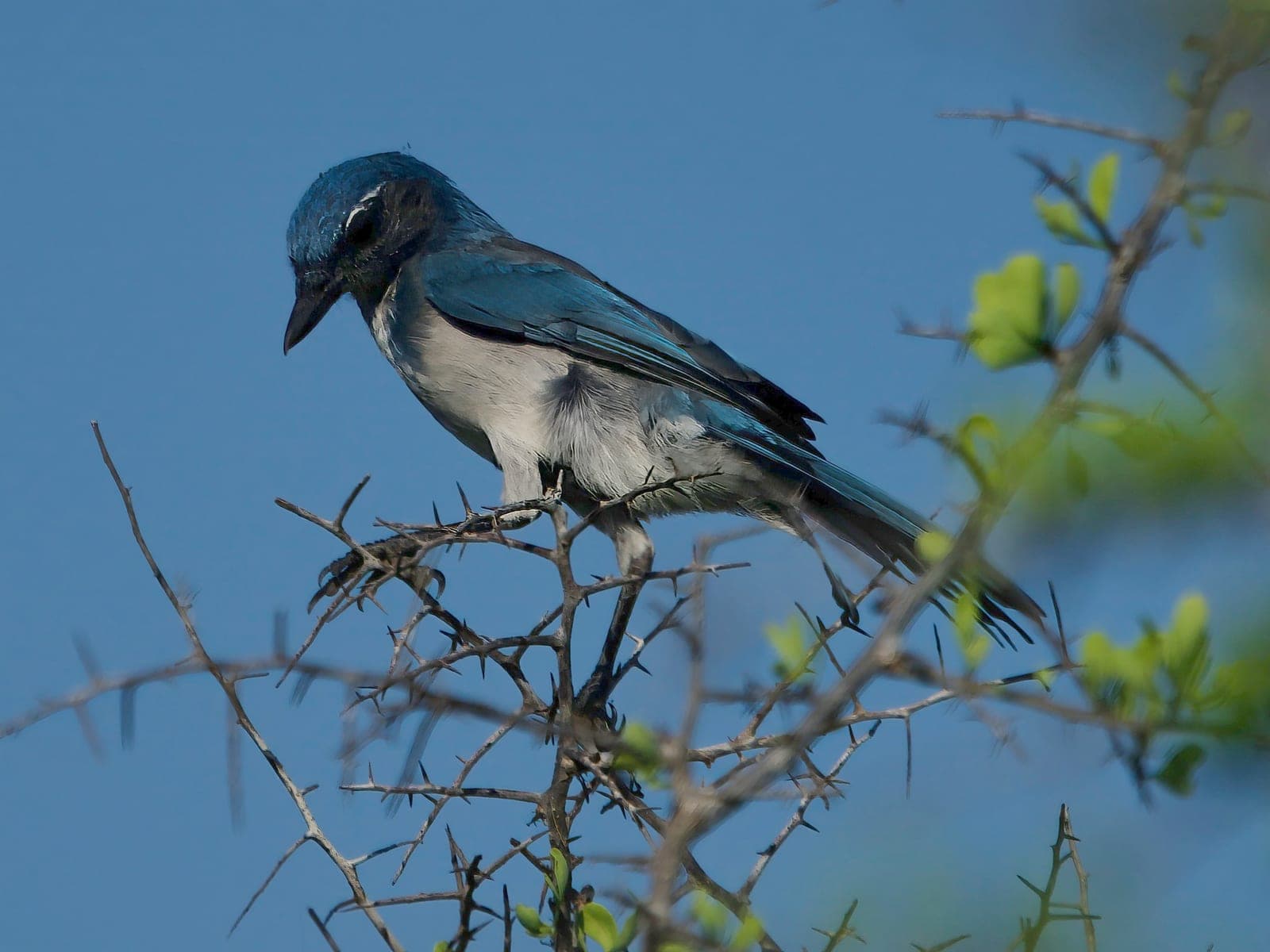
This is a slim, long-tailed jay with no crest. The head, wings and tail are a rich blue, and a patch of gray-brown sits on the back between the wings. A thin white eyebrow runs over a dark cheek, and the white throat is framed by a blue necklace that partly crosses the upper breast. The underparts are pale gray. The bill is stout and black. Scrub-jays often perch upright on a fence post or wire, flick their tails, and drop to the ground with a swooping, flap-and-glide flight.
- No crest; bright blue head, wings and tail
- Gray-brown patch on the back
- White throat bordered by a blue necklace
- Thin white eyebrow over a dark cheek
- Harsh, rising 'jree' or a rapid 'check-check-check' series
Look-alikes
Woodhouse's Scrub-Jay
Woodhouse's Scrub-Jay, the interior West's scrub-jay, is duller and grayer, with a faint or broken necklace and grayer underparts. It lives in pinyon-juniper and oak country from the Great Basin to the Southwest, meeting the California Scrub-Jay mainly around the western edge of Nevada.
Steller's Jay
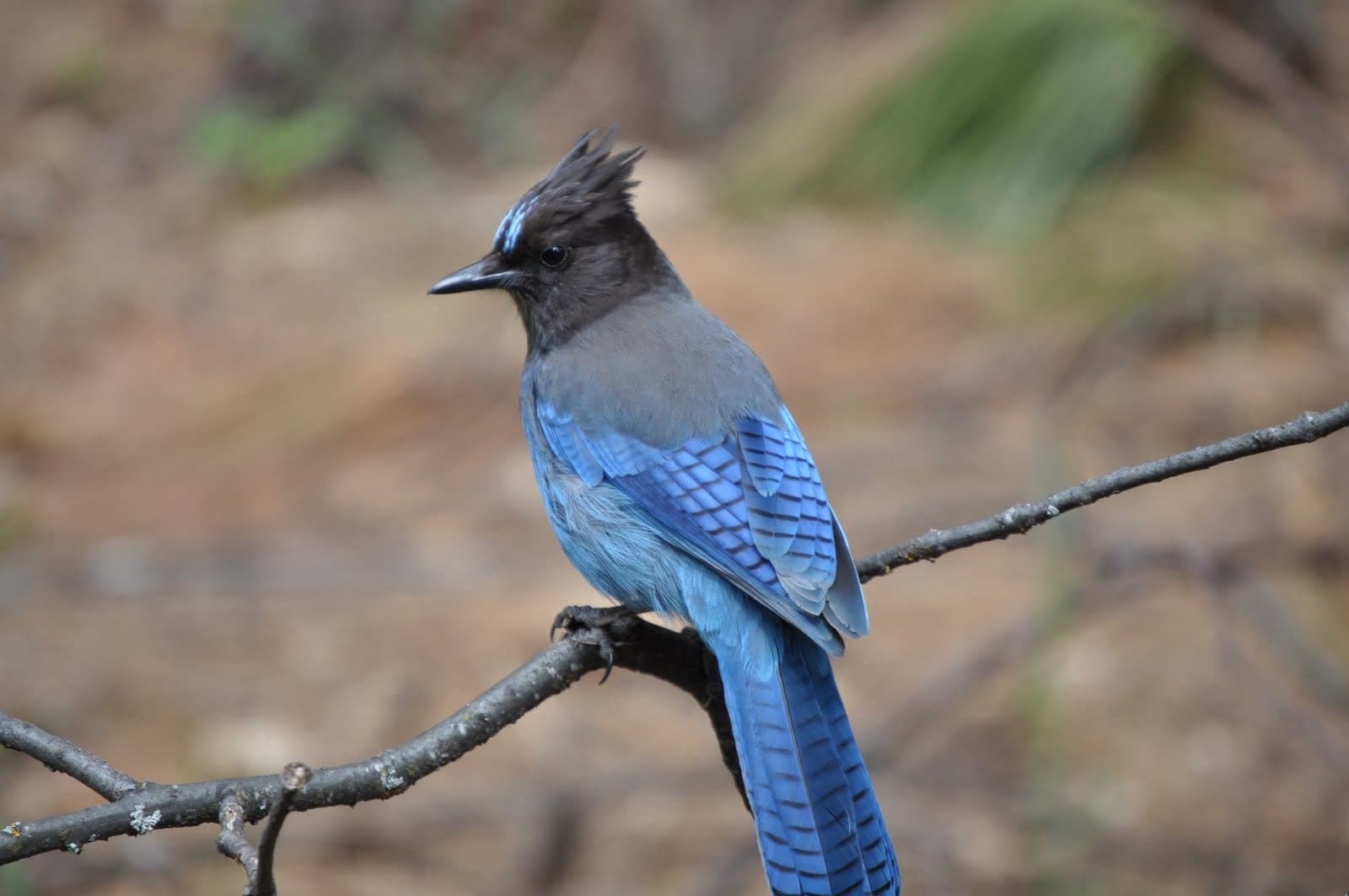
Steller's Jays have a tall crest and a black head and chest, with no white throat or eyebrow. They favor conifer forest, usually higher in the mountains than scrub-jays.
Island Scrub-Jay
The Island Scrub-Jay is larger and more brightly colored, with a heavier bill, and it lives only on Santa Cruz Island off Southern California, where no California Scrub-Jays occur.
Range & habitat
California Scrub-Jays live along the Pacific side of North America, from western Washington and a toehold in southern British Columbia south through western Oregon and most of California west of the Sierra Nevada crest, into northern Baja California. A small area of western Nevada near Reno is also included. The species has spread north in recent decades: it was absent from Washington's breeding bird surveys in the early 1970s and is now common around Puget Sound.
Scrub-jays live in oak woodland, chaparral, streamside thickets and foothill woods with pines, and they have taken to towns in a big way. Well-planted suburbs, parks and orchards with oaks and shrubs often hold more scrub-jays than wild land does. They avoid dense conifer forest and the high mountains, leaving those to the Steller's Jay.
Through the seasons
Spring
Nesting runs from about March into July. Pairs that have held the same territory all year build in shrubs and small trees, and the yard's usually brash jays turn quiet near the nest.
Summer
Insects, especially caterpillars, feed the young. Fledglings follow their parents and beg loudly, and adults keep feeding them for a month or more after they leave the nest.
Fall
Acorn season. Watch for jays flying with an acorn in the bill, then hopping across a lawn to push it into the soil and cover it with a leaf or pebble. In poor acorn years some birds wander farther than usual.
Winter
Pairs stay on their territories and live largely on stored acorns and seeds. Winter is an easy time to see scrub-jays at feeders and perched on fences and wires in the open.
How to find and attract California Scrub-Jays
In most of coastal California, a scrub-jay is one of the easiest birds to find: listen for a harsh, scolding 'jree' from an oak or a fence, and check open lawns for a blue bird hopping and burying food.
- Peanuts, in or out of the shell, are the surest draw; scrub-jays will carry them off and bury them.
- Sunflower seed and suet on a platform feeder also work well.
- Plant native oaks and berry-producing shrubs such as toyon and coffeeberry for food and nest sites.
- Leave some dense shrubs untrimmed in spring; most nests are only 5 to 15 feet off the ground.
- Look for them in oak woodland parks and along foothill trails, especially on fall mornings.
- Add a shallow birdbath; water is a strong draw during long, dry California summers.
Diet & life cycle
What it eats
California Scrub-Jays are omnivores whose diet swings with the seasons. In spring and summer they eat many insects, with caterpillars making up much of what they feed their young, plus spiders and snails. In fall and winter they rely on acorns, other nuts, seeds and berries. They also take small lizards, frogs, rodents, and the eggs and nestlings of other birds. They cache food in scattered spots, mostly in the ground, and lab studies show they can recall hundreds of hiding places along with what they stored in each and how quickly it spoils.
Life cycle
Unlike the Florida Scrub-Jay, which breeds with family helpers, the California Scrub-Jay nests in single pairs that usually hold one territory year-round. Both birds build a thick cup of twigs and grass lined with rootlets and sometimes hair, usually 5 to 15 feet up in a shrub or small tree. The female incubates three to five eggs for about 16 to 18 days, and the male often feeds her on the nest. The young fledge about 18 to 22 days after hatching. Most pairs raise one brood a year, occasionally two.
Oldest on record
The USGS Bird Banding Laboratory lists the record under the old name Western Scrub-Jay: a bird banded as a youngster in California in June 1932 and recovered there in March 1948, at least 15 years 9 months old.
SourceAttracting & watching
Scrub-jays are among the easiest western birds to attract. Peanuts, sunflower seed and suet on a platform will bring them in within days, and a birdbath keeps them coming through summer. Oaks are the best long-term planting, since jays both eat and bury the acorns. They do not use nest boxes; dense native shrubs give them nest sites.
Conservation
Least Concern (IUCN). California Scrub-Jays are common, with an estimated 1.6 million birds, and Breeding Bird Survey data show the population as roughly stable overall while expanding north in Washington. West Nile virus has hit jays hard in places, including California's Central Valley. They are protected under the Migratory Bird Treaty Act.