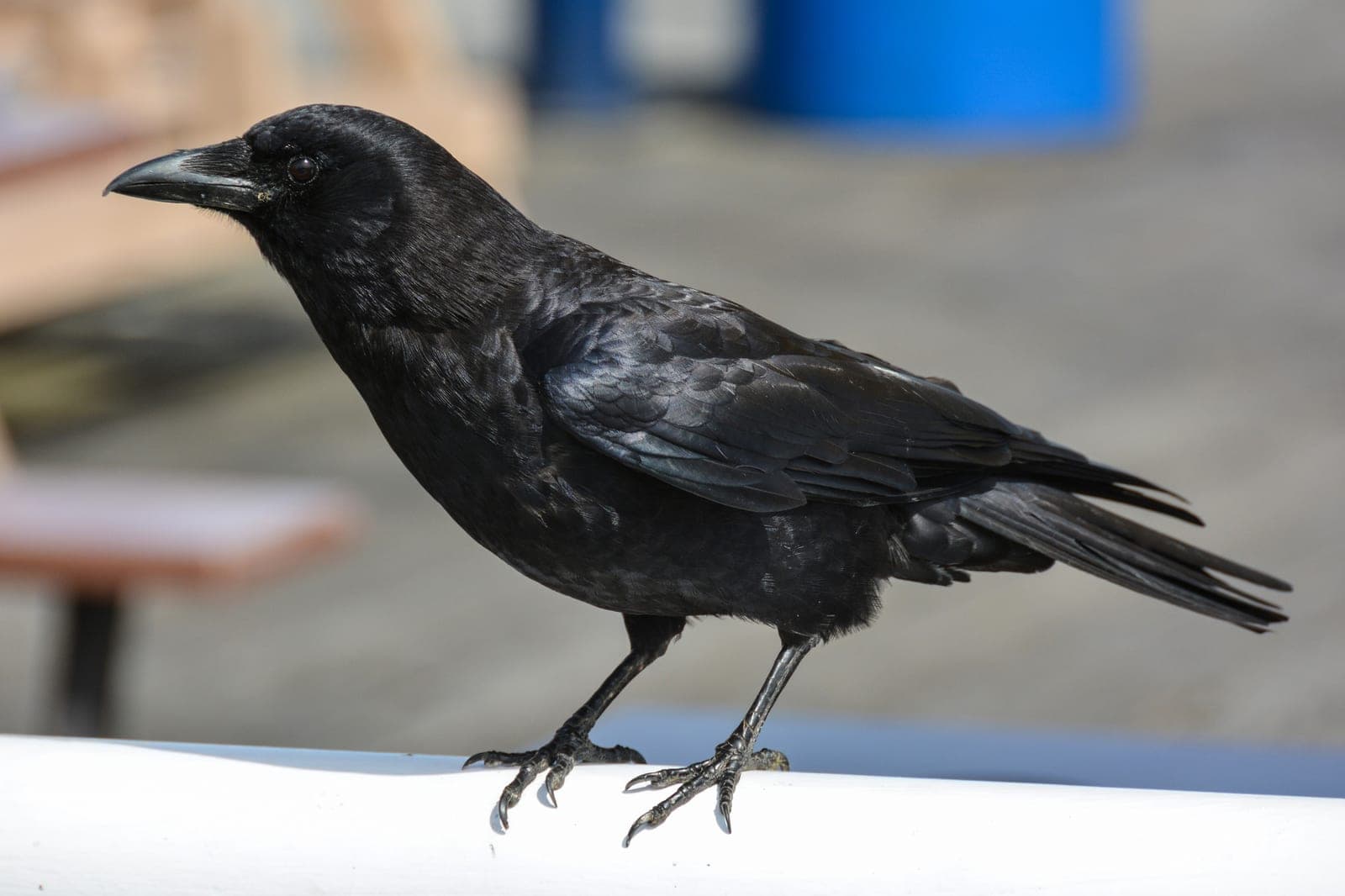
How to identify a american crow
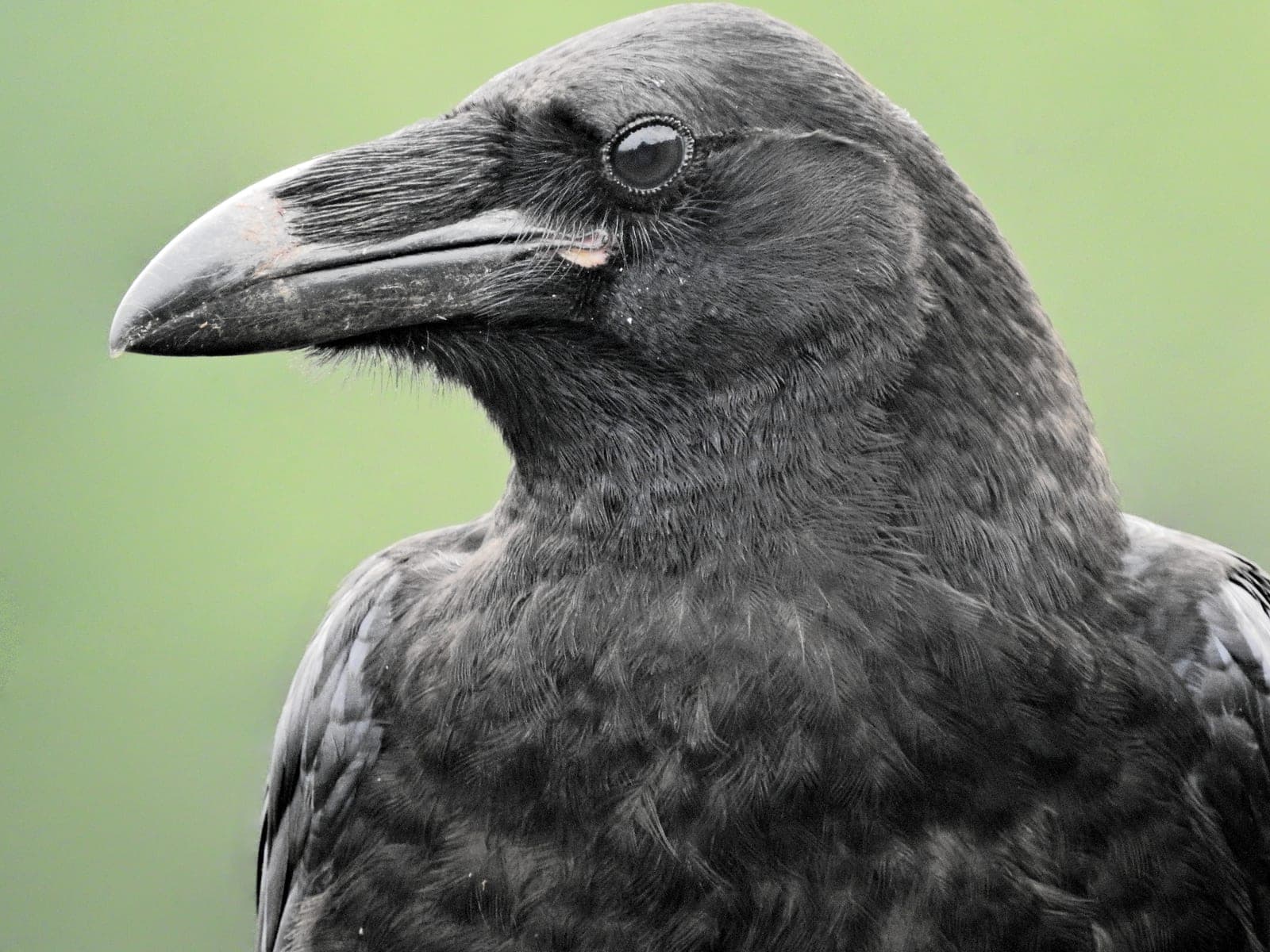
Crows are big, glossy black birds, black from bill to toes, with a faint purple-blue sheen in good light. The bill is stout and straight, and the legs are sturdy, so crows walk on the ground with a confident strut. In flight the wings are broad and fingered at the tips, the wingbeats are steady rowing strokes, and the tail is short and fanned with a rounded or squared end. Crows rarely soar for long. Size and voice separate them from ravens and blackbirds: a crow is far bigger than a grackle and clearly smaller than a raven, and it caws rather than croaks.
- All black, including bill, legs and eyes
- Tail short and fan-shaped, rounded or square at the tip
- Steady, rowing flight; seldom soars or glides far
- Smooth throat feathers, not shaggy
- Loud 'caw' or 'caah', often in a series
Look-alikes
Common Raven
Ravens are much larger, with a heavy, curved bill, shaggy throat feathers and a long wedge-shaped tail in flight. They soar like hawks and give a deep, croaking 'gronk' instead of a caw.
Full comparison →Fish Crow
Fish Crows look almost identical but are slightly smaller and live mainly along the Atlantic and Gulf coasts and up major eastern rivers. Voice is the reliable clue: a short, nasal 'uh-uh' or 'cah' instead of a full caw.
Common Grackle
Grackles are far smaller, about a foot long, with a pale yellow eye, a long keel-shaped tail and a glossy purple or bronze head. They squeak and chuck rather than caw.
Range & habitat
American Crows live across much of Canada short of the tundra, along the coast of southern Alaska, and south across nearly all of the lower 48 states, missing only the hottest desert country of the Southwest. Since 2020 the smaller crows of the Pacific Northwest coast, once called the Northwestern Crow, count as part of this species. Many northern crows move south in fall, while those in the rest of the range stay put all year.
Crows use almost any open or semi-open country with trees for nesting and roosting: farmland, pastures, river groves, woodland edges, beaches and tideflats, golf courses, highway medians and town centers. They have moved steadily into cities, nesting in parks and street trees. Only dense unbroken forest, open tundra and hot desert hold few crows.
Through the seasons
Spring
Pairs nest from early spring, often helped by their grown young from previous years. Big winter roosts break up, and crows turn quieter and spread out across territories, though they still mob passing hawks and owls loudly.
Summer
Fledglings leave the nest about a month after hatching and follow their parents, begging loudly for food. Family groups forage together on lawns, beaches and freshly mowed fields.
Fall
Northern crows drift south and families gather into flocks. Toward evening, look for long, loose lines of crows all flying the same direction toward a roost.
Winter
Crows gather at communal night roosts that can hold thousands or tens of thousands of birds, often in towns and cities. They stage noisily in open areas nearby before settling at dusk.
How to find and attract American Crows
Crows are easy to find and hard to fool. Watch for them walking on open ground, follow the racket when a group mobs an owl or hawk, and in winter trace the evening flight lines back to a roost.
- On winter afternoons, note which way crows are flying in the last hour of light; following the lines often leads to a roost.
- A sudden, angry chorus of caws usually means a hawk or owl is nearby; scan the trees where the crows are diving.
- Unsalted peanuts in the shell, scattered on open ground, are the classic way to win over a local crow family.
- Be patient and consistent: crows are wary and recognize individual people, so the same person at the same time works best.
- Keep any offerings small and away from neighbors' gardens, since a crowd of crows can become a nuisance.
- A ground-level birdbath or shallow pan of water draws crows to drink and to soak dry food.
Diet & life cycle
What it eats
Crows eat almost anything. They walk fields and lawns for earthworms, beetles, grubs and grasshoppers, and they take seeds, grain, nuts, berries and fruit. They also eat frogs, small snakes, mice, carrion, shellfish, garbage, and the eggs and young of other birds. Along coasts they drop clams and other shellfish onto rocks or pavement to crack them. Like hawks and owls, they cough up pellets of hair, bone and other material they cannot digest.
Life cycle
Crows live in extended families. Young birds rarely breed before age two and many wait longer, and in the meantime they often stay to help their parents feed the next year's nestlings and guard the territory. The pair builds a bulky basket of sticks, bark and mud lined with grass, moss and hair, usually 10 to 70 feet up in a tree. The female lays four to six eggs and incubates them for about 18 days. The young leave the nest at around four to five weeks. Wild crows average about seven to eight years.
Oldest on record
The oldest American Crow in the USGS Bird Banding Laboratory's longevity table was a female banded as an adult in Washington in February 2006 and seen alive there, still wearing her color bands, in October 2022: at least 18 years 4 months old.
SourceAttracting & watching
Crows will visit yards that offer unsalted peanuts, a little suet, or water, though they come warily at first. They do not use nest boxes. The best watching is in winter, when a dusk roost in a city park or riverside grove can put thousands of crows in the sky at once, and in spring, when families mob owls and hawks.
Conservation
Least Concern (IUCN). With about 28 million birds, crows remain abundant, but Breeding Bird Survey data show a slight long-term decline since 1966. West Nile virus, which reached North America in 1999, is especially deadly to crows and caused local losses of up to 72% in a single season. Crows are protected under the Migratory Bird Treaty Act; federal rules let states hold regulated crow seasons, so check local laws.