How to identify a black-billed magpie
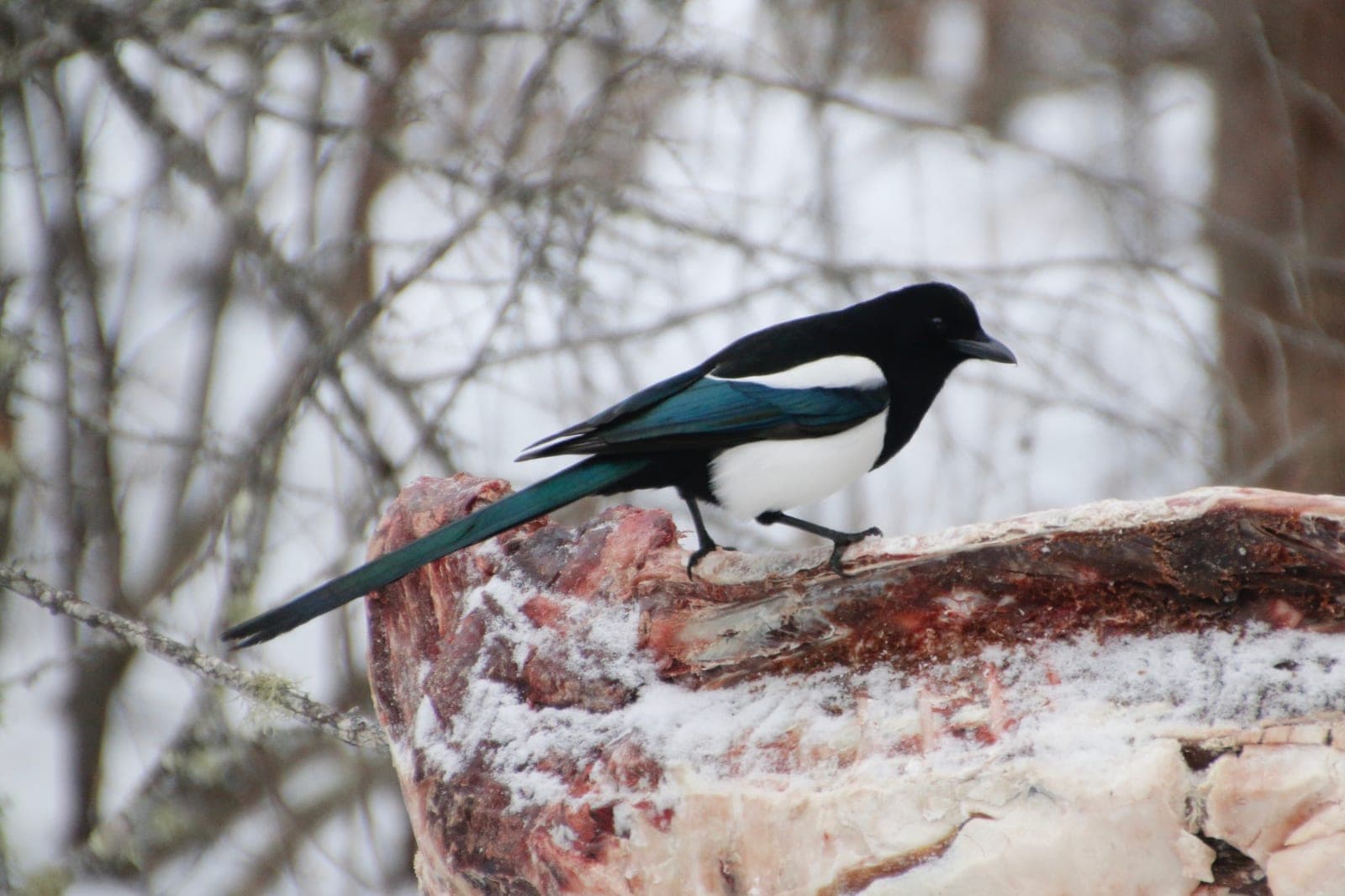
No other bird in its range looks like a magpie. The head, chest, back and undertail are black, the belly and a long stripe along each shoulder are bright white, and the long, tapered tail makes up about half the bird's length. In sunlight the black wings and tail shine iridescent blue and green. In flight the wings show large white patches on the outer feathers that flash with every wingbeat. The bill and legs are black. Males average noticeably larger than females, which is unusual in the crow family.
- Black and white body with a white belly and white shoulder stripes
- Very long, tapered tail glossed blue-green
- Big white wing patches flashing in flight
- All-black bill with no yellow skin around the eye
- Rapid, nasal 'mag? mag? mag?' or 'yak-yak-yak' chatter
Look-alikes
Yellow-billed Magpie
The Yellow-billed Magpie has a bright yellow bill and a patch of yellow skin behind the eye. It lives only in California's Central Valley and nearby foothills, where Black-billed Magpies do not occur.
Eurasian Magpie
The Eurasian Magpie of Europe and Asia looks nearly identical and was long considered the same species. Genetic studies led ornithologists to split them in 2000; a magpie seen in western North America is a Black-billed.
Range & habitat
Black-billed Magpies range from the coast of southern Alaska across the interior of British Columbia and the Prairie Provinces, then south through the northern Great Plains, the Rocky Mountain states and the Great Basin. The southern edge runs roughly through northern New Mexico, northern Arizona, northern Nevada and northeastern California, and the eastern edge through the Dakotas, Nebraska and central Kansas. They are absent from the Pacific coast south of Alaska and from California's Central Valley.
Magpies need open ground for feeding and scattered trees or tall shrubs for nesting and cover. They are most common in streamside groves on the open plains, sagebrush and rangeland with willows or cottonwoods, farm shelterbelts, forest edges and towns. They avoid dense, unbroken forest, open grassland with no trees at all, and the hottest deserts.
Through the seasons
Spring
Pairs build or rebuild their domed stick nests, often near other pairs in a loose colony. The male chases the female and flashes his white wing patches, then feeds her while she lays and incubates.
Summer
Long-tailed fledglings leave the nest at three to four weeks, and families work pastures and roadsides for grasshoppers, beetles and other insects.
Fall
Families merge into flocks with a clear pecking order. Some magpies move upslope after the breeding season, while others drift a short way south or downslope as winter nears.
Winter
Magpies ride out hard prairie winters by scavenging carcasses, raiding caches and visiting feeders. Flocks share night roosts in dense trees, and their bulky nests stand out in bare branches.
How to find and attract Black-billed Magpies
In the right country magpies are hard to miss: look along roadsides, fence lines and pastures with scattered trees, and listen for their harsh, rapid chatter. In towns across the interior West they visit yards year-round.
- Drive ranch roads in the Rockies and northern plains and scan fence posts, livestock and roadkill.
- Check the backs of cattle, deer, elk and moose; magpies pick ticks off large animals.
- Offer suet, peanuts and black-oil sunflower seed on a platform or ground feeder.
- Look for the huge, domed nests in leafless trees in winter, then come back in spring to watch the pair.
- Follow a sudden outburst of chatter: magpies gang up on hawks, owls and cats, and also gather loudly around a dead magpie.
- Keep tall shrubs and trees such as willows, hawthorns and cottonwoods for nest sites.
Diet & life cycle
What it eats
Magpies are omnivores that eat more insects than most crows: grasshoppers, beetles, caterpillars and flies make up much of the summer diet. They also eat carrion, rodents, small snakes, and the eggs and young of other birds, and in winter they turn more to seeds, berries and nuts. They walk on the ground and flip over debris with the bill, steal food from other birds, follow predators to scavenge leftovers, and pull ticks off cattle, deer, elk and moose. They cache extra food in the ground.
Life cycle
Magpies often pair for life. Both birds build a nest that is a feat of engineering: a mud or manure cup lined with rootlets, grass and hair, set inside a domed ball of sticks that can be about 3 feet across, with an entrance on each side. Nests are usually 15 to 30 feet up in a tree or tall shrub. The female lays about six or seven eggs and incubates them alone for 16 to 21 days while the male brings food. The young leave the nest 24 to 30 days after hatching, and pairs raise one brood a year.
Oldest on record
The oldest Black-billed Magpie in the USGS Bird Banding Laboratory's longevity table was banded as an adult in Saskatchewan in October 2013 and recaptured and released there in November 2021, at least 9 years 5 months old.
SourceAttracting & watching
In towns and on farms across the interior West, magpies come to yards for suet, peanuts and sunflower seed, especially in winter, and they drink and bathe at open water. They do not use nest boxes; leave dense trees and tall shrubs for their domed nests. For watching, ranch country, river bottoms and wildlife refuges in the northern Rockies and plains are reliable year-round.
Conservation
Least Concern (IUCN). Magpies are still common, with about 6 million birds, but Breeding Bird Survey data show a long-term decline, roughly 38% between 1966 and 2019. Early in the 20th century they were trapped, shot and poisoned under bounty programs, and today livestock pesticides and West Nile virus also kill them. They are protected under the U.S. Migratory Bird Treaty Act, with control allowed where they cause damage; in Canada they are managed by the provinces.