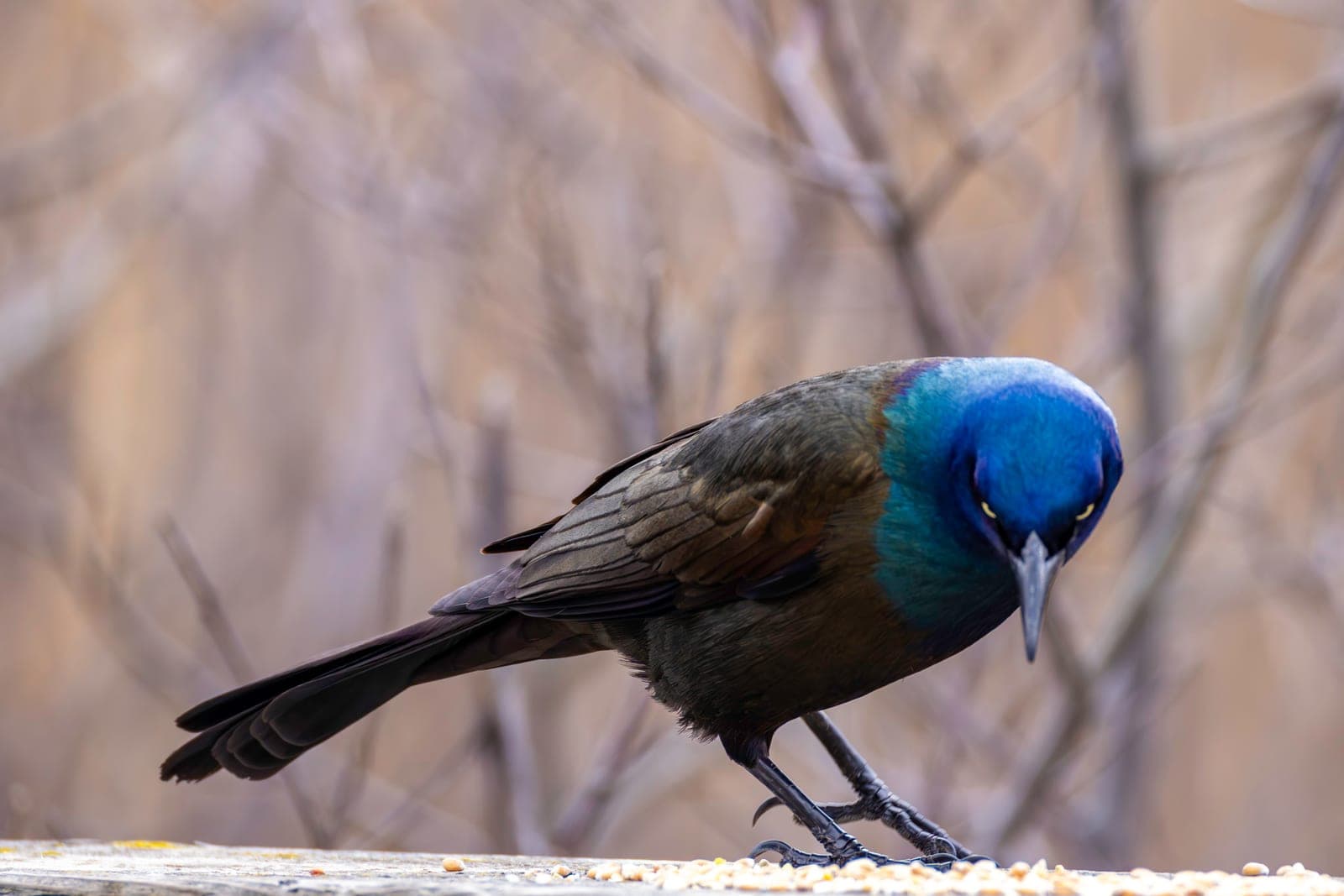
How to identify a common grackle
Grackles are larger and lankier than other eastern blackbirds, with a long, wedge-shaped tail that males often fold into a V, like the keel of a boat, in flight. The bill is long, heavy and slightly curved, and adults have pale yellow eyes. In good light, males show a glossy blue-purple head; the widespread 'bronzed' form has a bronze body, while the 'purple' form of the Southeast is glossed purple and green. Females are smaller, shorter-tailed and duller. Juveniles are dull brown with dark eyes, and molting adults in late summer can look ragged and nearly tailless.
- Long, keel-shaped tail, often held in a V in flight
- Pale yellow eyes in adults
- Iridescent blue-purple head over a bronze or purple body
- Long, heavy, slightly curved bill
- Squeaky song like a rusty hinge
Look-alikes
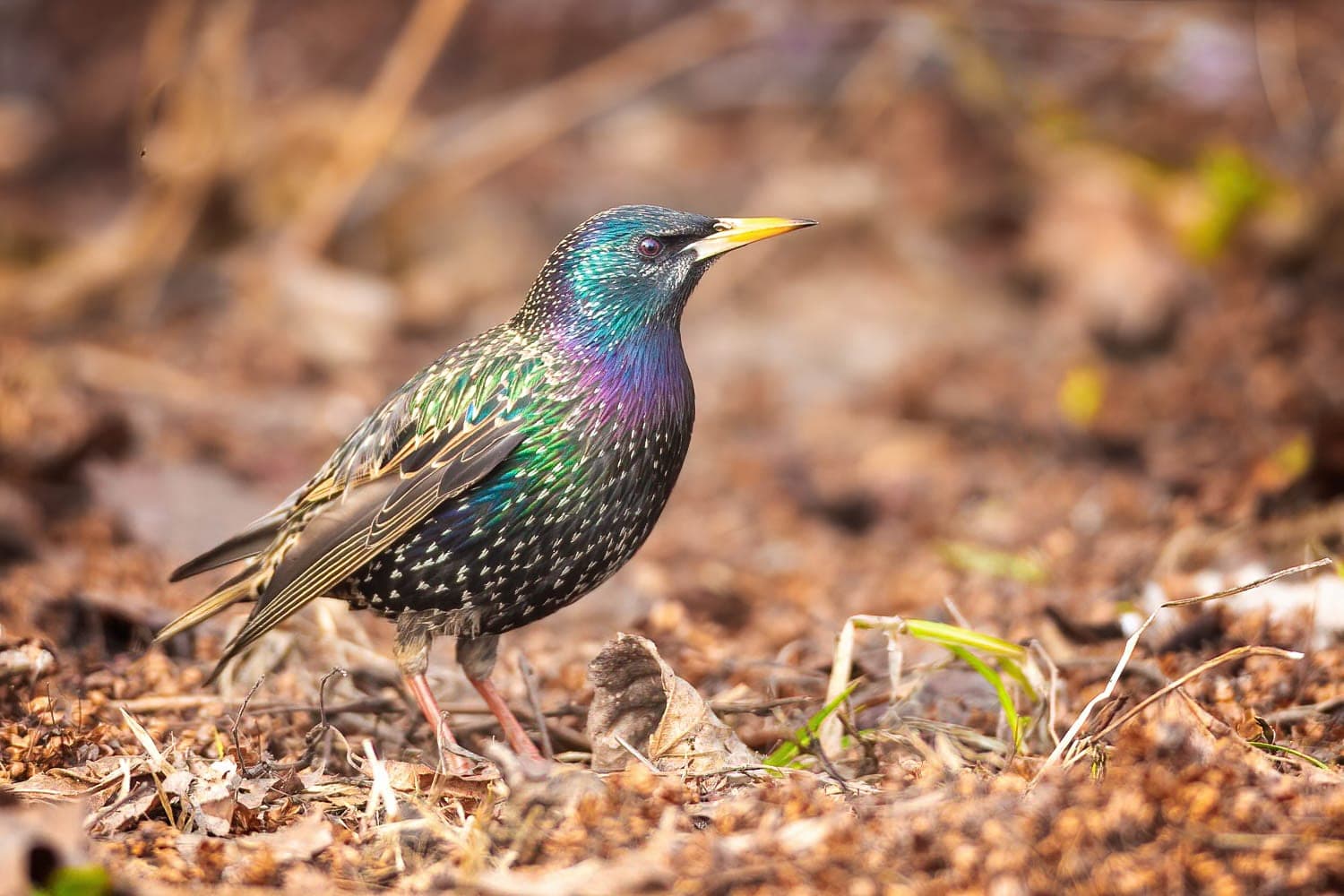
European Starling
Starlings are shorter and stockier, with a short square tail, pointed triangular wings, dark eyes and, in spring, a yellow bill; in fall and winter they are covered in white spots. Grackles have long tails, pale eyes and dark bills all year.
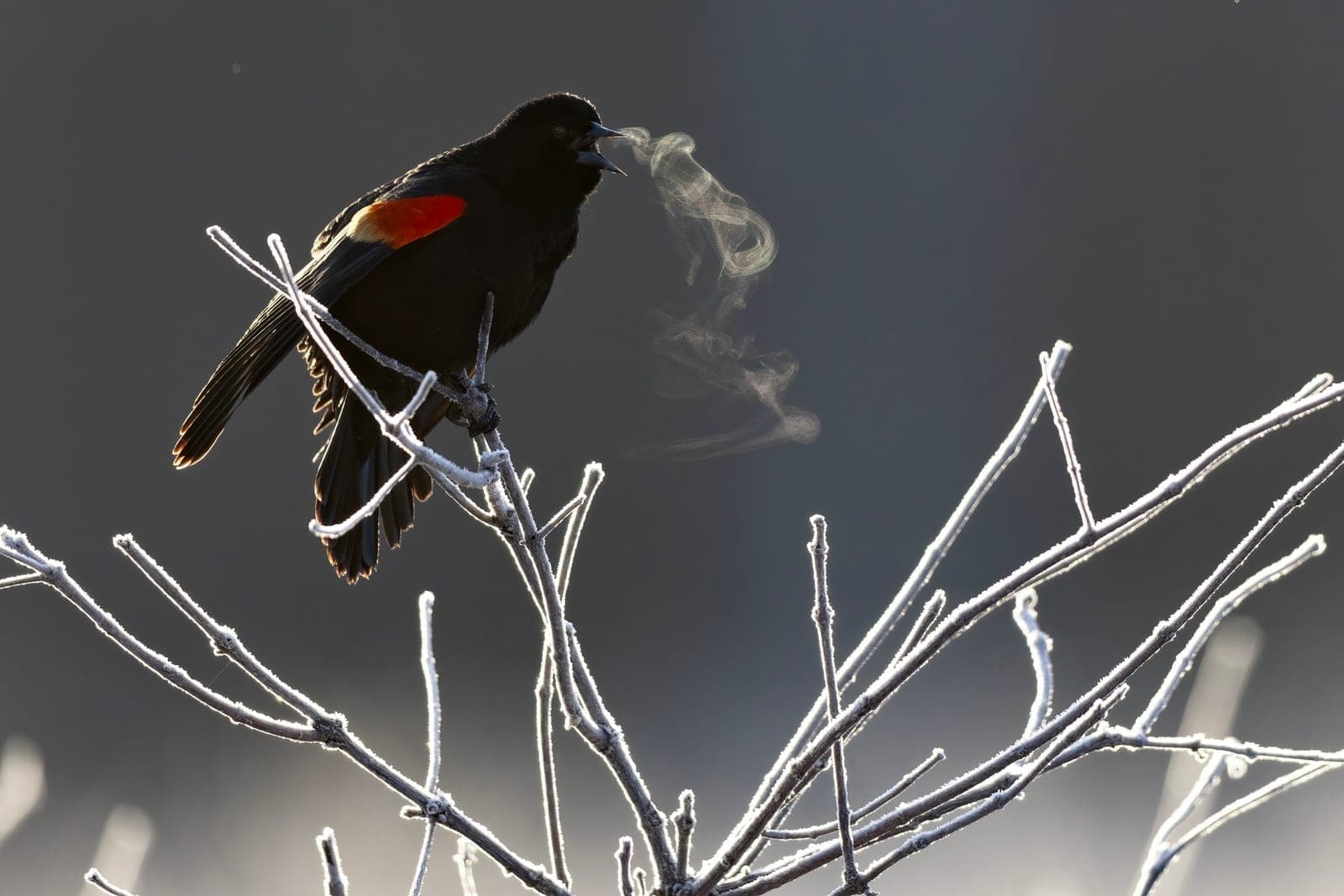
Full comparison →Red-winged Blackbird
Male red-wings are smaller and short-tailed, with dark eyes and red-and-yellow shoulder patches. The two species flock together in winter, so check size, tail length and eye color.
Full comparison →Great-tailed and Boat-tailed Grackles
These bigger grackles have far longer tails, and males are glossy purple-blue throughout. Great-tailed Grackles live in Texas and the Southwest and keep spreading north; Boat-tailed Grackles stick to Atlantic and Gulf coastal marshes.
Brewer's Blackbird
A mostly western bird, Brewer's Blackbird is smaller, with a shorter tail and a shorter, straighter bill. Males are glossed purple on the head and green on the body; females are plain brown with dark eyes.
Range & habitat
Common grackles live across North America east of the Rocky Mountains, breeding from Alberta east across southern and central Canada to the Atlantic, and south to the Gulf Coast and Florida. Their range has pushed westward in recent decades, helped by forest clearing and farming, and they now turn up regularly in parts of the West. Northern birds migrate in flocks to the southeastern United States for the winter, while southern birds stay year-round.
Grackles are birds of open and semi-open country with scattered trees: farmland, towns, suburbs, parks, cemeteries, streamsides, marsh edges and woodland borders. They feed on the ground in fields, lawns, pastures, feedlots and shallow water, and they nest and roost in dense trees, especially conifers, often near water.
Through the seasons
Spring
Grackles are early migrants, back in the North by March. Males puff out their feathers, half-spread their wings and tail, and give a short, creaky song, or point their bills straight up at rivals. Loose colonies form in conifers and dense trees.
Summer
Egg-laying peaks in late April and May, and most females raise one brood. By late June, adults and young gather in big foraging flocks. Late in summer, molting adults look ragged and short-tailed.
Fall
Grackles join huge mixed flocks of red-winged blackbirds, starlings and cowbirds that feed in fields by day and stream to communal roosts at dusk. Northern birds migrate late, often into November.
Winter
Most grackles winter in the Southeast, in roosts that can hold hundreds of thousands of birds or more. Some stay north near feeders, farms and open water.
How to find and attract common grackles
In spring and summer, grackles are easy to find: check lawns, parks, parking lots and shorelines for a big blackbird walking with a high-stepping strut, and listen for the creaky song and loud 'chack' calls. In fall and winter, watch for long, noisy flocks heading to roosts at sunset.
- Look in spring for courting males puffing up and pointing their bills skyward.
- Grackles will eat almost anything on a platform feeder: cracked corn, sunflower, millet, suet and peanuts.
- If grackles are crowding out smaller birds, switch to nyjer or safflower and use tube feeders with short perches or caged feeders.
- Tall conifers and dense evergreens near water attract nesting colonies.
- Watch for anting: grackles sometimes let ants crawl through their feathers, possibly to fight parasites.
- At dusk in late fall and winter, scan farm country and southern marshes for roost flights.
Diet & life cycle
What it eats
Grackles are true omnivores. In winter and migration they eat mostly grain and seeds, such as corn, acorns and weed seeds, and a hard ridge, or keel, on the roof of the mouth helps them saw open acorns and hard kernels. In summer they take beetle grubs, grasshoppers, caterpillars, earthworms and spiders, plus crayfish, minnows, frogs, lizards, small rodents, and the eggs and nestlings of other birds. They sometimes steal food from robins and have been seen killing adult House Sparrows.
Life cycle
Grackles often nest in loose colonies, typically 10 to 30 pairs, hidden in dense conifers or shrubs near water, and occasionally in tree holes, old buildings or even the lower part of an Osprey nest. The female builds a bulky cup of weeds, grass and twigs, usually with some mud, and lays most often four or five pale blue to gray eggs blotched with brown. She incubates them for about 11 to 15 days, and both parents feed the young, mostly on insects, until they leave the nest at about two weeks. Males sometimes abandon their mate before the young fledge to pair with another female.
Oldest on record
The oldest common grackle in the USGS Bird Banding Laboratory longevity table was a male at least 23 years and 1 month old. He was banded in Minnesota in October 1972 and was caught by a bird of prey there in July 1994, a remarkable age for a songbird.
SourceAttracting & watching
Grackles show up at any feeder offering cracked corn, sunflower, millet, suet or bread, and a flock can empty a platform fast. If you would rather save seed for smaller birds, tube feeders with short perches, caged feeders, safflower and nyjer are less appealing to them. For watching, nothing beats a winter roost flight at dusk or a spring lawn full of strutting, puffed-up males.
Conservation
Near Threatened (IUCN). The common grackle is still one of the most numerous birds in eastern North America, but the Breeding Bird Survey shows a drop of about 1.5 percent a year from 1966 to 2019, more than half the population, and Christmas Bird Count data suggest even steeper winter losses. It was moved to Near Threatened on the IUCN Red List in 2018. Suspected causes include changes in farming, pesticides and decades of roost control: federal programs killed up to 18 million grackles in Kentucky, Tennessee and Alabama between 1974 and 1992. Grackles are protected under the Migratory Bird Treaty Act, though a federal depredation order allows them to be controlled where they are seriously damaging crops.