Fish · Side by side
Tarpon vs Snook
How to tell them apart
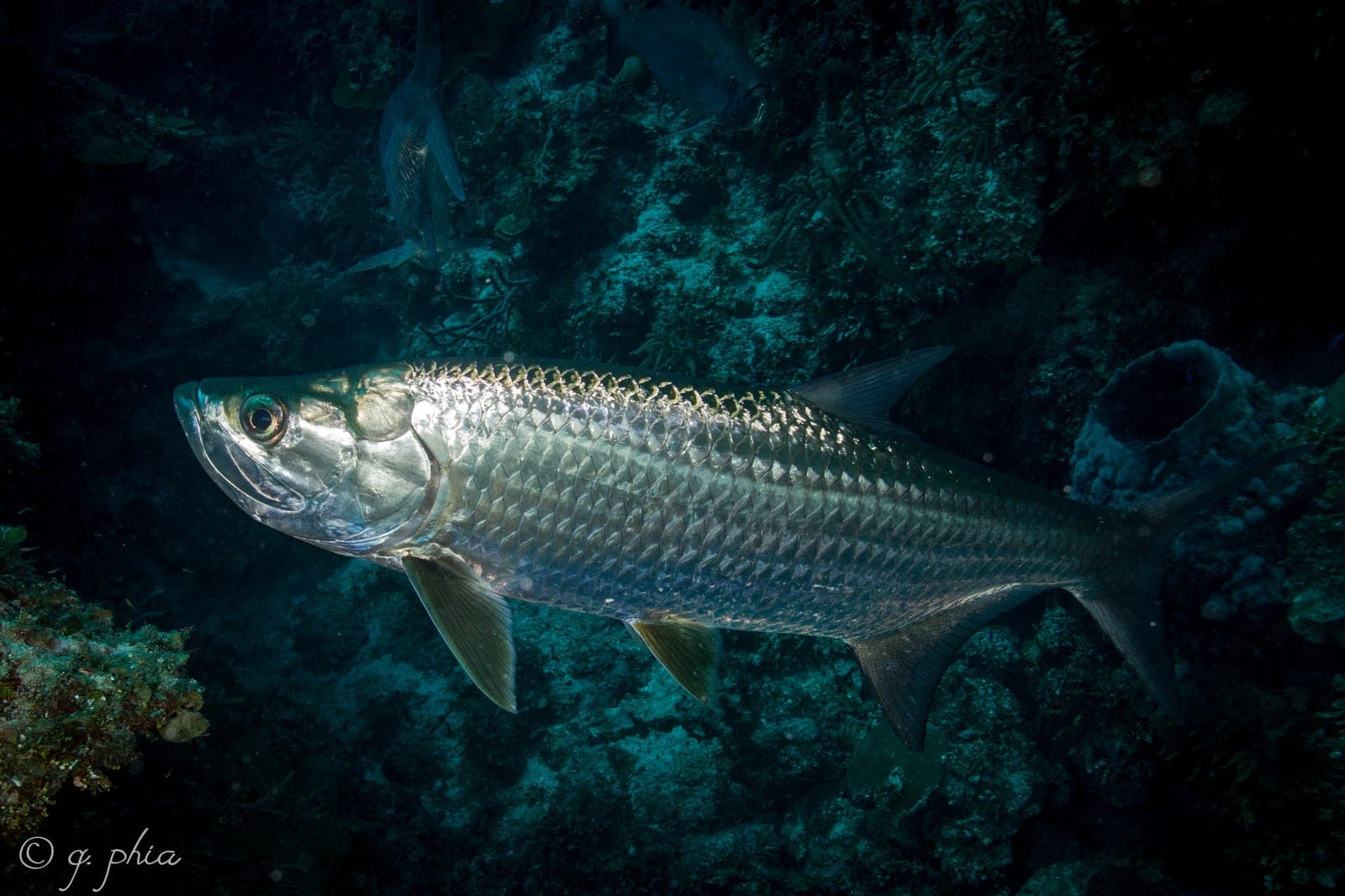
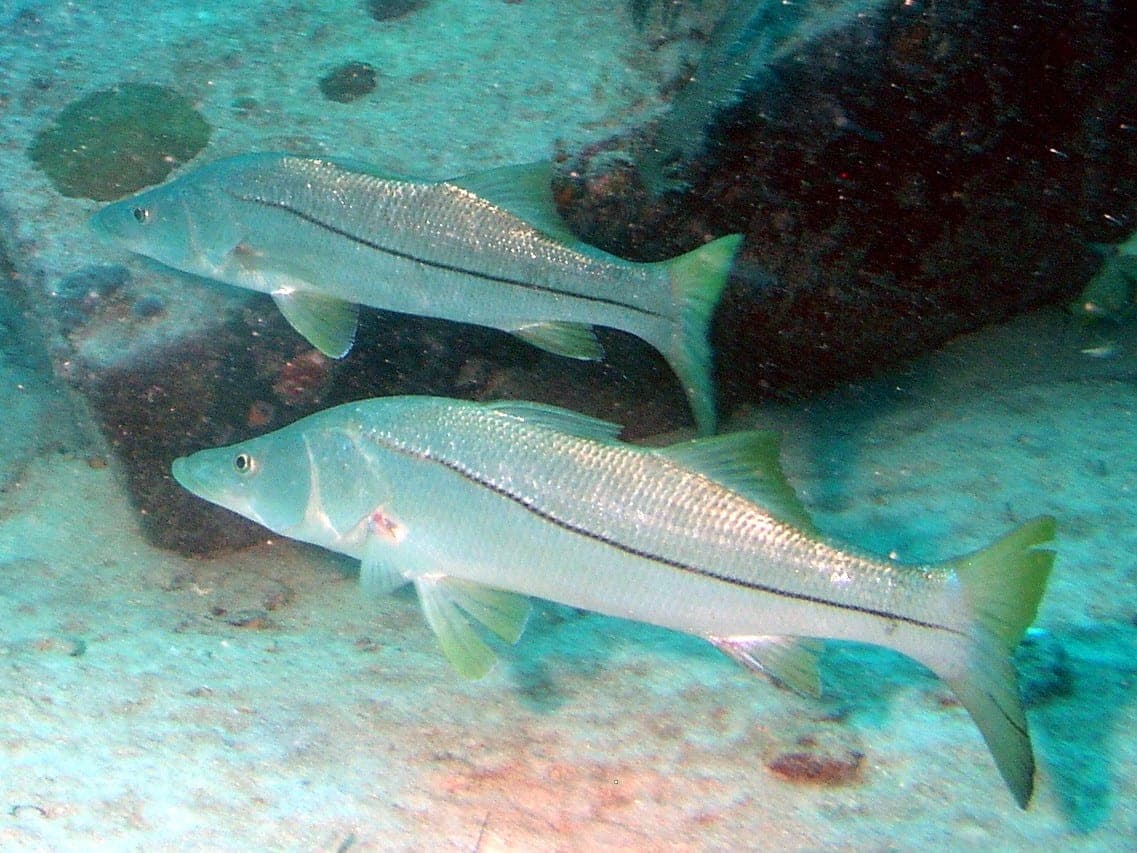
Quick answer
Check the side of the fish: a snook has a bold black lateral line running from the gill cover into the tail and two separate dorsal fins, while a tarpon has no stripe, huge mirror-like scales, an upturned mouth and a single dorsal fin whose last ray trails as a long filament.
Tarpon and snook are Florida's two great inshore glamour fish. They haunt the same mangroves, bridges, passes and dock lights, and on a dark night a big swirl under the lights could be either one. Up close they could hardly be more different, and so are the rules: tarpon are released, while snook are one of the best fish you can legally keep in season.
Key differences
| Trait | Tarpon | Snook |
|---|---|---|
| Side markings | No stripe; huge, mirror-like scales | Bold black lateral line; small scales |
| Dorsal fin | One fin; last ray trails as a long filament | Two dorsal fins separated by a gap |
| Head and mouth | Upturned mouth, jutting lower jaw, bony throat plate | Long flat snout, sloping forehead, protruding lower jaw |
| Typical size | Adults commonly 40–60 in | Commonly 20–32 in, about 2–11 lb |
| World record | 286 lb 9 oz (IGFA, 2003) | 53 lb 10 oz (IGFA, 1978) |
| Lifespan | 50+ years | About 15 years for males, 21 for females |
| Breathing | Gulps air with a lung-like swim bladder | Does not breathe air |
| On the table | Not eaten in the U.S.; released | Excellent eating; skin removed |
Where their worlds overlap
Both are tropical fish at the northern edge of their range in Florida, and both are badly hurt by cold: snook turn sluggish below about 65°F, and sudden freezes kill both species in shallow water. Their young grow up side by side in mangrove creeks and backwaters. Adults meet again at passes, inlets, bridges and lighted docks, especially at night on a falling tide. The big difference is travel. Most snook stay close to their home estuary, while adult tarpon migrate hundreds of miles, running up the Atlantic coast to the Carolinas and beyond, and around the Gulf to Louisiana and Texas each summer.
Different relatives, different fights
The two are not related. Tarpon belong to an ancient group with leptocephalus larvae, shared with ladyfish, bonefish and eels. Snook are spiny-finned fish whose closest relatives include the barramundi and the Nile perch. The fights show it. A hooked tarpon goes airborne, sometimes jumping as high as 10 feet, and its bony mouth throws many hooks. A hooked snook bulldogs straight for pilings and mangrove roots, where its sharp gill covers and the barnacles cut line, so a heavy leader matters more than heavy line.
Which one can you keep?
In Florida, tarpon are a catch-and-release fish: they cannot be sold, and keeping one is allowed only under a special permit, usually for a potential record. Their flesh is bony and strong anyway. Snook are a protected game fish with no commercial sale, but anglers can keep a fish within the slot limit during open seasons, and the meat is excellent once the soapy-tasting skin is removed. Rules for both change, so check current regulations before every trip.
By the numbers
The traits the daily fish game compares for each.
| Clue | Tarpon | Snook |
|---|---|---|
| Family | Tarpon family | Snook family |
| Water | Both | Both |
| Region | Gulf Coast | Gulf Coast |
| Body shape | Streamlined | Streamlined |
| Max length | 98 in | 55 in |
| Max weight | 355 lb | 54 lb |
| Diet | Carnivore | Carnivore |
FAQ
Are tarpon and snook related?
No. Tarpon are related to ladyfish and bonefish and pass through an eel-like larval stage. Snook belong to the family Centropomidae, and their close relatives include the barramundi and the Nile perch.
Can you catch tarpon and snook in the same place?
Yes. In South Florida both feed around bridges, passes, mangroves and lighted docks, often on the same tide, and a live mullet or pinfish can draw either one.
Which gets bigger, a tarpon or a snook?
Tarpon, by far. Big females can pass 8 feet and 200 pounds, and the world record is 286 pounds, 9 ounces, while a 20-pound snook is a trophy and the common snook record is 53 pounds, 10 ounces.
Can you eat tarpon or snook?
Snook are among the best-eating inshore fish when legal to keep. Tarpon are bony and strong-tasting and are treated as catch-and-release in Florida.
Could you tell them apart from a few clues? Test yourself in today's puzzle.
Play the daily fish game