Fish · Side by side
Bluegill vs Redear Sunfish
How to tell them apart
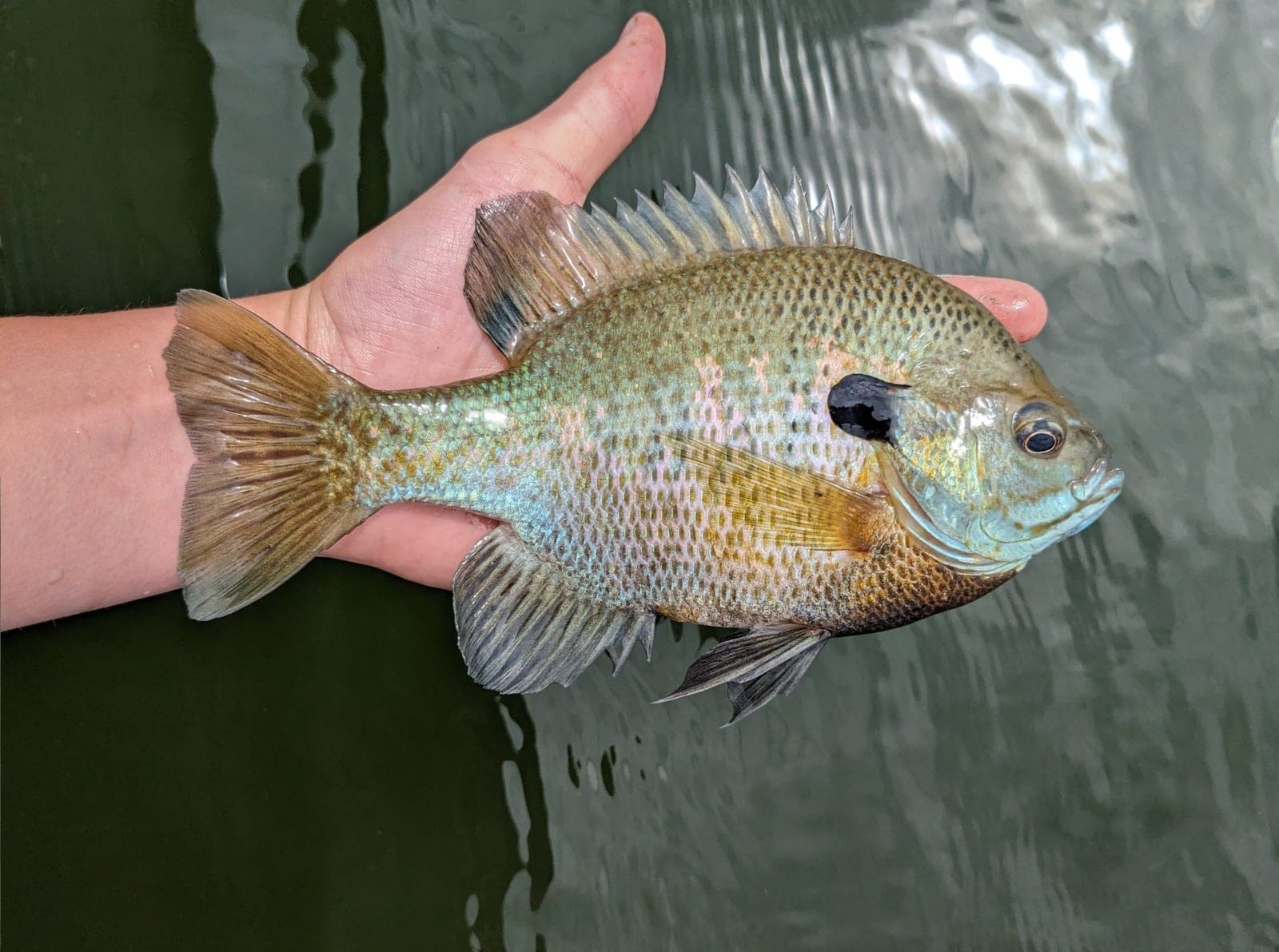
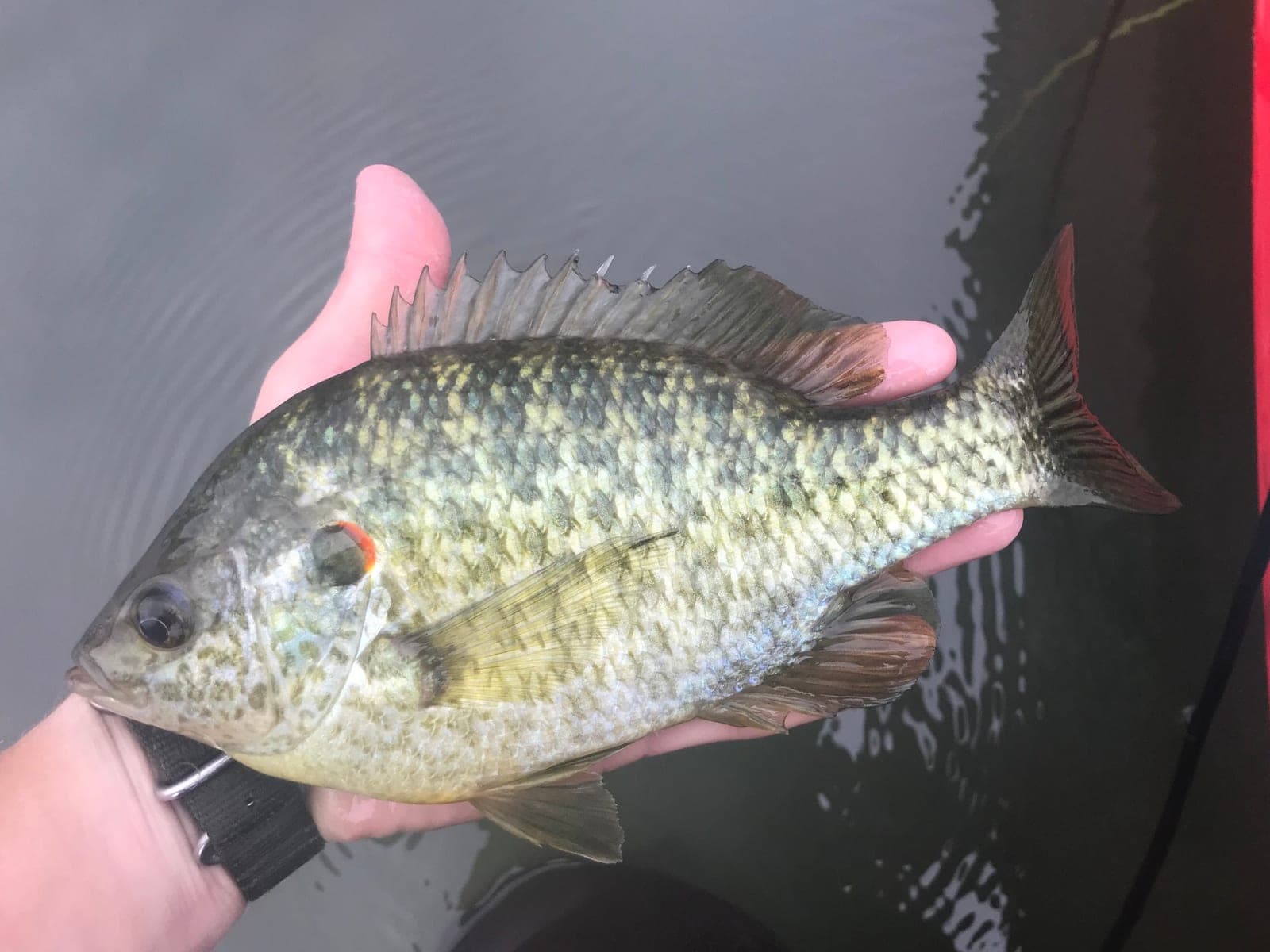
Quick answer
Look at the ear flap: a bluegill's is solid black to the edge, while a redear's is short and black with a pale border and a cherry-red or orange edge. Bluegill also have a blue chin and a dark blotch on the rear of the dorsal fin, which redear lack.
Bluegill and redear sunfish are both 'bream' to southern anglers, share the same deep, flat body and small mouth, and are commonly stocked together in farm ponds. They live different lives, though: bluegill feed throughout the water on insects, while redear grind snails and clams off the bottom. A quick look at the gill cover tells them apart.
Key differences
| Trait | Bluegill | Redear Sunfish |
|---|---|---|
| Ear flap | Solid black to the edge | Short, pale-bordered, tipped red or orange |
| Chin and lower gill cover | Blue to purple wash | No blue |
| Soft dorsal fin | Dark blotch at the rear base | No blotch |
| Body color | Dark olive with distinct vertical bars | Golden-olive with faint bars and speckles |
| Main food | Insects and their larvae | Snails, small clams and mussels |
| Where it feeds | Surface to bottom | Mostly on the bottom |
| Native range | Much of eastern and central North America | Southeastern United States |
| World record | 4 lb 12 oz (IGFA, 1950) | 6 lb 4 oz (IGFA, 2021) |
Where you will find each
Bluegill are native from the Great Lakes to the Gulf and have been stocked almost everywhere. Redear are a southeastern fish, native from the Carolinas to Texas and up the Mississippi valley to southern Illinois and Missouri, though stocking has carried them as far as Ohio and Arizona. In the same lake, bluegill hold around weeds, docks and shallow cover, while redear stay closer to the bottom, often a little deeper, over shell, sand and mud.
Why ponds get both
Bluegill and redear are a common pairing with largemouth bass in stocked farm ponds, and they divide the food supply. Bluegill eat insects and plankton through the water, while redear specialize in snails and other mollusks, cracking the shells with heavy teeth in the throat. Redear also help control the snails that host fish parasites. The two occasionally hybridize, and in-between fish show traits of both.
Fishing for each
Bluegill are the easier target: they hit small jigs, spinners, flies and worms under a float at almost any depth. Redear want bait on the bottom, usually a red worm or a piece of nightcrawler, and their bite is a soft tug that is easy to miss. Both crowd onto spawning beds in late spring and early summer, with redear often nesting slightly deeper. Redear grow larger, so they give bigger fillets, and both are first-rate eating.
By the numbers
The traits the daily fish game compares for each.
| Clue | Bluegill | Redear Sunfish |
|---|---|---|
| Family | Sunfish family | Sunfish family |
| Water | Freshwater | Freshwater |
| Region | Nationwide | Southern waters |
| Body shape | Round & deep | Round & deep |
| Max length | 16 in | 17 in |
| Max weight | 5 lb | 6 lb |
| Diet | Insectivore | Carnivore |
FAQ
Is a shellcracker the same as a bluegill?
No. Shellcracker is the southern nickname for the redear sunfish, a separate species. Both are commonly called bream, which causes much of the confusion.
Which gets bigger, bluegill or redear?
Redear. Their world record is 6 pounds, 4 ounces from Lake Havasu, Arizona, against 4 pounds, 12 ounces for the bluegill, and redear average a bit larger too.
What is the best bait for redear compared with bluegill?
Redear are best caught on worms fished right on the bottom. Bluegill take worms too, but also crickets, waxworms, small jigs and flies anywhere in the water column.
Can bluegill and redear interbreed?
Yes, though not often. Sunfish of the genus Lepomis hybridize occasionally, and bluegill × redear crosses do occur. Hybrids usually show a mix of both parents' ear-flap and body markings.
Could you tell them apart from a few clues? Test yourself in today's puzzle.
Play the daily fish game