Fish · Side by side
Bluegill vs Pumpkinseed
How to tell them apart
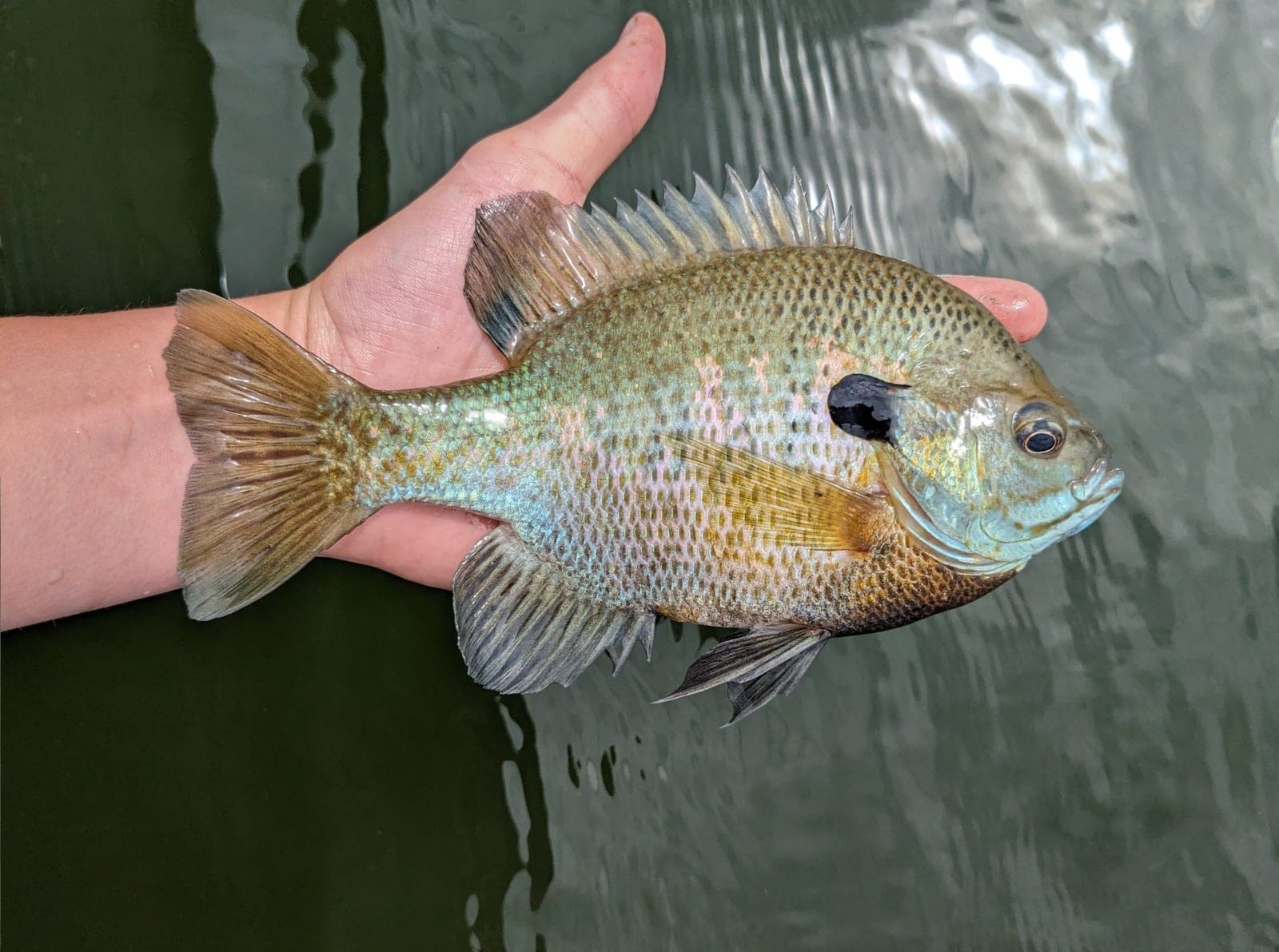
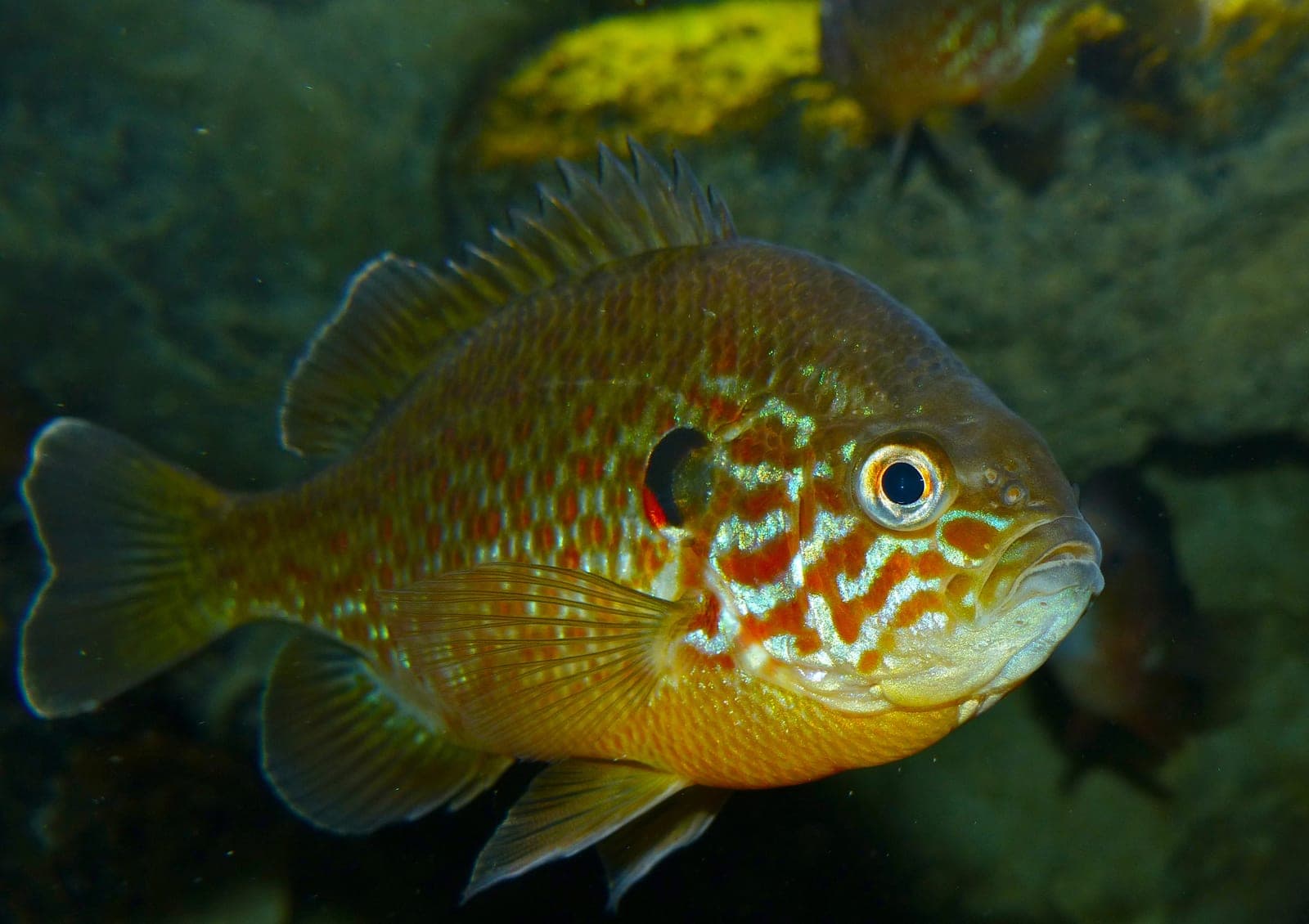
Quick answer
Check the ear flap at the back of the gill cover: a bluegill's is solid black to the edge, while a pumpkinseed's is black with a bright red to orange half-moon spot on the tip. Pumpkinseeds also have wavy blue-green lines across the cheek.
Bluegill and pumpkinseed are close cousins in the sunfish family, with the same round, flat shape and small mouth, and across the northern United States and southern Canada they often share the same dock or weed bed. They even nest side by side and crossbreed. One look at the gill cover is usually enough to tell them apart.
Key differences
| Trait | Bluegill | Pumpkinseed |
|---|---|---|
| Ear flap | Solid black to the edge | Black with a red-orange half-moon tip |
| Cheek | Plain, with a blue wash on the chin | Wavy turquoise and orange lines |
| Soft dorsal fin | Dark blotch at the rear base | No single dark blotch |
| Sides | Olive with five to nine dark vertical bars | Flecked with orange, yellow and emerald spots |
| Spawning water | About 67–80°F, late May into August | About 55–63°F, late spring into early summer |
| Native range | Most of the East, South and Midwest | Northeast, Great Lakes and upper Midwest |
| World record | 4 lb 12 oz (IGFA, 1950) | 1 lb 8 oz (IGFA, 2016) |
Where you will find each
Bluegill are the more widespread of the two, native from the Great Lakes to the Gulf Coast and stocked into ponds almost everywhere. Pumpkinseeds are a northern and eastern fish, most at home in clear, weedy glacial lakes and ponds from New Brunswick and the Great Lakes to Manitoba. Where they overlap, pumpkinseeds tend to hug shallow vegetation near shore, while bigger bluegill are more willing to roam deeper weed edges and open water. Pumpkinseeds handle low oxygen better, bluegill handle heat better.
Hybrids: when it looks like both
The two species nest in the same shallow colonies, and pumpkinseeds sometimes build their nests right inside a bluegill colony. Crossbreeding is fairly common as a result, and hybrids mix the parents' marks: a weak colored edge on the ear flap, faint cheek lines or a smudge on the dorsal fin. If a sunfish does not fit either description cleanly, it may well be a hybrid.
Which is better to catch and eat?
Both are excellent panfish with mild, white, flaky meat, and they fry up the same way. Bluegill grow larger, so they give thicker fillets and more of a fight. Pumpkinseeds are easier to catch from shore because they live so close to the bank, and they are often the first fish to move shallow in spring because they nest in cooler water.
By the numbers
The traits the daily fish game compares for each.
| Clue | Bluegill | Pumpkinseed |
|---|---|---|
| Family | Sunfish family | Sunfish family |
| Water | Freshwater | Freshwater |
| Region | Nationwide | Northern lakes & rivers |
| Body shape | Round & deep | Round & deep |
| Max length | 16 in | 12 in |
| Max weight | 5 lb | 2 lb |
| Diet | Insectivore | Insectivore |
FAQ
Is a pumpkinseed a type of bluegill?
No. They are separate species in the same genus, Lepomis, along with redear and green sunfish. They are closely related enough to interbreed.
Which gets bigger, bluegill or pumpkinseed?
Bluegill. Their world record is 4 pounds, 12 ounces, against 1 pound, 8 ounces for the pumpkinseed, and most pumpkinseeds stay under 8 inches.
Do pumpkinseed and bluegill taste different?
Not noticeably. Both have mild, sweet, white meat. Bluegill fillets are usually a bit larger simply because the fish grow bigger.
What does the red spot on a sunfish's ear mean?
A red to orange spot on the tip of a black ear flap is the pumpkinseed's signature. A redear has a red or orange edge too, but no wavy cheek lines or orange flecks on its sides.
Could you tell them apart from a few clues? Test yourself in today's puzzle.
Play the daily fish game