Birds · Side by side
Cooper's Hawk vs Red-tailed Hawk
How to tell them apart
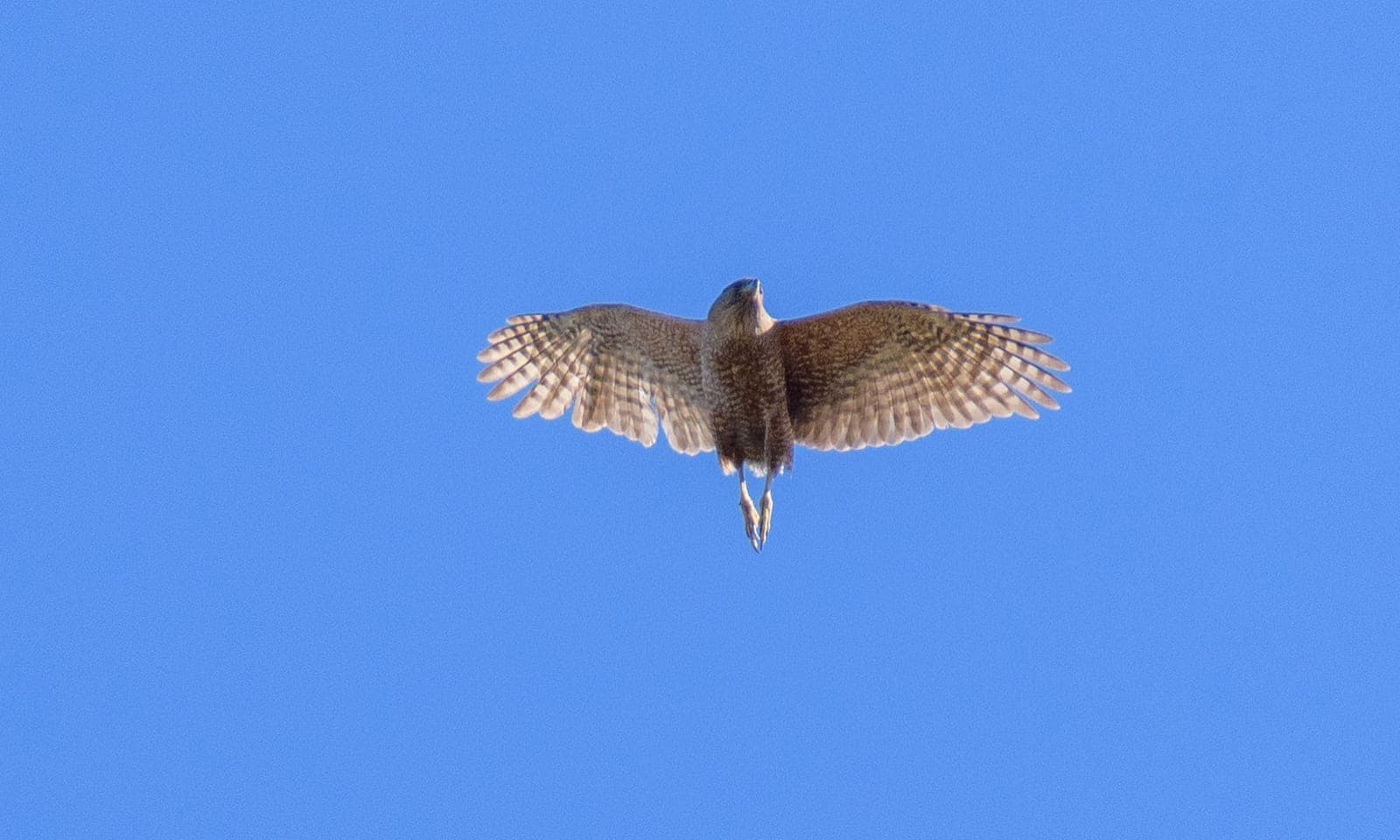
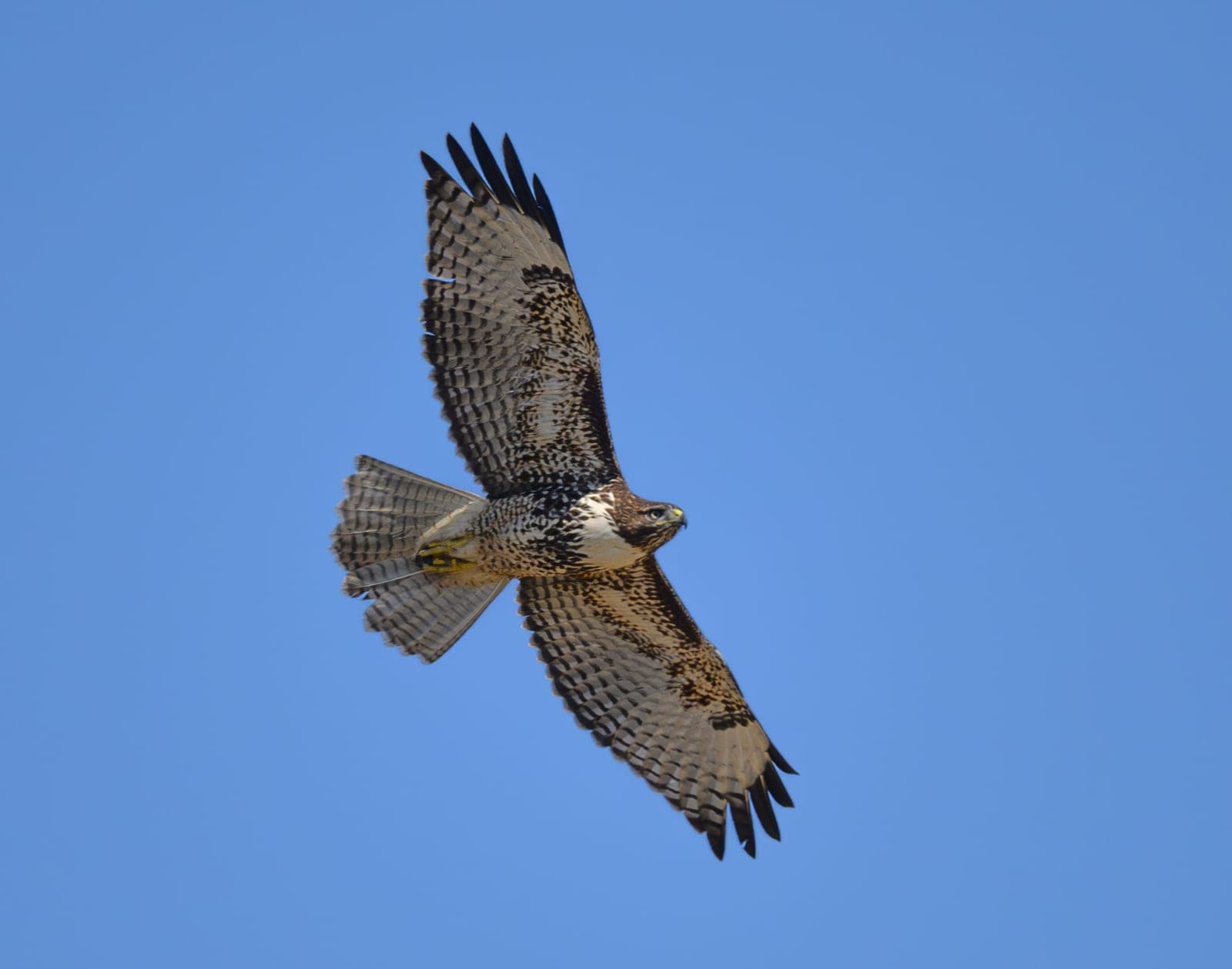
Quick answer
Shape first: a Cooper's Hawk has short, rounded wings and a long, rounded tail and flies flap-flap-glide, while a Red-tailed Hawk is a bulky soarer with broad wings, a short fan of a tail and, on adults, a brick-red tail and a dark belly band. A hawk raiding a bird feeder is almost always a Cooper's (or a Sharp-shinned); one on a highway pole is usually a red-tail.
Cooper's Hawks and Red-tailed Hawks are the two hawks people see most around homes, farms and roads, and 'what hawk is that?' usually comes down to one or the other. They hunt in completely different ways — one a bird-chasing woodland hawk, the other a soaring rodent hunter of open country — and their shapes, habits and haunts give them away fast.
Key differences
| Trait | Cooper's Hawk | Red-tailed Hawk |
|---|---|---|
| Body shape | Slim, long-tailed, short rounded wings | Stocky, broad wings, short wide tail |
| Weight | 8 oz–1.5 lb, about crow-sized | 1.5–3.3 lb |
| Adult colors | Blue-gray back, dark cap, rusty-barred chest, orange to red eyes | Brown back, white chest with a dark belly band, brick-red tail |
| Flight | Quick flaps and glides; dashes through cover | Long, slow soaring circles; sometimes hovers in wind |
| Main prey | Medium-sized birds: robins, doves, starlings, pigeons | Rodents and rabbits |
| Hunting style | Ambush from cover, then a short, fast chase | Watches open ground from a high perch, then glides down |
| Typical spot | Woods, suburbs, near feeders | Field edges, highway poles, open country |
| Call | Flat, rapid 'cak-cak-cak' | Hoarse, falling 'keeeer' scream |
Two kinds of hawk
The Red-tailed Hawk is a buteo, a soaring hawk with broad wings for riding thermals and a habit of hunting from high perches over open ground. The Cooper's Hawk is an accipiter-type hawk built for speed in tight quarters: short wings to slip between branches and a long tail to steer. Taxonomy now underlines the split. In 2025 the American Ornithological Society moved Cooper's Hawk from Accipiter into the revived genus Astur, while the Red-tailed Hawk stays in Buteo.
Juveniles
Young birds of both species are brown above and streaked below, and both have yellowish eyes, so color alone can mislead. A juvenile Cooper's shows crisp, narrow brown streaks on a white chest and the same long, banded tail with a white tip as an adult. A juvenile red-tail is bulkier, with a brown tail crossed by many thin dark bars, a streaky belly band and whitish mottling on the back. Flight settles it: rowing flaps and a glide mean Cooper's, while lazy soaring circles mean red-tail.
Chicken hawks and the law
Both species carried the old name 'chicken hawk,' and either may take an unguarded bird from a poultry yard, though their normal prey is wild birds for the Cooper's and rodents for the red-tail. Both are protected under the Migratory Bird Treaty Act, so shooting or trapping one requires a federal permit. Covered runs, netting and secure coops are the practical answer.
By the numbers
The traits the daily bird game compares for each.
| Clue | Cooper's Hawk | Red-tailed Hawk |
|---|---|---|
| Group | Hawks & eagles | Hawks & eagles |
| Colors | Gray, Orange, White | Brown, White, Red |
| Habitat | Backyards | Grassland |
| Region | Nationwide | Nationwide |
| Length | 16 in | 22 in |
| Wingspan | 30 in | 49 in |
| Diet | Meat | Meat |
FAQ
Is the hawk at a bird feeder a Cooper's Hawk?
Usually, or its smaller look-alike, the Sharp-shinned Hawk. Red-tails hunt rodents in open country and seldom chase songbirds around feeders.
Which hawk is bigger, a Cooper's or a Red-tailed Hawk?
The Red-tailed Hawk. A big female Cooper's weighs up to about 1.5 pounds, while red-tails run roughly 1.5 to 3.3 pounds and have much broader wings.
Do both hawks migrate?
Partly. Northern populations of both move south in fall, while most birds farther south stay year-round. Cooper's Hawks migrate earlier, peaking in late September and early October in the East; red-tails move later in fall.
Could you tell them apart from a few clues? Test yourself in today's puzzle.
Play the daily bird game