How to identify a red-tailed hawk
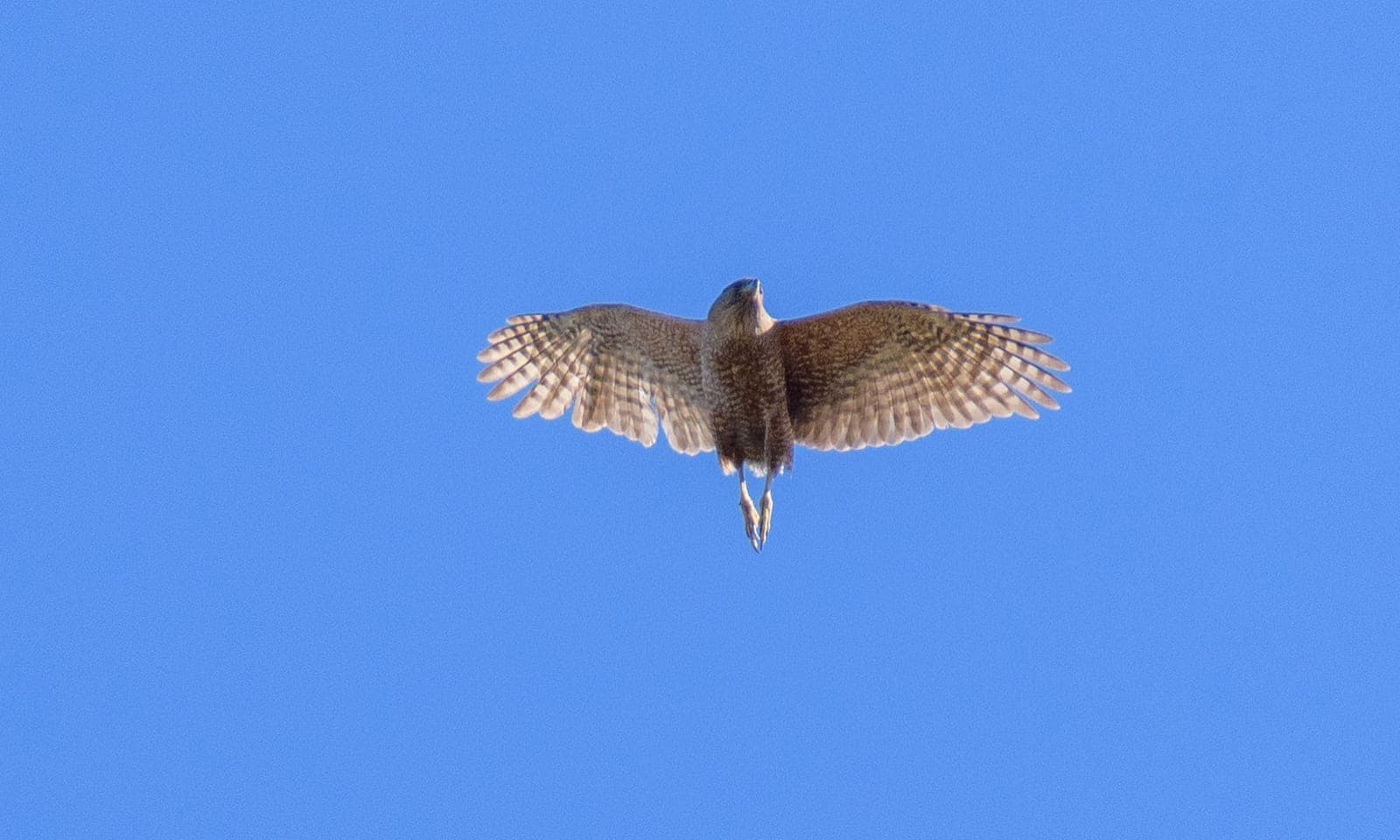
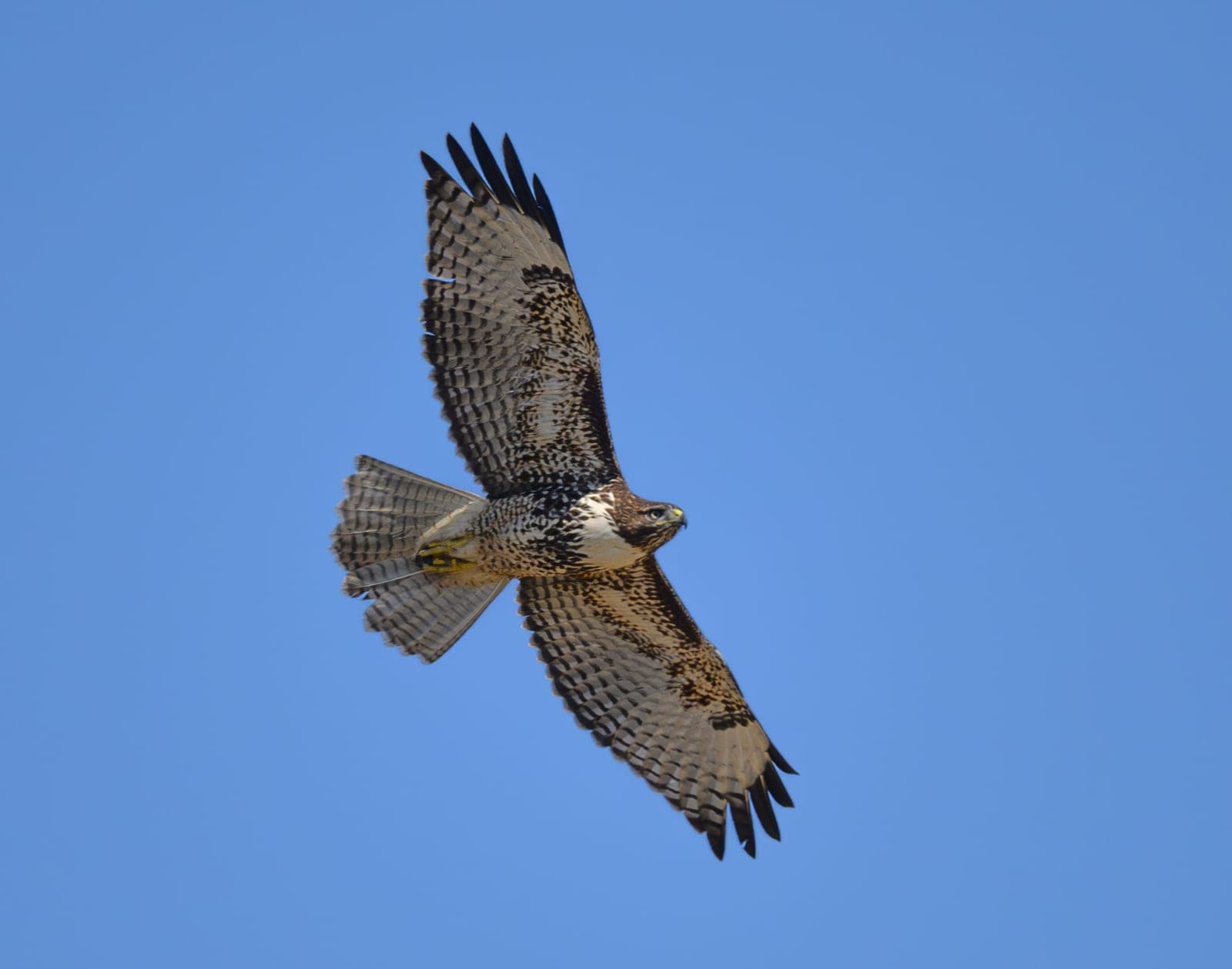
Red-tails are stocky buteos — hawks built for soaring, with broad, rounded wings and a short, fan-shaped tail. Adults show a brick-red upper tail that flashes when the bird banks or lands; from below the same tail looks pale and pinkish. Most eastern birds have a white chest crossed by a band of dark streaks on the belly, but few North American hawks vary as much: western birds come in light, rusty and nearly black forms, the dark Harlan's form has a whitish, smudged tail, and the pale Krider's form looks washed out. Juveniles have a brown tail with about six thin dark bars and pale yellowish eyes that darken to reddish-brown over three to four years. Females are up to a quarter larger than males but wear the same colors.
- Brick-red upper tail on adults
- Dark belly band of streaks across a pale chest
- Dark bar along the leading edge of the inner wing, seen from below
- Whitish mottling on the shoulders and back of perched birds
- Broad, rounded wings and a short, wide tail; soars in slow circles
- Hoarse, two- to three-second 'keeeer' scream that slurs downward
Look-alikes
Red-shouldered Hawk
Red-shouldered Hawks are slimmer, with rusty barring on the underparts, a black tail crossed by narrow white bands and pale crescents near the wingtips in flight. They favor wet woods and river bottoms, while red-tails hunt more open ground.
Rough-legged Hawk
This Arctic-nesting winter visitor often hovers over fields. It shows a white tail base with a dark band at the tip, black wrist patches under the wings and legs feathered to the toes, and lacks the red-tail's rusty tail.
Cooper's Hawk
Cooper's Hawks are smaller, with short wings, a long rounded tail and a flap-flap-glide flight, and adults are blue-gray above with rusty barring below. They chase birds through cover instead of watching fields from a pole.
Full comparison →Range & habitat
Red-tails breed from central Alaska and the Yukon east to southern Quebec and the Maritimes, then south through the whole Lower 48, Mexico, Central America and the West Indies. They are absent only from unbroken forest and the high Arctic. Most birds from Canada and Alaska move south for winter, though coastal populations in the Pacific Northwest and Nova Scotia often stay, and most migrants stop short of southern Mexico. Across the rest of the range, adults usually stay on territory year-round.
A red-tail needs two things: open ground to hunt over and a high perch or tall tree to watch from and nest in. That combination turns up almost everywhere — farmland broken by woodlots, prairie groves, desert with saguaros, mountain valleys, coasts and city parks. Utility poles along treeless highway medians have turned interstates into some of the best red-tail habitat on the continent, and the species now nests on buildings and ledges in big cities, as Manhattan's famous Pale Male did, becoming the first red-tail in decades known to raise young in that borough.
Through the seasons
Spring
Northbound migrants move from late February into April, peaking in late March and early April; the Derby Hill hawk watch near Oswego, New York, has counted up to 19,000 red-tails in a spring. Resident pairs are already courting with high, circling flights and steep dives, and eggs go down early in spring.
Summer
After four to five weeks of incubation, chicks hatch and leave the nest six to seven weeks later, though they fly weakly for a couple more weeks. By midsummer, brown-tailed juveniles with banded tails and pale eyes start showing up on fence posts, still trailing their parents.
Fall
Red-tails migrate late in the fall, passing one by one on days with favorable winds rather than in flocks. Hawk Ridge in Duluth, Minnesota, has tallied as many as 15,000 in a single autumn. Upland bird and deer hunters see them working field edges and fencerows for voles.
Winter
Winter is the easiest time to see red-tails: leaves are down, northern birds have arrived, and hawks sit in the open along roads and farm fields hunting voles and mice. Pairs that stay on territory year-round begin renewing their courtship flights by late winter.
How to find and attract Red-tailed Hawks
Red-tails are easy to find and impossible to lure with a feeder; they go where hunting is good. Scan edges and perches, look up on sunny days, and learn the scream.
- Scan utility poles, fence posts and lone trees along highways and farm fields, especially in winter.
- Watch for broad-winged hawks circling on thermals from late morning into the afternoon on sunny days.
- Listen for the hoarse, falling scream, often given by a bird soaring high over its territory.
- Visit a spring or fall hawk watch such as Hawk Ridge in Duluth or Derby Hill in New York.
- Keep unmowed field edges and old fields that hold voles and mice; prey brings the hawks.
- Leave tall dead trees and big shade trees standing as hunting perches and potential nest sites.
- Skip rodent poisons: hawks that eat poisoned rats and mice can bleed to death internally.
Diet & life cycle
What it eats
Red-tails eat whatever is common and catchable, but rodents dominate, making up as much as 85 percent of the diet in some studies. Voles, mice, gophers, chipmunks, ground squirrels, tree squirrels and rabbits are the staples, with snakes, birds up to pheasant size, and the occasional bat, frog or insect filling in. They can kill prey heavier than themselves, including adult black-tailed jackrabbits, striped skunks and western diamondback rattlesnakes, and they will eat carrion when hungry. Most hunting is done from a perch: the hawk watches, then drops in a long glide to pin prey on the ground. Pairs sometimes hunt together, one flushing a squirrel around a trunk to the other.
Life cycle
Red-tails first breed at about two years old and usually keep the same mate and territory for many years, taking a new partner only when one dies. Both birds build or refurbish a bulky stick nest, often lined with bark and fresh green sprigs, high in the tallest tree around, on a cliff ledge, in a saguaro or on a tower. The female lays one to five eggs, usually two or three, and both parents incubate for about 28 to 35 days. The male brings most of the food while the female tends the chicks, which leave the nest at six to seven weeks and start catching their own prey six or seven weeks after that. Great Horned Owls, which begin nesting as early as December, often take over red-tail nests, so the hawks frequently build a new one nearby.
Oldest on record
The oldest Red-tailed Hawk in the USGS Bird Banding Laboratory longevity records was at least 30 years and 8 months old. It was banded as an adult in Michigan in October 1981 and found injured in Michigan in February 2011.
SourceAttracting & watching
Red-tails do not visit feeders; they visit good hunting ground. Rural yards with hayfields, pasture or weedy field edges, a tall snag or two and no rodent poison are the best bet, and a red-tail on a backyard fence is usually after voles or squirrels, not songbirds. For watching, winter drives through farm country and spring and fall hawk watches deliver the most birds. Red-tails are protected under the Migratory Bird Treaty Act, so their feathers and other parts may not be kept without a federal permit.
Conservation
Least Concern (IUCN). Red-tails are widespread and common, and numbers have held steady or increased in many areas since the 1960s. Like other hawks they were once shot freely as 'chicken hawks'; today they are fully protected in the United States under the Migratory Bird Treaty Act. In cities, secondary poisoning from rat bait is a documented threat.