How to identify a cooper's hawk
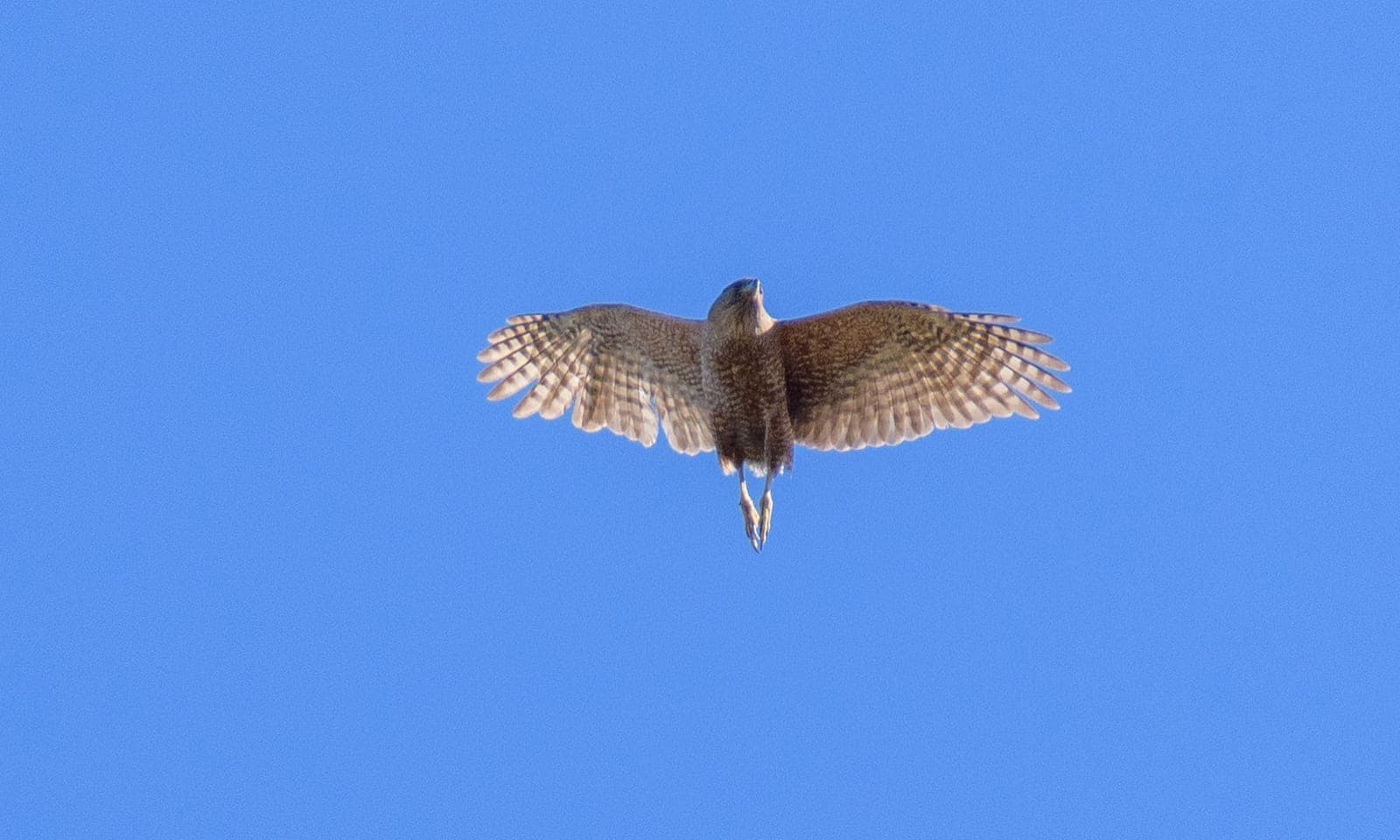
Cooper's Hawks are built for chasing birds through trees: short, rounded wings and a long tail that works like a rudder. Adults are slate blue-gray above with a dark cap, a paler nape and fine rusty barring across a whitish chest; the long tail carries dark bands and a broad white tip. Juveniles are brown above with crisp brown streaks on a white chest. Eye color tracks age, from yellow in young birds through orange to deep red in older adults, and males usually have darker eyes than females. Females are about 20 percent larger than males and roughly 40 percent heavier, so a big female is close to crow-sized while a small male can look a lot like a Sharp-shinned Hawk in the field.
- Long tail with a rounded tip and a broad white band at the end
- Short, rounded wings; flies with a few quick flaps and a glide
- Adults: blue-gray back, dark cap and rusty-barred chest
- Large, blocky head that projects well ahead of the wings in flight
- Thick legs and a loud, flat 'cak-cak-cak' near the nest
Look-alikes
Sharp-shinned Hawk
Sharp-shins are jay-sized rather than crow-sized, with a small head that barely projects in flight, pencil-thin legs and a square or notched tail tip with a narrow white band. A male Cooper's and a female sharp-shin come close in size, so shape and tail tip matter most.
American Goshawk
Goshawks are bigger and bulkier, and adults have a bold white eyebrow, a dark cheek and fine gray barring below. They live in large northern and mountain forests and are seldom seen hunting in towns.
Red-tailed Hawk
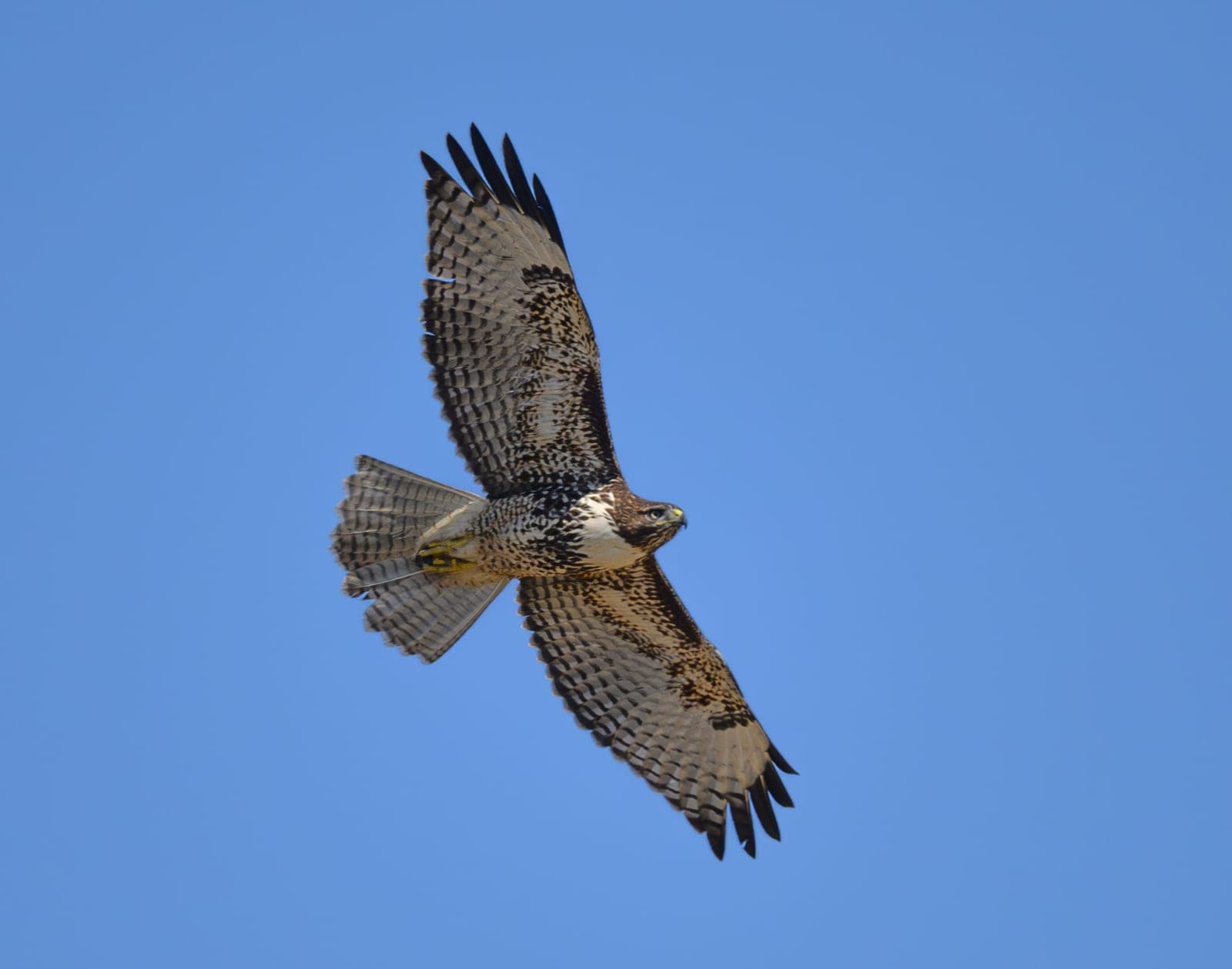
Red-tails are much heavier, with broad wings, a short wide tail and a dark belly band. They soar in wide circles over open country and hunt rodents from poles instead of chasing birds through cover.
Full comparison →Range & habitat
Cooper's Hawks nest from southern Canada across nearly all of the Lower 48 and into northern Mexico; south of Canada they are the most widespread nesting bird-hunting hawk of their group. Most of the breeding range is occupied year-round. Only birds from the northern edge move south in fall, joining residents across the United States and wintering south into Mexico.
Classic Cooper's habitat is mature or mixed woodland with tall trees for nesting and openings or edges for hunting, including wood edges and river groves. Over recent decades the species has moved into towns and cities in a big way, nesting in large parks and leafy neighborhoods where pigeons, doves, starlings and House Sparrows are abundant. In winter, especially in the West, it also hunts more open country.
Through the seasons
Spring
Spring migrants pass from late February into May. Pairs settle into nesting woods, the male feeds the female for up to a month before she lays, and in the Northeast most eggs go down in the first half of May.
Summer
The female incubates for about 34 to 36 days while the male hunts for both. The young climb around the nest tree at about four weeks and fly soon after, and noisy, brown-streaked juveniles practice hunting around the nest woods through late summer.
Fall
In the East, migration runs from late August to mid-October and peaks in late September and early October. Young birds lead the way: at Cape May, New Jersey, more than nine in ten Cooper's Hawks counted have been juveniles. Females migrate earlier and winter farther south than males of the same age.
Winter
Many Cooper's Hawks stay through winter, and this is when they show up most at feeders, where flocks of doves, sparrows and starlings make easy targets. Northern migrants add to the numbers in southern states.
How to find and attract Cooper's Hawks
Nobody has to lure a Cooper's Hawk: a busy bird feeder does it. The skill is spotting a bird that hunts by surprise, and keeping your songbirds safe while you watch.
- Watch the feeder when songbirds suddenly freeze or scatter; a hawk is usually perched within sight.
- Check dense trees and shrubs near feeders, where a Cooper's will sit still and wait for an opening.
- Listen in spring and early summer for the loud, flat 'cak-cak-cak' of adults near a nest.
- Place feeders within a few feet of dense shrubs so small birds can dive for cover quickly.
- If a hawk hunts your feeders daily, take them down for a week or two until it moves on.
- Visit a fall hawk watch such as Cape May in late September for a steady flow of migrants.
Diet & life cycle
What it eats
Birds make up most of a Cooper's Hawk's diet — roughly half to more than four-fifths, depending on the study — and more than 250 species have been recorded. Favorites are medium-sized: American Robins, European Starlings, Mourning Doves, Northern Flickers and jays, plus Rock Pigeons and House Sparrows in towns. Chipmunks, tree and ground squirrels, mice and bats round out the menu, with the odd reptile. One estimate puts a Cooper's Hawk's intake at about two birds a day. It hunts by stealth, slipping from perch to perch through cover, then bursting out in a short, reckless chase. A 2002 study of museum skeletons found healed fractures in the wishbone and shoulder bones of nearly one in five of these bird-chasing hawks, with Cooper's Hawks showing the highest rate.
Life cycle
Cooper's Hawks are usually monogamous and tend to build a new nest each year: a bulky stick platform about two feet across, 25 to 50 feet up in a tall tree, often on top of an old squirrel or crow nest or a mistletoe clump. The female lays three to five pale bluish eggs, sometimes one to seven, and does most of the incubating, which takes about 34 to 36 days; the male takes short turns while she eats. She broods the chicks for their first two weeks while he hunts for the family. The young clamber around the nest tree at about four weeks and fly at four to five weeks. Clutches in the Northeast average about four eggs, and successful nests there fledge about three young.
Oldest on record
The oldest Cooper's Hawk in the USGS Bird Banding Laboratory longevity records was a male at least 20 years and 4 months old. It was banded as a young bird in California in October 1986 and found dead in Washington State in October 2006. The USGS list still files the species under its old name, Accipiter cooperii.
SourceAttracting & watching
Cooper's Hawks come to yards for the birds at the feeder, not the seed. Feeders placed close to dense shrubs or evergreens give songbirds an escape route, a brush pile adds more cover, and decals on nearby windows keep fleeing birds from hitting the glass. For long, close looks at many hawks, a ridge or coastal hawk watch in late September and early October beats any backyard. Like all hawks, Cooper's Hawks are protected under the Migratory Bird Treaty Act.
Conservation
Least Concern (IUCN). Long persecuted as a 'chicken hawk,' the Cooper's Hawk was then hit hard by DDT: average clutch size fell from about 3.5 eggs before 1945 to 2.7 during the peak DDT years and rebounded once the pesticide was banned. Today the population is stable or increasing and has adapted well to cities, although in urban southeastern Arizona a parasitic disease, trichomoniasis, caused about half of recorded nestling deaths.