Birds · Side by side
Common Loon vs Double-crested Cormorant
How to tell them apart
Quick answer
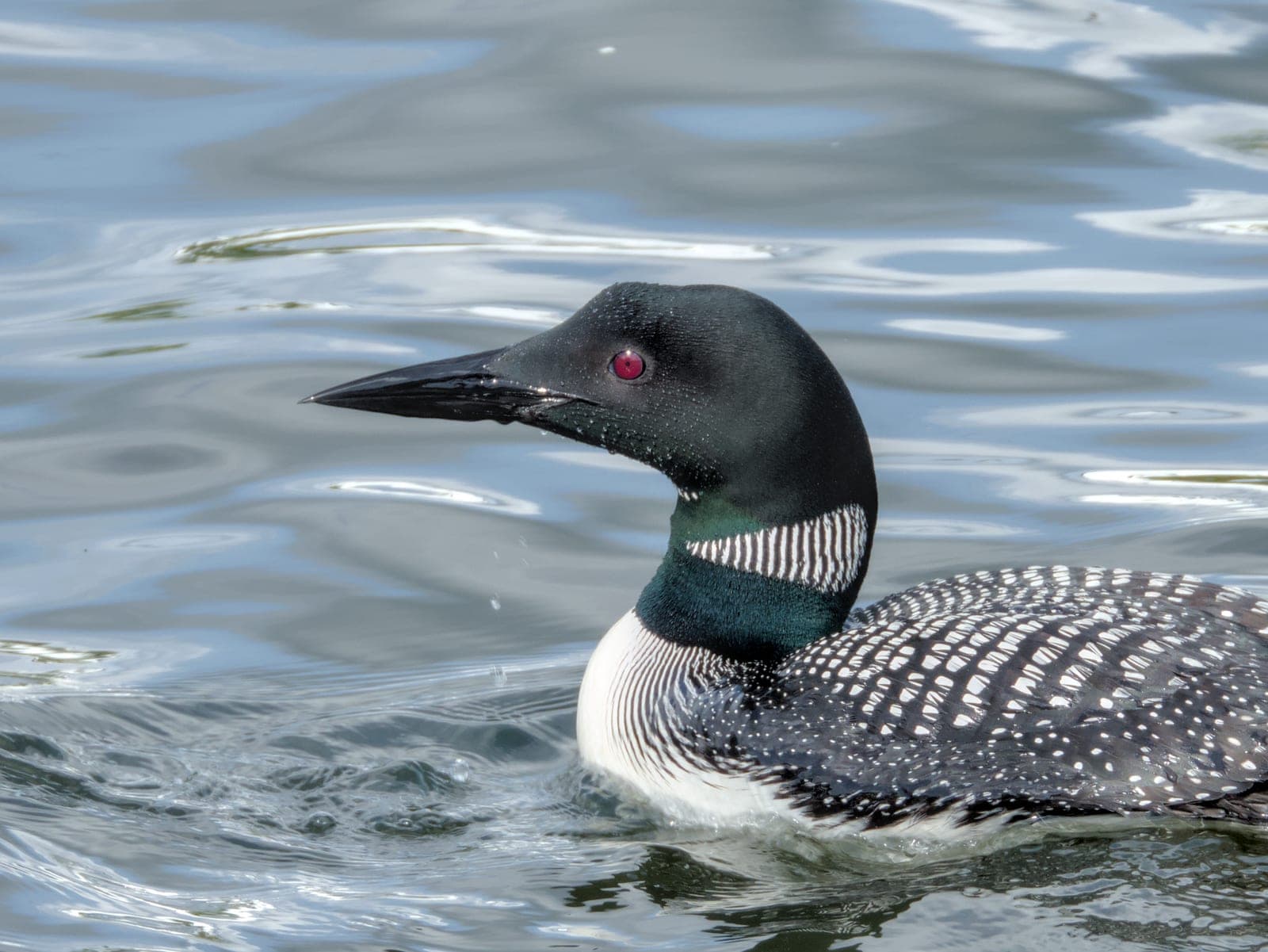
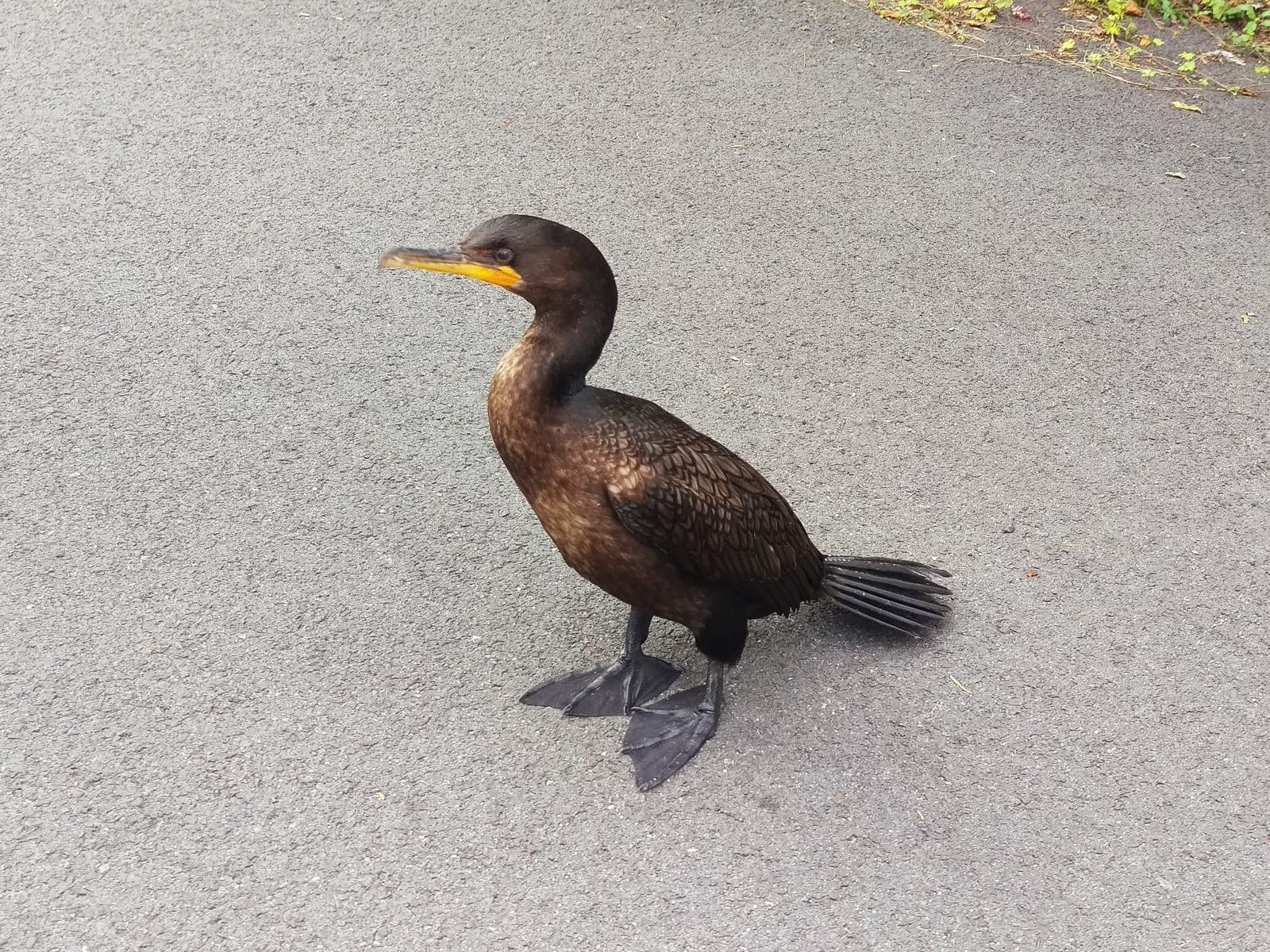
Look at the bill and the perch: a loon holds a thick, straight, daggerlike bill level and never perches out of the water, while a cormorant has a thin, hooked bill tilted upward with orange skin at its base and loves to stand on posts and snags with its wings spread.
From a dock or a boat, a dark, low-riding bird that slips under and pops up far away could be a common loon or a double-crested cormorant. Both are big fish-eaters that chase prey underwater with their feet, both summer on northern lakes and both winter along the coasts. They are not closely related, though, and a few field marks separate them quickly, at any season.
Key differences
| Trait | Common Loon | Double-crested Cormorant |
|---|---|---|
| Bill | Thick, straight, daggerlike, held level | Thin, hooked at the tip, tilted upward |
| Summer plumage | Black head, red eye, white necklace, checkered back | All black with orange-yellow face and throat skin |
| Winter plumage | Gray-brown above, white below | Adults stay black; young are brown with pale breasts |
| Perching | Never perches; comes ashore only to nest | Stands on posts, rocks and snags, often with wings spread |
| Flight | Hunchbacked, feet trailing, alone or in small groups | Kinked neck, often in long lines or V's |
| Voice | Wails, tremolos and yodels | Mostly silent away from colonies |
| Nesting | Single pairs at the edge of lakes and islands | Colonies in trees or on the ground |
| Weight | About 5.5–13.5 lb | About 2.5–5.5 lb |
On the water
Both birds sit low, but the shapes differ. A loon is long and broad-backed, with a thick neck and a heavy head held level, and in summer its checkered back and white necklace show even at a distance. A cormorant looks thinner and snakier, with its head and hooked bill angled up. Both dive smoothly from the surface. Loons often peer underwater with the face submerged before diving, and they never climb out onto a rock or dock to dry off; cormorants do so constantly.
Where each lives
Common loons breed on clear northern lakes from New England and the upper Great Lakes states across Canada to Alaska, and winter on salt water along both coasts. Double-crested cormorants live almost everywhere there is water and fish: Great Lakes islands, prairie lakes, southern reservoirs, catfish ponds, mangroves and rocky coasts. On a northern lake in summer both may be present, but a cormorant colony is a crowded, noisy, whitewashed affair, while a loon pair has the bay to itself.
Two very different reputations
Loons are beloved: state bird of Minnesota, provincial bird of Ontario and on Canada's dollar coin. Their main conservation worries come from people on the lake, including lead sinkers and jigs that poison them, disturbance and boat wakes at nests. Cormorants are controversial: their numbers soared after protection and the DDT ban in 1972, and since 2021 the U.S. Fish and Wildlife Service has let state and tribal agencies control them under special permits to ease conflicts with fisheries. Both remain protected under the Migratory Bird Treaty Act.
By the numbers
The traits the daily bird game compares for each.
| Clue | Common Loon | Double-crested Cormorant |
|---|---|---|
| Group | Loons | Cormorants |
| Colors | Black, White | Black |
| Habitat | Wetlands | Wetlands |
| Region | Northern | Nationwide |
| Length | 31 in | 32 in |
| Wingspan | 46 in | 47 in |
| Diet | Fish | Fish |
FAQ
Are loons and cormorants related?
Not closely. Loons belong to their own order, while cormorants are grouped with anhingas, gannets and boobies. Their similar diving lifestyles evolved separately.
Why do cormorants dry their wings when loons don't?
Cormorant feathers are not fully waterproof, so the birds stand with wings spread to dry them. Loons have dense, waterproof plumage, and their legs sit so far back that they can barely walk, so they stay on the water.
Which dives deeper, a loon or a cormorant?
The loon. Most loon dives are 13 to 33 feet deep, and loons have been recorded near 200 feet. Cormorant dives are typically about 5 to 25 feet deep.
Can you see loons and cormorants on the same lake?
Yes. Both summer on northern lakes and winter in coastal waters, so it is common to see a cormorant perched on a marker while a loon fishes nearby.
Could you tell them apart from a few clues? Test yourself in today's puzzle.
Play the daily bird game