How to identify a double-crested cormorant
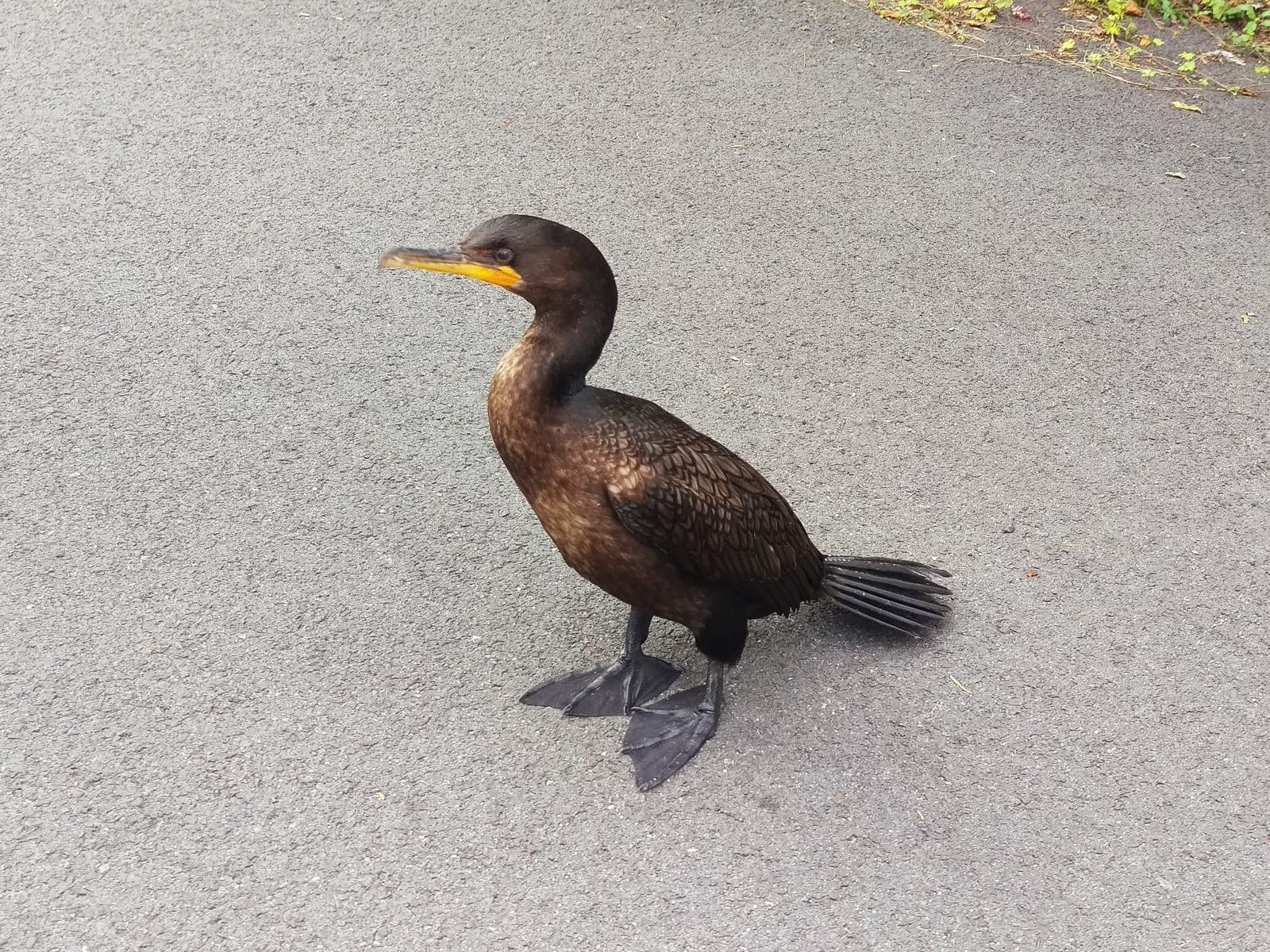
Adults look all black at a distance; up close the back and wings have a bronzy, scaled look and the body a faint greenish gloss. The neck is long, the tail fairly long and stiff, and the bill thin and hooked at the tip. Bare orange-yellow skin covers the face and throat in front of the eye, the best mark at any range. In breeding season adults grow two small tufts above the eyes, the 'double crests', which are black in most eastern and interior birds and white or mixed in many western and Alaskan birds, but they are seldom noticed in the field. Immatures are brown, paler on the neck and breast, sometimes nearly white. On the water cormorants sit low with the bill tilted up. In flight they show a slight crook in the neck just behind the head and often travel in long lines or loose V's, like silent, dark geese.
- All-dark body with orange-yellow skin on the face and throat
- Thin, hooked bill, tilted upward while swimming
- Perches upright with wings spread to dry
- Kinked neck in flight, often in lines or V's
- Immatures brown with a pale neck and breast
Look-alikes
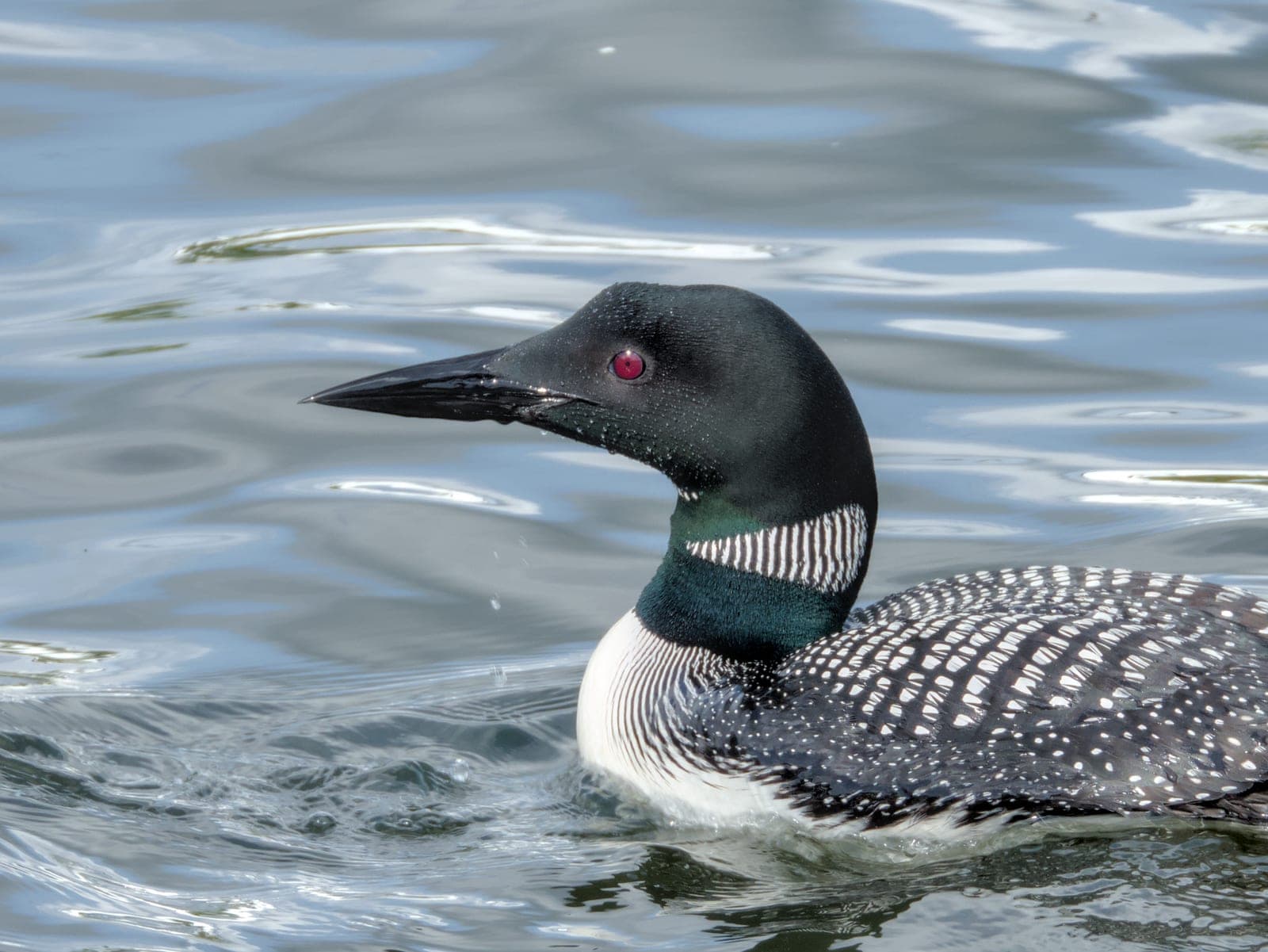
Common Loon
Loons hold a thick, straight, daggerlike bill level, never perch on posts, and in summer wear a black head and checkered back. A cormorant's bill is thin and hooked, with orange skin at its base, and it spends hours standing on perches.
Full comparison →Neotropic Cormorant
Smaller and longer-tailed, with a smaller patch of throat skin that forms a point behind the bill, edged in white during breeding season. It is common in Texas and spreading north and west.
Anhinga
A bird of southern swamps with a straight, sharply pointed bill and no hook, a very long fan-shaped tail and silvery-white streaks on the wings. Anhingas often soar high like hawks.
Great Cormorant
A bigger, bulkier Atlantic Coast cormorant, mostly seen in winter, with a white throat patch and, in breeding season, white patches on the flanks.
Range & habitat
Double-crested cormorants range from the Aleutian Islands and coastal Alaska across southern Canada and nearly all of the lower 48 to Florida, the Bahamas, Cuba and Mexico. Big breeding concentrations are on the Great Lakes, the northern prairies, and the Atlantic and Pacific coasts and in Florida. Interior birds migrate in fall, many to the Gulf Coast, the lower Mississippi Valley and Florida, while some Pacific Coast and Florida birds stay all year.
Cormorants use lakes, reservoirs, rivers, bays, estuaries and rocky coasts, from big northern lakes to southern catfish ponds and mangrove swamps — nearly any water with fish. They feed in open water, alone or in flocks, and loaf on rocks, sandbars, buoys, pilings and dead trees. They nest in colonies on islands, in trees, on cliffs, on the ground and on structures such as bridges and channel markers. Their droppings eventually kill the trees they nest in, which is one reason colonies are unpopular with lakeshore owners.
Through the seasons
Spring
Migrants return to northern lakes and coasts in April and May, often in long, goose-like lines. Adults grow their crests, and colonies come alive as males court females by splashing with their wings, swimming in zigzags and bringing up bits of weed.
Summer
Colonies are crowded and pungent. Chicks hatch after about four weeks, fly at about five to six weeks and are independent at nine to ten weeks. Feeding flocks work schools of baitfish in shallow bays and river mouths.
Fall
Large flocks move south in September and October, following coastlines and big rivers, mostly by day. At a distance their lines and V's are easy to mistake for geese, but they fly silently.
Winter
Most interior birds winter along the Gulf Coast, in the lower Mississippi Valley, where catfish ponds draw large numbers, and in Florida. Some stay on open northern water, especially below dams.
How to find and watch double-crested cormorants
Cormorants are among the easiest waterbirds to find: look for dark, upright shapes on the highest perch over the water. Watching one hunt and then dry off is the real show.
- Scan channel markers, dock posts, rock jetties and dead snags for dark, upright birds with wings held out.
- Watch a swimming bird slip under; it can stay down for 30 seconds to over a minute, chasing fish with its feet.
- In spring and fall, look for lines and V's of dark birds flying low over the water; unlike geese, they make no sound.
- In winter, check open water below dams and river tailwaters, where baitfish concentrate.
- View colonies only from a boat at a distance or from shore; flushed adults leave eggs and chicks to gulls.
- Learn the brown immatures with pale breasts so they are not mistaken for a different species.
Diet & life cycle
What it eats
Cormorants eat mainly fish, taking whatever schooling or slow-moving species are most abundant, from small baitfish and panfish to the young of game fish, plus crayfish, shrimp, crabs, frogs, salamanders and eels. They chase prey underwater with their webbed feet, usually at middle and upper depths rather than on the bottom, grab it with the hooked bill and swallow it at the surface. Diet changes with season and place, and where they feed on stocked fish, hatchery ponds or catfish farms, they come into conflict with people.
Life cycle
Cormorants usually start breeding at about three years old and nest in colonies, often alongside gulls, herons and pelicans. Nests are piles of sticks, weeds and debris in trees or on the ground. The female lays 3 to 4 bluish-white eggs, which become stained in the nest, and both parents incubate for 25 to 33 days, typically 28 to 30. Both feed the chicks, which may leave ground nests at three to four weeks, usually fly at five to six weeks and are probably independent at nine to ten weeks. Their feathers are not fully waterproof, so they must dry them in the sun after fishing.
Oldest on record
The oldest double-crested cormorant in the USGS Bird Banding Laboratory's longevity table was at least 24 years 9 months old. It was banded as a chick in Oregon in July 1997 and identified alive from its color bands in Washington in April 2022.
SourceAttracting & watching
Cormorants never visit yards, but they are easy to watch from harbors, piers, causeways, bridges and lakeside parks, where they often perch close to people; channel markers and jetties in coastal towns hold birds all year in the South. Wing-drying birds make fine photo subjects at close range. Breeding colonies on Great Lakes and coastal islands are best seen from a boat at a respectful distance, never by landing, because gulls quickly take eggs from nests the adults leave.
Conservation
Least Concern (IUCN). Persecution at nesting colonies and then DDT drove cormorant numbers down through the mid-1900s. After the species gained federal protection in 1972, through an amendment to the migratory bird treaty with Mexico, and DDT was banned the same year, populations soared: Great Lakes nests went from 89 in 1970 to about 38,000 by 1991. Cormorants remain protected under the Migratory Bird Treaty Act, but since 2021 the U.S. Fish and Wildlife Service has offered a special permit that lets state and tribal wildlife agencies control them, after trying nonlethal methods first, to reduce conflicts with fisheries. In Canada, Ontario opened a hunting season for cormorants in 2020.