How to identify a common loon
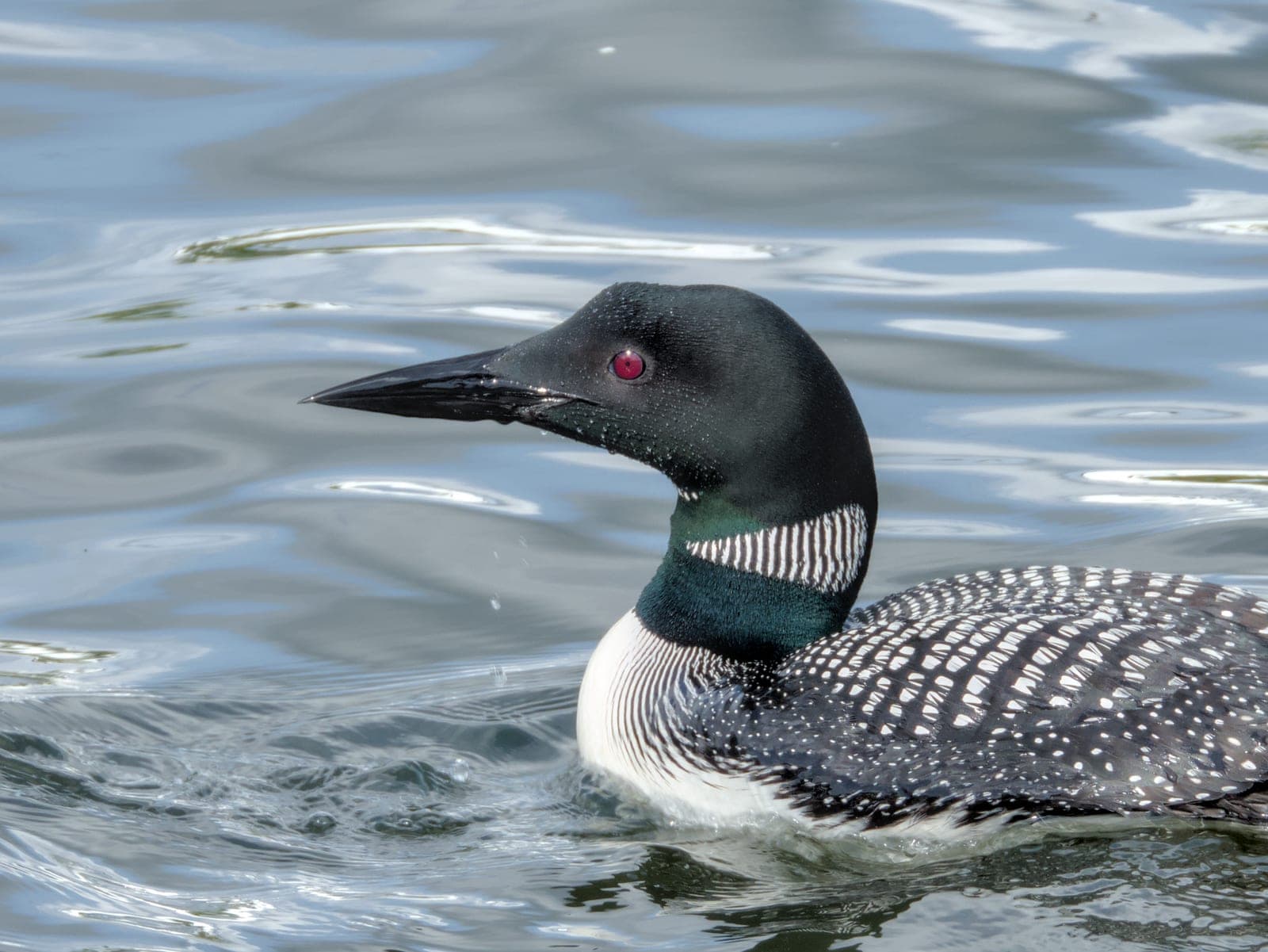
In breeding plumage a common loon is unmistakable: a glossy black head that can shine green, a red eye, a necklace and collar of short white stripes, a back checkered in bold black and white, and clean white underparts. The bill is long, thick, straight and black, held level. From fall through winter loons turn plain, dark gray-brown above and white below, with a jagged border on the side of the neck, a pale area around the eye and a pale gray bill with a darker ridge; first-winter birds show a scaly back. Loons ride low in the water, often with little more than the head and back showing, and slip under without a jump. In flight they look hunchbacked and long-bodied, with the head slightly drooped and big feet trailing past the short tail.
- Black head, red eye and white-striped necklace (breeding)
- Black-and-white checkerboard back (breeding)
- Thick, straight, daggerlike bill held level
- Rides low in the water and dives without a leap
- Wails, tremolos and yodels on breeding lakes
Look-alikes
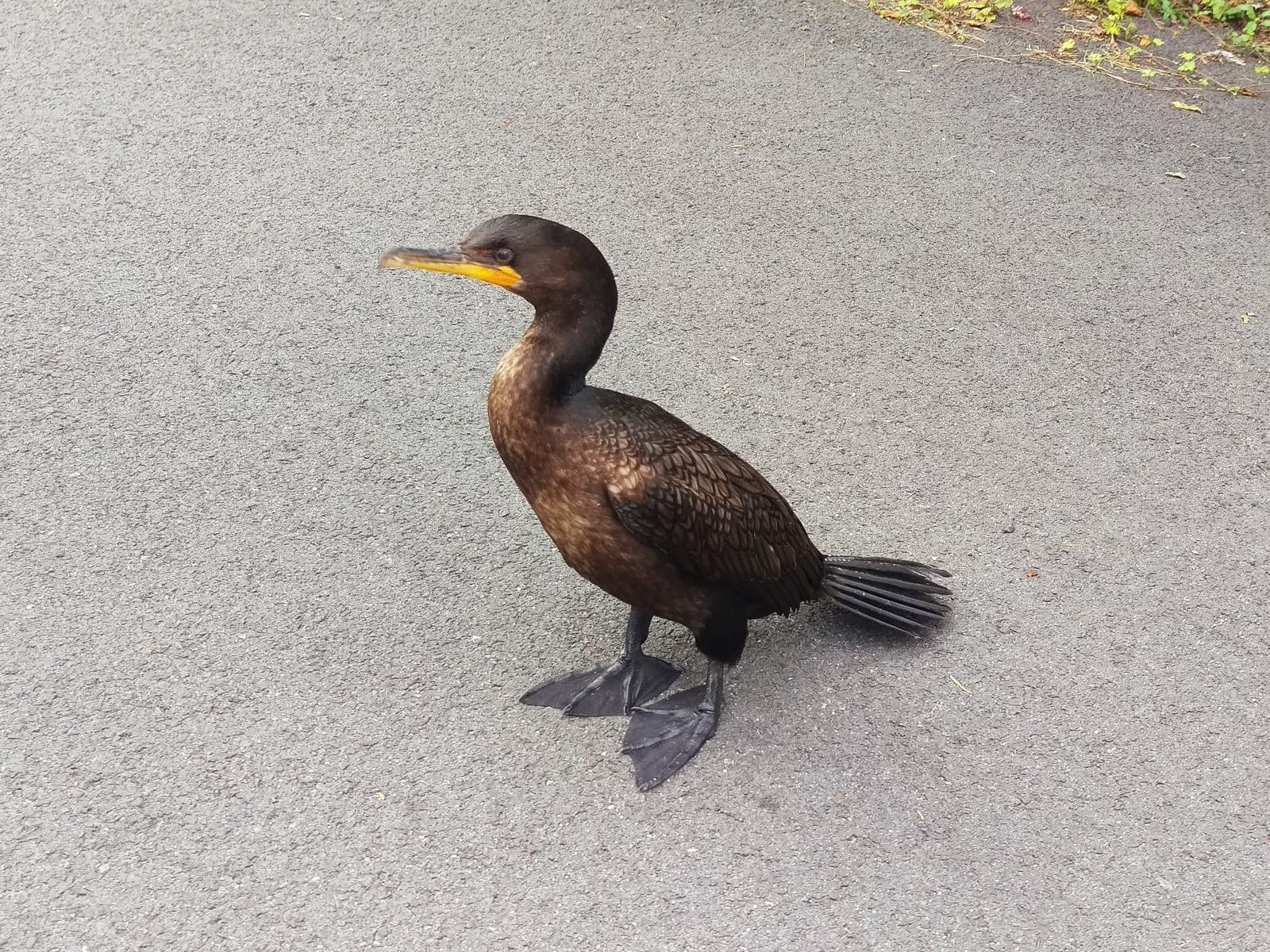
Double-crested Cormorant
Cormorants are all dark with orange-yellow skin at the base of a thin, hooked bill that they hold tilted upward, and they perch on posts and snags with their wings spread. Loons hold a straight bill level and come ashore only to nest.
Full comparison →Pacific Loon
Smaller, with a rounder head and a thinner bill. Breeding birds have a pale gray nape; winter birds show a neat, straight line between the dark back of the neck and the white throat rather than a jagged one.
Red-throated Loon
The smallest loon, with a thin bill that looks upturned. In summer it has a plain gray head and a dark red throat; in winter its back is speckled with fine white spots and its face is mostly white.
Yellow-billed Loon
Even bigger than a common loon, with a pale ivory bill that tilts slightly upward. It breeds in the Arctic and is rare south of Alaska and western Canada.
Range & habitat
Common loons breed across Alaska and Canada below the tundra and in the northern tier of the lower 48: northern New England and New York, Michigan, Wisconsin and Minnesota, and scattered lakes in the northern Rockies and Washington, as well as Greenland and Iceland. Minnesota has more breeding loons than any state except Alaska, an estimated 12,000 adults. In winter loons move to salt water along the Atlantic from Newfoundland to the Gulf of Mexico and along the Pacific from Alaska to Mexico, with some on large ice-free lakes and reservoirs inland. In Europe the same bird winters along the Atlantic coast as the great northern diver.
In summer loons need clear lakes big enough for a long running takeoff, with plenty of small fish and quiet islands, points or marsh mats where they can nest right at the waterline. Clear water matters because they hunt by sight. Their legs sit so far back on the body that they can barely walk, so they come ashore only to nest. In winter they live on shallow bays, sounds and nearshore ocean waters, and on the largest lakes and reservoirs that stay open.
Through the seasons
Spring
Loons arrive on breeding lakes soon after ice-out, usually in April or May, and big numbers rest on the Great Lakes and other open water along the way. Males defend territories with yodels, and pairs build a nest mound on an island or shoreline.
Summer
Eggs hatch after about four weeks, often in June or July. Chicks swim within a day, ride on a parent's back when small and are fed fish for weeks. By late summer, adults gather in loose social groups on bigger lakes.
Fall
Adults usually leave first, while juveniles stay on their home lake until near freeze-up and then head south on their own. Migrants stage on the Great Lakes and other large waters before reaching the coasts.
Winter
Loons spend the winter on salt water along both coasts in drab gray-and-white plumage. They replace their flight feathers all at once in late winter, leaving them flightless for a few weeks. Young birds stay on the ocean for their first two or three years.
How to find and watch common loons
On a northern lake, loons are easiest to find by ear at dawn and dusk; on the coast in winter, by scanning calm water beyond the surf with binoculars. Either way, watching without crowding them matters, because a loon pushed off its nest leaves the eggs exposed.
- Listen at dawn, at dusk and after dark in June and July for the long wail, the quavering tremolo and the male's rising yodel.
- Scan open water from shore or a dock; a loon can stay under for close to a minute and surface far from where it dove.
- Give nests and chicks room: the Loon Preservation Committee recommends staying at least 150 feet from a nest, and farther if a loon flattens its neck low over it.
- Back away at once if a loon gives repeated tremolos, rears up and runs across the surface, or calls with its neck stretched low over the water.
- Keep wakes down near shorelines and islands, where nests sit at the water's edge and can be swamped.
- Fish with lead-free sinkers and jigs, and never toss old tackle or line in the water or on shore.
- In winter, check jetties, inlets, harbors and calm bays along the Atlantic, Gulf and Pacific coasts.
Diet & life cycle
What it eats
Loons eat mostly fish, such as minnows, yellow perch and suckers, chased down underwater with powerful kicks of the feet. Before diving a loon often swims with its face in the water, peering for prey. Small fish are swallowed underwater; larger ones are brought to the surface. Loons also eat crayfish and other crustaceans, mollusks, aquatic insects, leeches and frogs, and swallow small pebbles from the bottom that help grind food, the habit that leads them to lost lead sinkers.
Life cycle
Pairs nest right at the waterline, building a mound of grasses, reeds and mud on an island, a marsh hummock or a floating nest platform, and often reuse the same site year after year. The usual clutch is two olive-brown, spotted eggs, which both parents incubate for 26 to 29 days. Chicks leave the nest within a day or two, can dive within a few days and often ride on a parent's back when small. Both parents feed them, and young loons can fly at about 10 to 13 weeks. Juveniles spend their first two or three years on the ocean, and most first breed at four to six years old.
Oldest on record
The oldest common loon in the USGS Bird Banding Laboratory's longevity table was a male banded as a chick in Michigan in July 1987 and identified alive from his color bands in Michigan in April 2021, making him at least 33 years 9 months old.
SourceAttracting & watching
Loons never visit yards, but lakeshore owners help them by leaving shoreline plants and fallen logs natural and by supporting floating nest platforms where lake associations and agencies run them. The best watching is from a quiet canoe, kayak or dock at dawn or dusk in June and July, or from shore with binoculars; in fall and winter, jetties and harbors on both coasts give close looks at gray winter birds. Minnesota's DNR, like several other agencies and lake groups, recruits volunteers to count loons on their lakes each summer.
Conservation
Least Concern (IUCN); state-listed in several states. Common loons are widespread, but they face real threats on their breeding lakes. Lead tackle is well documented: loons swallow lost sinkers along with the pebbles they eat for grit, or take jigs and fish with tackle attached, and the U.S. Fish and Wildlife Service says a single piece can kill a loon within two to four weeks. Minnesota's DNR reports that lead may account for up to half of the dead adult loons researchers find in some breeding areas, and New Hampshire and several other states restrict small lead sinkers and jigs. Mercury, shoreline development, boat wakes and human disturbance also cut nesting success. Michigan and New Hampshire list the loon as threatened, and New York lists it as a species of special concern.