How to identify a red-winged blackbird
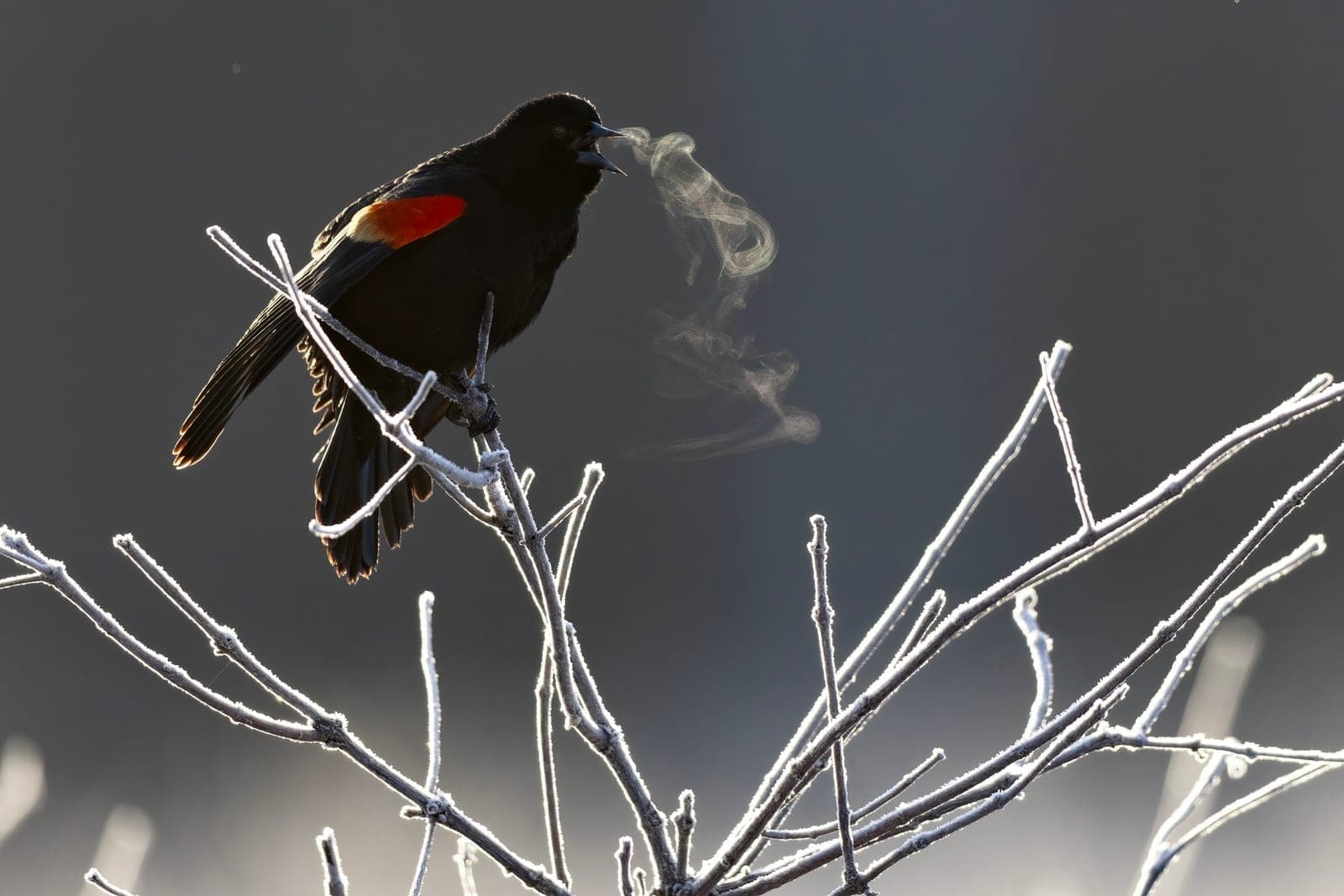
Adult males are glossy black with red shoulder patches, called epaulets, bordered by a yellow or buff stripe. When a male sings he flares the patches wide; at rest he can tuck them away so that only the pale border shows. Females look like a different species: dark brown and heavily streaked all over, with a pale eyebrow, a pale throat often tinged peach or pink, and a sharply pointed bill. Young males are a blotchy mix of brown and black with orange-red shoulders. In parts of central California, 'bicolored' males have all-red epaulets with no yellow border.
- Male: black with red shoulder patches edged in yellow
- Female: brown and heavily streaked, with a pale eyebrow
- Sharply pointed, conical black bill
- Gurgling 'conk-la-ree' song from cattails or fence posts
- Nests and sings in marshes, ditches and wet fields
Look-alikes
Tricolored Blackbird
Found mainly in California, male Tricolored Blackbirds have darker red epaulets bordered in white rather than yellow, and they nest in dense colonies. Females are darker overall and can be very hard to separate.
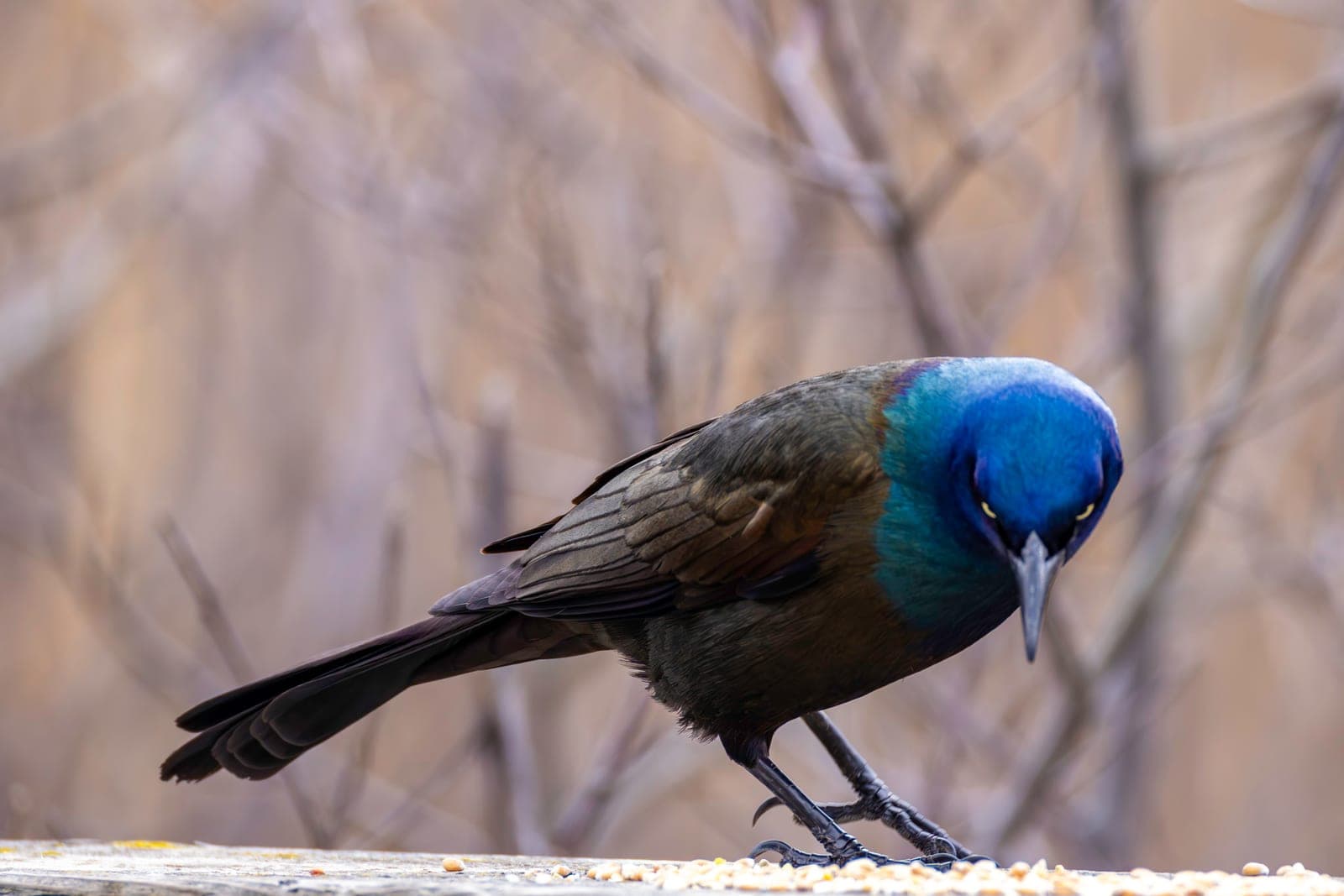
Common Grackle
Grackles are much larger and longer-tailed, with pale yellow eyes and an iridescent purple or bronze sheen, and they never show red shoulders. Both feed together in fall and winter flocks.
Full comparison →Brown-headed Cowbird
Male cowbirds are smaller, with a stubby bill and a brown head on a glossy black body. Female cowbirds are plain gray-brown without the heavy streaking of a female red-wing.
Song Sparrow
Female red-wings are often taken for big sparrows. Song Sparrows are smaller, with a stubbier bill, a long rounded tail and a gray-and-brown striped face; a female red-wing has a long, sharply pointed bill and streaks even on the back.
Range & habitat
Red-winged blackbirds nest from central Alaska and the Yukon east across Canada to the Atlantic provinces, through every one of the lower 48 states, and south through Mexico and Central America to northern Costa Rica. Birds in the southern and western United States are mostly year-round residents. Northern populations migrate to the southern states for winter, some Great Lakes birds traveling as far as 750 miles, and wintering birds gather by the millions in southern roosts.
Red-wings nest mostly in freshwater marshes, especially among cattails and bulrushes, but also in brushy swamps, wet meadows, roadside ditches, hayfields, weedy fields, farm ponds and the upper edges of salt marshes. They forage in open country such as fields, pastures, mudflats and lawns. In fall and winter, flocks spread across crop fields, feedlots and pastures and roost at night in marshes or dense thickets.
Through the seasons
Spring
Males arrive first, often in February or March across the North, and immediately start singing and flashing their epaulets from cattails and treetops. Females follow a few weeks later and choose nest sites inside the males' territories.
Summer
Nesting peaks from late April into July. Adults mob hawks, crows and people that come near nests, and males sometimes strike a walker's head. A single male may have several females nesting on his territory.
Fall
After nesting, red-wings join huge flocks of grackles, cowbirds and starlings that feed on waste grain and weed seeds. Northern birds migrate south from September into November.
Winter
Mixed blackbird roosts in the South can hold millions of birds; one near Milan, Tennessee, held about 11 million in the winter of 1975–76. Some red-wings stay north wherever they find open water and food.
How to find and attract red-winged blackbirds
From late winter through summer, almost any cattail marsh, wet ditch or pond edge will hold red-wings. Listen for the gurgling song and sharp 'check' calls, and look for males flaring their shoulders on the tallest perches. In fall and winter, scan farm fields and watch for big flocks moving to roosts at dusk.
- Visit marshes in March and April, when newly arrived males display constantly and sing from every cattail.
- Keep your distance from nests in summer; if adults dive at you, you are too close.
- Offer cracked corn, millet or sunflower seed on a platform feeder or the ground; red-wings also eat suet.
- Let cattails, sedges and other wetland plants grow around a pond or ditch to give them nesting habitat.
- At dusk in fall and winter, watch the sky over farm country for long streams of blackbirds heading to communal roosts.
Diet & life cycle
What it eats
Over a full year, red-wings eat mostly seeds: weed and grass seeds and waste grain make up roughly three-quarters of an adult's diet, along with some berries. In the breeding season they switch heavily to insects such as beetles, caterpillars and grasshoppers, plus spiders, millipedes and snails, and nestlings are fed mostly insects. Big fall flocks can damage ripening corn, rice, sunflower and sorghum.
Life cycle
A territorial male may have several females nesting on his patch of marsh, with a record of 15, and studies find that a quarter to a half of nestlings are fathered by males other than the territory holder. Each female builds her own nest, a bulky cup of grass, reeds and leaves lashed to cattails, sedges or shrubs, often low over water. She lays three or four pale blue-green eggs marked with black and brown and incubates them for 10 to 12 days. The young leave the nest at 11 to 14 days, and the female does most of the feeding. Most females raise one brood a season, some more.
Oldest on record
The oldest red-winged blackbird in the USGS Bird Banding Laboratory longevity table was a female at least 14 years and 11 months old. She was banded as an adult in Maryland in May 2010 and recaptured and released there in May 2023.
SourceAttracting & watching
Red-wings readily visit feeders, especially in early spring and in winter. Cracked corn, millet and sunflower on a platform or the ground draw them, and they can also cling to tube feeders and suet cages. Cattails and other marsh plants around a pond or retention basin provide nesting habitat. For the best show, visit a marsh at dawn in March or April, or watch a winter roost flight at sunset.
Conservation
Least Concern (IUCN). Red-winged blackbirds remain abundant, with a population Audubon puts around 180 million, but the Breeding Bird Survey shows a decline of about 0.6 percent a year from 1966 to 2019, roughly 28 percent overall, mostly in the United States. They are native and protected under the Migratory Bird Treaty Act, but because flocks damage crops, a federal depredation order allows them to be controlled where they are seriously damaging crops, after nonlethal methods are tried.