How to identify a song sparrow
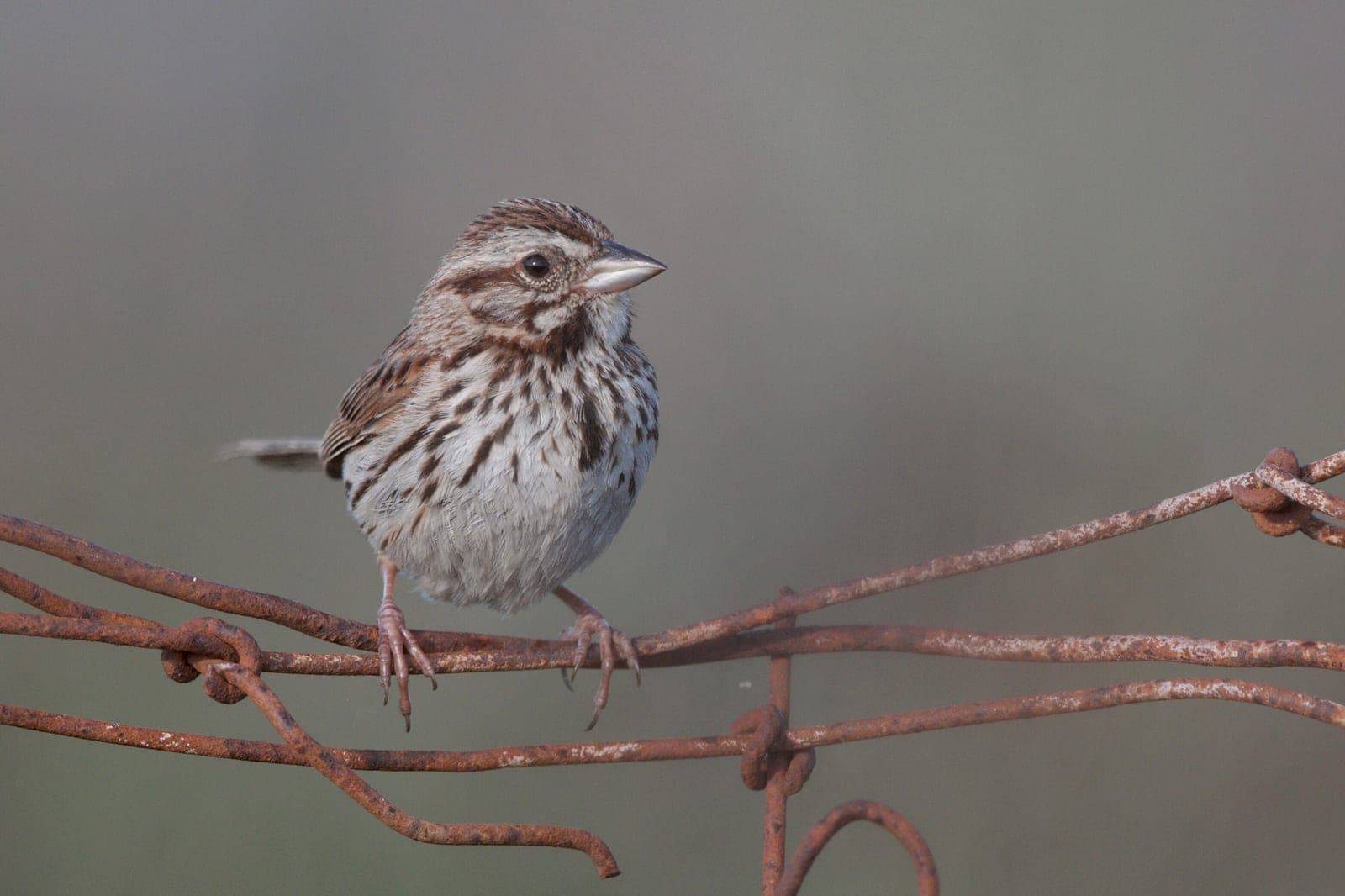
Song sparrows are warm brown and gray, with thick brown streaks on a whitish breast and flanks that usually run together into a dark spot in the center of the chest. The face is striped: a broad gray eyebrow, a brown stripe behind the eye and a dark stripe on each side of the throat, like a mustache. The tail is long and rounded, and in flight the bird pumps it up and down. Color and size change a lot across the range: rusty and medium-sized in the East, dark and sooty in the Pacific Northwest, pale and reddish in the desert Southwest, and large and gray with a long bill on the Aleutians. The heavy streaks, the central spot and the pumping tail stay constant.
- Heavy brown breast streaks that merge into a central spot
- Broad gray eyebrow and a dark stripe on each side of the throat
- Long, rounded tail pumped up and down in flight
- Song opens with a few clear notes, then a buzzy trill
- Usually feeds on the ground close to dense cover
Look-alikes
Savannah Sparrow
Savannah Sparrows have a shorter, notched tail, finer streaks and often a yellow wash above the eye, and they live in open fields and grasslands rather than thickets.
Lincoln's Sparrow
Lincoln's Sparrows are smaller and neater, with fine black streaks across a buffy breast band and a gray face. Their streaks rarely gather into a central spot, and they are shy migrants in most of the lower 48.
Fox Sparrow
Fox Sparrows are bigger and stockier, with heavy triangular spots crowding the breast and a reddish or dark tail. They scratch noisily in leaf litter and are mostly winter visitors in the lower 48.
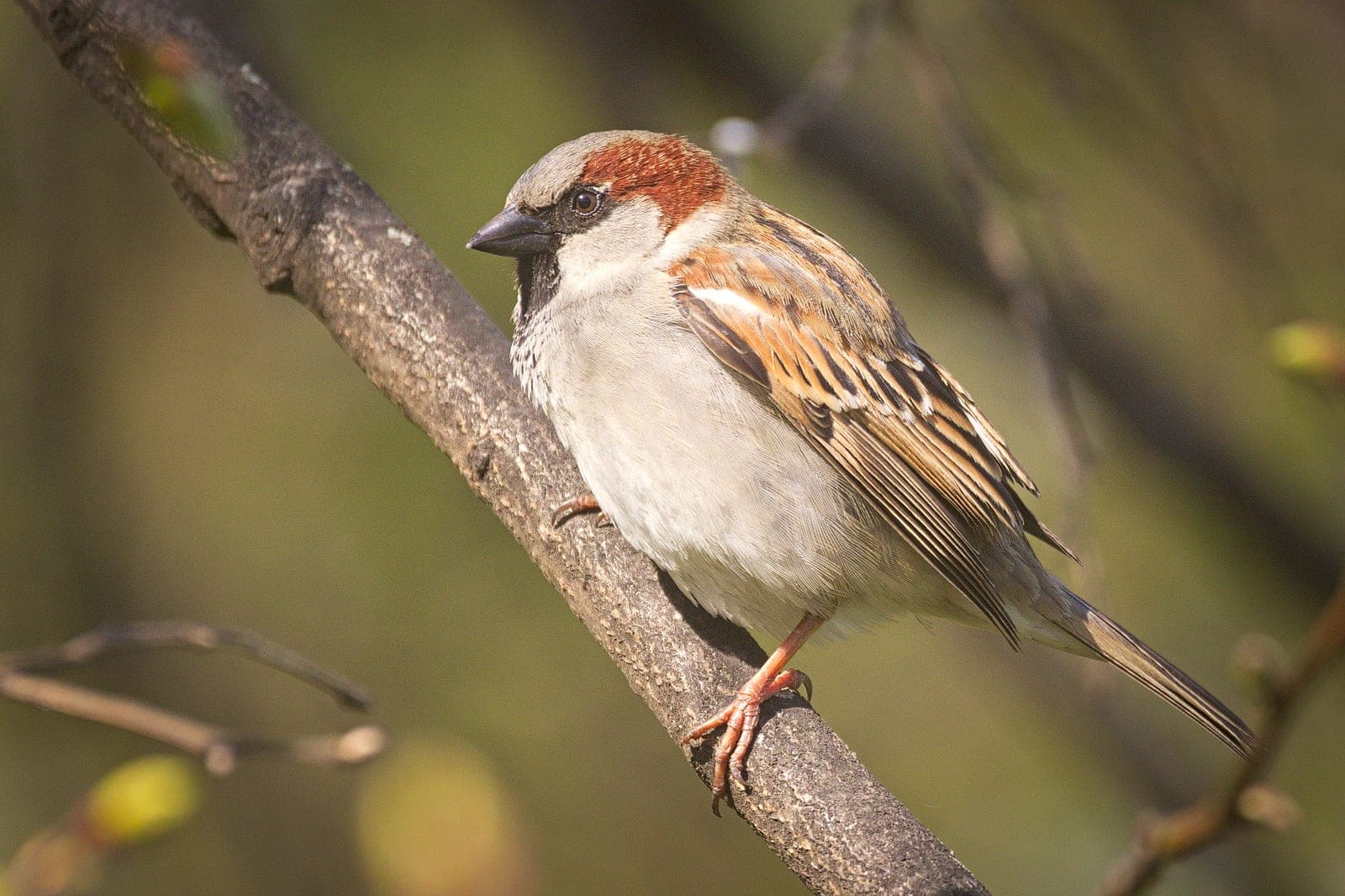
House Sparrow
Female House Sparrows have a plain, unstreaked breast, a buff eyebrow and a thicker bill, and they stay near buildings. A Song Sparrow is always heavily streaked below.
Full comparison →Range & habitat
Song sparrows breed across most of Canada and the United States, from the Aleutians and southern Alaska east to Newfoundland, south to the southern Appalachians and the central states and, in the West, into the highlands of central Mexico. Southern and coastal populations stay put all year. Birds from the northern interior migrate, wintering across the southern United States and into northern Mexico, so in much of the lower 48 a song sparrow can be found in every month.
Song sparrows want dense, low cover next to open ground or water: brushy fields, hedgerows, streamside willows, marsh edges, overgrown gardens, woodland borders and roadside ditches. Some coastal forms live in salt marshes, desert birds keep to thick streamside brush, and Aleutian birds use almost any low cover they can find. They avoid deep forest and wide-open grassland.
Through the seasons
Spring
Song sparrows are among the first birds to sing at winter's end, often by February in milder areas. Migrants return to northern breeding grounds in March and April, and males sing from exposed perches to claim small territories.
Summer
Females build nests on the ground or low in shrubs and usually raise two or three broods, more where the season is long. Brown-headed Cowbirds lay in many song sparrow nests. Juveniles are buffier, with finer streaks.
Fall
Northern birds move south from September into November and turn up in weedy fields and hedgerows far from where they nested. Some males sing again on mild, sunny fall days.
Winter
Residents and northern migrants mix across much of the United States. Song sparrows feed on seeds on the ground near thickets and under feeders, usually alone or loosely mixed in with other sparrows.
How to find and attract song sparrows
Listen first. Song sparrows sing for much of the year, and the song, a few clear opening notes followed by a trill and a jumble, carries from shrub tops, fence posts and cattails. Near a thicket, a soft 'pish-pish' sound (birders call it pishing) often brings one up for a look.
- Check brushy edges near water, such as streams, ponds, ditches and marshes, for a streaky bird singing from a low perch.
- Learn the call note, a nasal 'chimp', which gives away a hidden bird in winter.
- Leave a brush pile or an unmowed, shrubby corner; song sparrows feed and nest in dense, low cover.
- Scatter millet or mixed seed on the ground near shrubs, or use a low platform feeder.
- Plant native shrubs and seed plants such as dogwoods, viburnums, native grasses and asters, and skip fall cleanup in part of the yard.
- Keep cats indoors; ground-nesting sparrows are especially vulnerable to them.
Diet & life cycle
What it eats
Song sparrows eat a mix of insects and seeds. In summer they take beetles, caterpillars, grasshoppers, ants, wasps and spiders, and they feed their nestlings mostly insects. In fall and winter they rely heavily on grass and weed seeds plus some berries. Coastal and island birds also pick small crustaceans and mollusks from the shoreline. Most food is found on the ground, where the bird scratches through leaf litter or wades into very shallow water.
Life cycle
Males defend small territories, so good habitat can hold many pairs close together. The female builds an open cup of grass, weeds and bark strips, lined with fine grass, rootlets and hair, usually on the ground under a grass clump or low in a shrub. She lays three to five pale greenish eggs heavily spotted with reddish brown and incubates them for about 12 to 15 days. The young leave the nest 10 to 12 days after hatching and stay with their parents for about three more weeks. Much of what is known about songbird territories comes from this species: Margaret Morse Nice's eight-year study of banded song sparrows in Columbus, Ohio, published in 1937 and 1943, became a classic of ornithology.
Oldest on record
The oldest song sparrow in the USGS Bird Banding Laboratory longevity table was at least 11 years and 4 months old. It was banded in Colorado in October 1963 and recaptured and released there in October 1973.
SourceAttracting & watching
Song sparrows are ground feeders, so seed scattered under shrubs or on a low platform works better than a hanging tube. White millet, cracked corn and sunflower chips all draw them. Brush piles, hedges, a weedy fence line and a shallow ground-level birdbath make a yard far more inviting than feeders alone. They do not use nest boxes; dense shrubs and tall grass, ideally near water, are what they need to nest.
Conservation
Least Concern (IUCN). Song sparrows remain widespread and abundant, with a population Audubon puts at about 130 million, but the Breeding Bird Survey shows a slow decline of about 0.6 percent a year from 1966 to 2019, roughly 27 percent overall. Several California salt-marsh and island subspecies are state Species of Special Concern because of habitat loss, and one Alaskan island form has been wiped out. Song sparrows are protected under the Migratory Bird Treaty Act.