How to identify a european starling
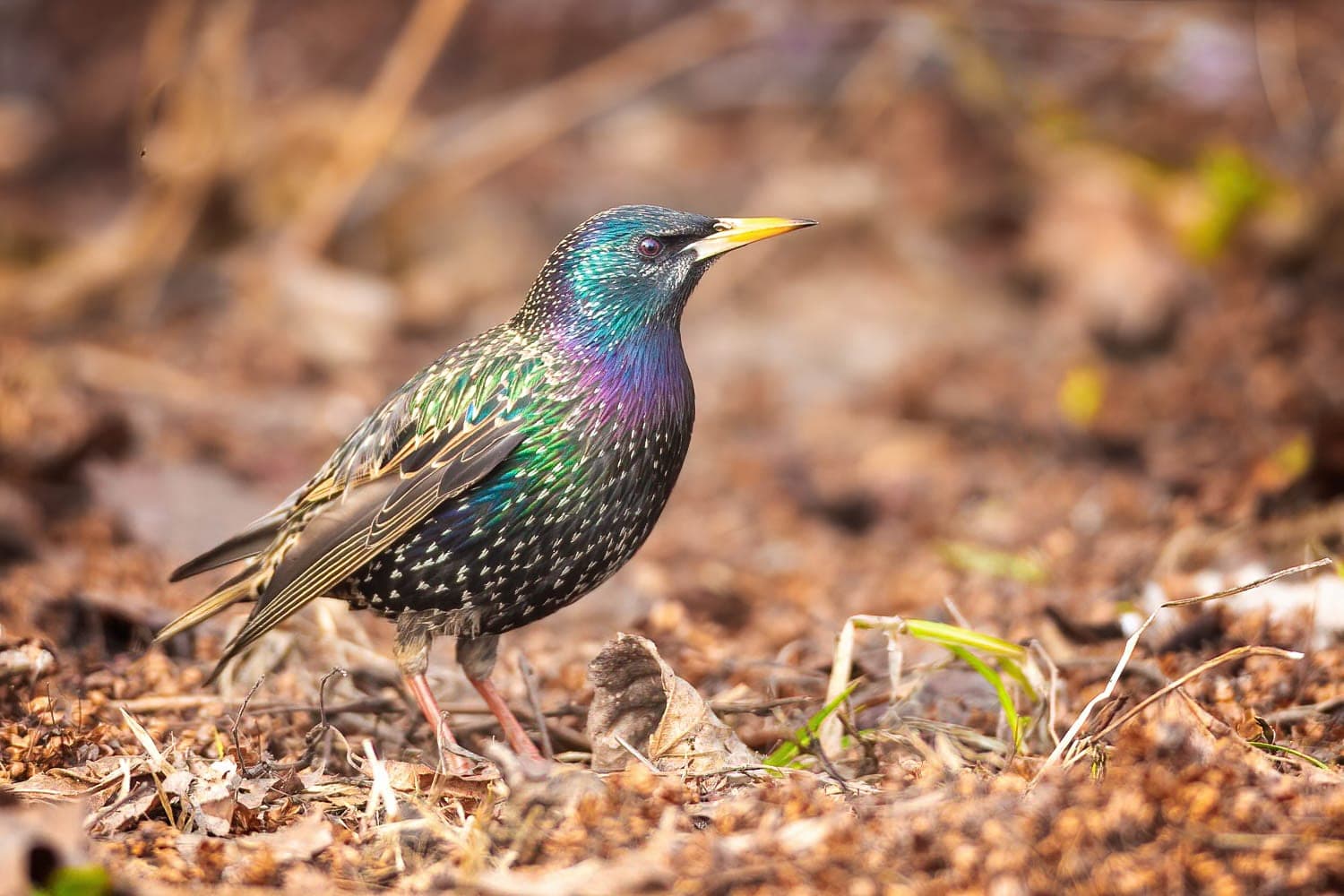
Starlings are about the size of a robin but chunkier, with a short, square tail, short pointed wings that form a triangle in flight, and a long, sharp, straight bill. In spring and summer adults are glossy black with purple and green iridescence and a lemon-yellow bill; the base of the lower bill is blue-gray on males and pinkish on females. After the late-summer molt, fresh feathers have white and buff tips, so fall birds are heavily spangled with white spots and the bill turns dark. The spots wear off over winter, leaving the bird glossy again by spring. Juveniles are plain gray-brown with a dark bill. Starlings walk with a brisk, waddling gait, probing the ground as they go.
- Short, square tail and triangular, pointed wings
- Long, sharp bill: yellow in breeding season, dark in winter
- Glossy purple-green black, spotted white in fall and winter
- Juveniles plain gray-brown with a dark bill
- Walks and probes in tight flocks on lawns and fields
Look-alikes
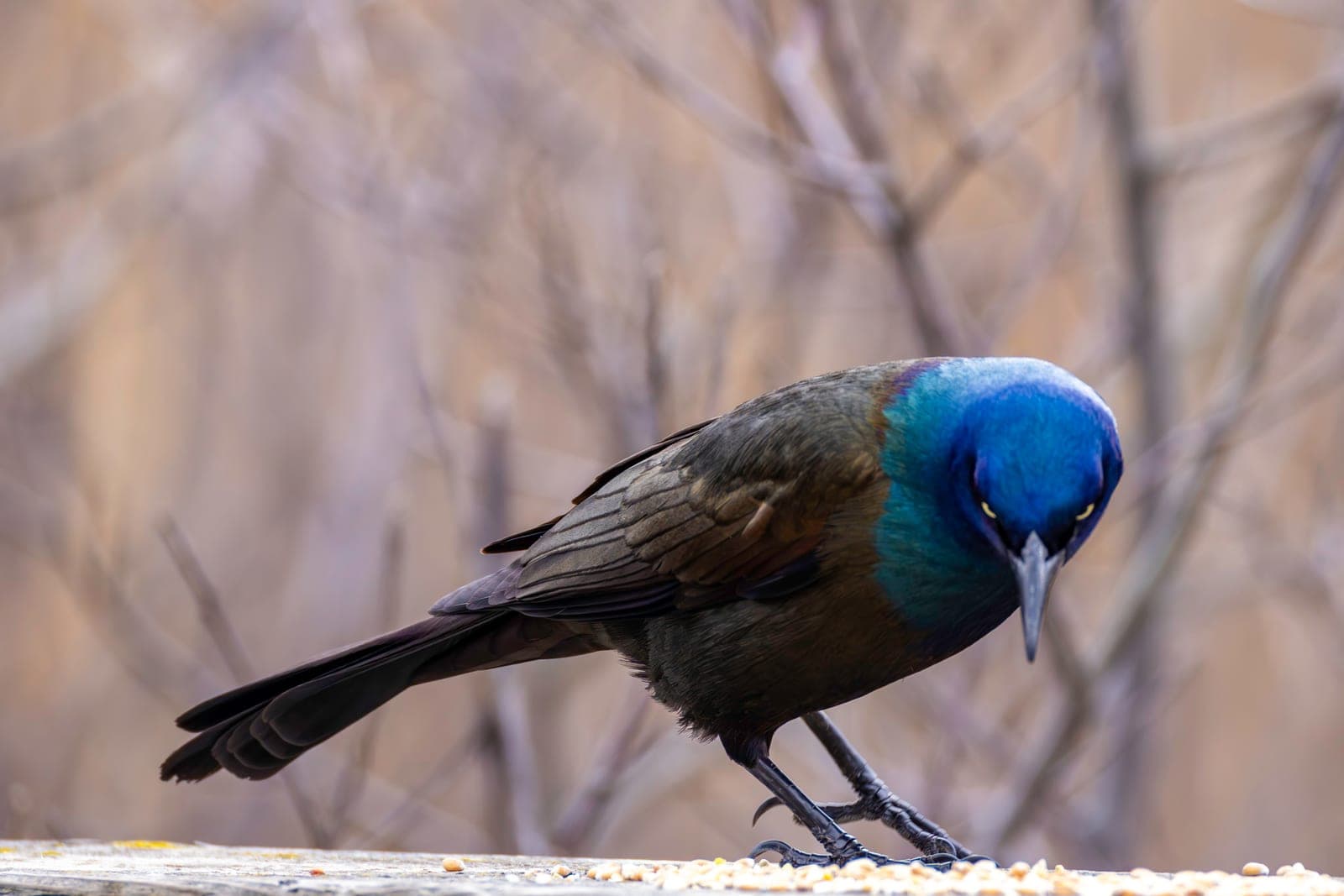
Common Grackle
Grackles are larger and lankier, with a long, keel-shaped tail, a pale yellow eye and a heavier, slightly curved bill. A starling has a short tail, dark eyes and never shows a long tail in flight.
Full comparison →Red-winged Blackbird
Male red-wings are matte black with red and yellow shoulder patches and a longer, rounded tail. Starlings are glossy, short-tailed and have a long, yellow or dark spike of a bill.
Brown-headed Cowbird
Male cowbirds have a brown head on a black body and a short, thick, finch-like bill. Juvenile starlings are uniformly gray-brown with a long, slender bill.
Purple Martin
In flight, both show pointed, triangular wings, but martins glide and swoop after insects high in the air with a forked tail, while starling flocks fly fast and direct with rapid wingbeats.
Range & habitat
Starlings are native to Europe and western Asia and have been introduced to North America, Australia, New Zealand, South Africa, Argentina and elsewhere. In North America they now live from southern Alaska and southern Canada across all of the lower 48 states to northern Mexico, and they are absent mainly from the far North and large tracts of unbroken forest or desert. Northern birds leave much of Canada in winter and move south, while populations farther south stay put. The current population descends from releases in Central Park in 1890 and 1891 after several earlier attempts in the 1870s failed.
Starlings thrive wherever people have opened the land: cities, suburbs, farms, feedlots, landfills, golf courses and pastures with short grass for probing. They need cavities for nesting and readily use holes in trees, buildings, streetlights, cactus and nest boxes. They are scarce in large stretches of wild forest, scrub and desert, but will settle around any building or town in the middle of such country.
Through the seasons
Spring
Males claim cavities early, often before native cavity nesters return, and sing long, wheezing, clicking songs while flapping their wings at the entrance to attract a mate. Breeding birds wear glossy black plumage and bright yellow bills.
Summer
Most pairs raise two broods. By early summer, flocks of plain gray-brown juveniles roam lawns and fields, and adults molt into fresh, white-spotted plumage by late summer.
Fall
Starlings gather in large flocks to feed on fruit, grain and insects, and at dusk they assemble into swirling clouds called murmurations before dropping into communal roosts.
Winter
Northern birds shift south, and huge roosts form in city centers, woodlots and marshes, sometimes holding enormous numbers. Flocks feed at feedlots, landfills and backyard suet feeders, and their bills turn dark until spring.
How to find and watch European starlings
Starlings are easy to find in almost any town or farm field. The rewarding part is watching their winter murmurations and listening for their mimicry; the practical part, for anyone with bird feeders or nest boxes, is keeping them from crowding out native birds.
- Watch for murmurations at dusk from late fall through winter over marshes, river bottoms and city roosts.
- Listen to a singing male: starlings mix whistles, rattles and clicks with near-perfect imitations of other birds, such as killdeer, meadowlarks and hawks, and of man-made noises.
- Learn the flight shape, short tail and pointed triangular wings, which separates starlings from blackbirds at a distance.
- Protect native cavity nesters by using bluebird boxes with entrances no larger than 1 1/2 to 1 9/16 inches, which keep out nearly all starlings.
- Use upside-down suet feeders, tube feeders with short perches, and avoid bread and cracked corn to keep flocks off backyard feeders.
- Avoid breathing dust where droppings pile up under large roosts; it can carry the fungus that causes histoplasmosis.
Diet & life cycle
What it eats
Starlings are omnivores. When insects are available they eat mostly beetles and their grubs, grasshoppers, flies, caterpillars, spiders, snails and earthworms, which they find by thrusting the bill into soil or turf and then forcing it open to pry a gap. Young are fed mostly insects. In fall and winter they turn to berries, fruit, grain, seeds, livestock feed and garbage, and they visit feeders for suet. Large flocks can damage cherries, grapes and other fruit crops and eat feed meant for cattle.
Life cycle
The male picks a cavity, starts a messy nest of grass, twigs, leaves, feathers and trash, and sings to attract a female, who often tosses out some of his material and finishes the job. She lays four to six pale bluish or greenish eggs, and both parents incubate, the female doing more, for about 12 days. Nestlings leave about three weeks after hatching and are fed for a week or two more. Pairs usually raise two broods, and some females lay eggs in other starlings' nests. Survival is low: only a small share of nestlings reach breeding age, and most adults live just a few years.
Oldest on record
The oldest European starling in the USGS Bird Banding Laboratory longevity table was a male at least 15 years and 3 months old. He was banded as an adult in Tennessee in February 1958 and found dead in a building or enclosure in Tennessee in 1972.
SourceAttracting & watching
Most backyard birders work to discourage starlings rather than attract them, mainly by choosing feeders and nest-box entrances they cannot use. They are still worth watching: a winter murmuration of thousands of birds turning in unison at sunset is one of the great bird spectacles, and a male's medley of borrowed sounds rewards a close listen.
Conservation
Least Concern (IUCN). Starlings are an invasive species in North America and are among the 100 worst invasives on an IUCN list. As a nonnative bird they are not protected under the Migratory Bird Treaty Act, though state and local laws can still apply. They take nest cavities from bluebirds, woodpeckers, swallows and purple martins, and U.S. crop damage has been estimated at around $800 million a year. Yet numbers are falling: North American breeding starlings dropped from about 166 million in 1970 to about 85 million, and the species has declined sharply in parts of its native Europe, including Britain.