How to identify a baltimore oriole
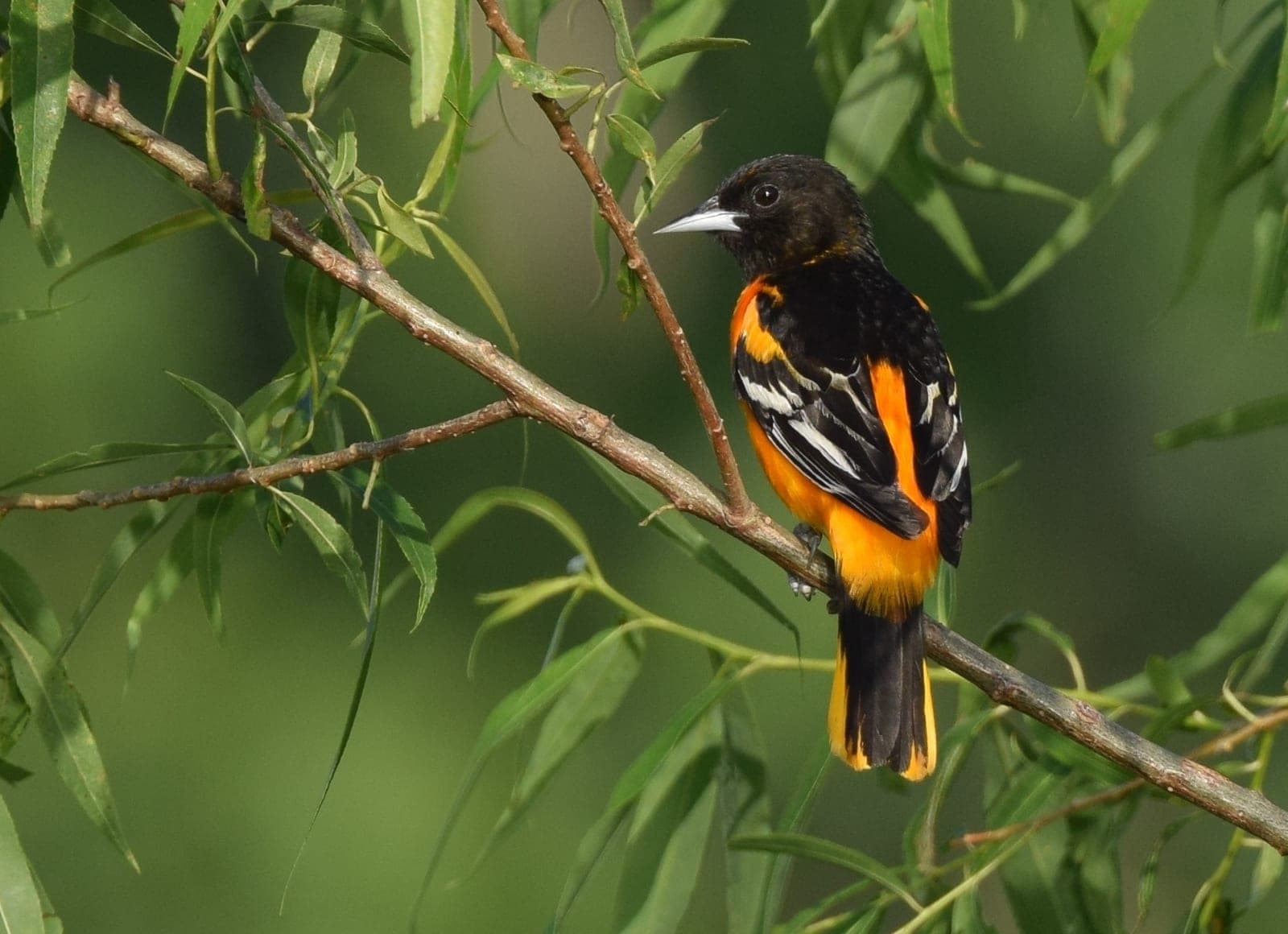
Baltimore Orioles are robin-shaped but slimmer, with a fairly long tail and a straight, sharply pointed bill. The adult male is a blaze of orange on the breast, belly, shoulder and rump, with a solid black hood, black back and black wings crossed by white wing bars. The shade of orange varies from deep, almost red-orange to yellowish orange. Females and young birds are brownish above and dull yellow-orange below, with two white wing bars and a variable amount of black on the head and throat. Young males keep a female-like look until the fall of their second year. Most people hear them first: a short phrase of rich, clear whistles, plus a dry chatter when the birds are agitated.
- Adult male: bright orange body with a fully black hood and back
- White wing bars on dark wings in every plumage
- Sharp, straight, pointed bill, not a cone like a finch's
- Female: dull orange-yellow below with white wing bars
- Loud whistled song from high in leafy trees
Look-alikes
Orchard Oriole
Orchard Orioles are smaller and shorter-tailed. Adult males are a dark brick-chestnut instead of flaming orange, and females are greenish-yellow with no orange tint, where a female Baltimore is usually warm orange-yellow below.
Bullock's Oriole
The western cousin. A male Bullock's has an orange face with a black line through the eye and a small black throat patch, plus a big white wing patch. The two meet and hybridize on the Great Plains, so in-between birds turn up there.
American Robin
Robins are bigger thrushes with a brick-red breast, a gray-brown back and a yellow bill, and they feed on lawns. An oriole is orange and black, has white wing bars, and stays up in the trees.
Range & habitat
Baltimore Orioles breed from the Canadian Prairies and eastern Montana east through southern Ontario, southern Quebec and New Brunswick, and south through the eastern United States to roughly central Mississippi, Alabama and northern Georgia. They winter mainly from southern Mexico through Central America into northern South America, and in the Caribbean. A small number stay through winter along the southeastern U.S. coast and in Florida, often at feeders. On the Great Plains their range meets that of Bullock's Oriole.
This is a bird of open, leafy woodland and edges rather than deep forest. Look in tall deciduous trees along rivers, in farm woodlots, parks, orchards, cemeteries and older neighborhoods with big shade trees. Elms were a favorite nesting tree, and cottonwoods, maples, willows and apple trees are used widely. In the tropics in winter they feed in flowering canopy trees, forest edges and shade-coffee plantations.
Through the seasons
Spring
Orioles return from the tropics in late April and May, and males announce themselves at once with loud whistles from the treetops. This is the best time to put out oranges and jelly, before natural food is plentiful.
Summer
Females weave their hanging nests and both parents feed the young, mostly on caterpillars. Families often visit feeders in midsummer. Fall migration starts surprisingly early, and many adults head south in July and August.
Fall
By September most Baltimore Orioles have left the North. Once the leaves drop, their empty pouch nests show up at the ends of branches, which is a good way to find next year's territories.
Winter
Most of the population winters from Mexico to northern South America, eating fruit, nectar and insects. A few stragglers winter in the Southeast, and some of them survive on backyard feeders.
How to find and attract Baltimore Orioles
Orioles spend most of their time high in leafy trees, so ears find them before eyes do. To bring them down to eye level, offer the sweet foods they love in spring, when the first migrants arrive hungry.
- Put out orange halves on a spike or platform as soon as orioles return in spring.
- Offer a small dish of grape jelly, and refresh it often so it stays clean.
- Hang an orange oriole nectar feeder with large perches; it uses the same sugar water as hummingbird feeders.
- Plant fruit they favor, such as mulberries, cherries and grapes; orioles pick the darkest, ripest fruit.
- Leave caterpillars alone where you can: they are the main food for oriole nestlings.
- Learn the song, a short run of clear, fluting whistles, and scan treetops along rivers and parks.
- After leaf fall, look for old pouch nests near branch tips to see where orioles nested.
Diet & life cycle
What it eats
In summer Baltimore Orioles eat mostly insects gleaned from leaves high in trees, especially caterpillars. They even take hairy forest tent caterpillars that many birds avoid, beating them against a branch to strip off the hairs. Beetles, grasshoppers, wasps, true bugs, spiders and snails round out the menu. They also eat ripe fruit and sip nectar, and they 'gape' soft fruit by stabbing in the closed bill and prying it open to lap the juice.
Life cycle
Males sing to hold territories and court females by bowing deeply with the tail fanned and wings half open. The female weaves the nest: a deep, hanging pouch of plant fibers, bark strips, grass, hair and sometimes string, tied by its rim to a slender, drooping branch, usually 20 to 30 feet up. She lays four or five eggs, sometimes three to six, which are pale bluish-white to gray with dark scrawls. She incubates them for about 12 to 14 days, and both parents feed the nestlings, which leave the nest about two weeks after hatching.
Oldest on record
The oldest Baltimore Oriole in the USGS Bird Banding Laboratory longevity table was a male at least 12 years old. He was banded in Minnesota in July 1996 and was found in Minnesota in 2007, after being caught by a bird of prey.
SourceAttracting & watching
Orange halves, grape jelly and an oriole nectar feeder are the classic trio, best put out in late April or May and kept clean. Fruiting trees and vines such as mulberry, cherry and grape help through summer, and tall shade trees give them nest sites. Watch for them along wooded rivers and in parks on spring mornings, when males sing hardest. Like other songbirds, orioles are protected under the Migratory Bird Treaty Act.
Conservation
Least Concern (IUCN). Baltimore Orioles are still widespread and common, with roughly 12 million birds, but the Breeding Bird Survey shows long-term declines, steepest in the northern and eastern parts of the range, where numbers fell by more than 1.5 percent a year from 1966 to 2015. Dutch elm disease, which killed many of the American elms they once nested in, is one likely factor.