How to identify a western meadowlark
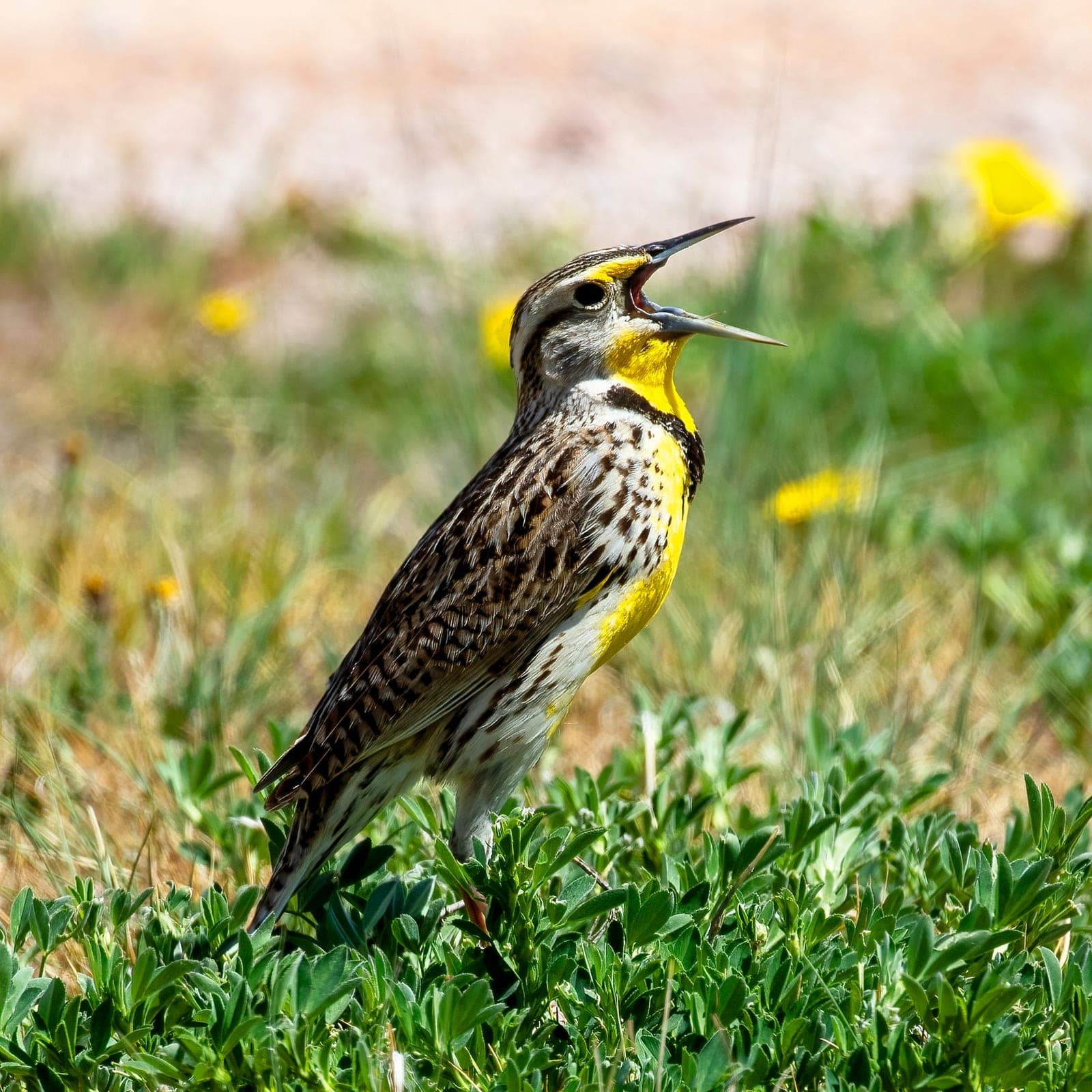
Meadowlarks are chunky, short-tailed birds about the size of a robin, with a long, sharply pointed bill. The back and wings are streaked brown, buff and black, which hides a sitting bird well in dry grass. When it turns, the underparts blaze lemon-yellow from throat to belly, crossed by a bold black V on the chest; in fall the V is partly veiled by pale feather tips. The crown and face are striped dark and pale. In flight, look for white outer tail feathers, flashing most on takeoff and landing, and a pattern of quick, stiff wingbeats broken by short glides. Western and Eastern meadowlarks look nearly identical, so the song is the surest mark: the Western's is a rich, flute-like jumble of bubbling notes that usually tumbles down the scale.
- Bright yellow underparts with a black V across the chest
- Streaky brown back, chunky body and short tail
- White outer tail feathers flash in flight
- Long, pointed bill; often sings from a fence post
- Gurgling, flute-like song and a low 'chuck' call
Look-alikes
Eastern Meadowlark
Almost identical in plumage. The Eastern sings a few clear, slurred, plaintive whistles instead of a bubbling jumble, and its call is a buzzy rattle rather than a low 'chuck.' Where both occur, Easterns tend to use taller, wetter grass.
Chihuahuan Meadowlark
A desert-grassland meadowlark of the Southwest, formerly lumped with the Eastern. It shows more white in the tail than a Western and sings simple whistles like an Eastern, not the Western's gurgling song.
Dickcissel
Dickcissels share the yellow breast and black bib, but they are sparrow-sized, with a thick, seed-cracking bill, a rusty shoulder patch and no white in the tail. Their song is a dry, repeated 'dick-dick-ciss-ciss.'
Range & habitat
Western Meadowlarks breed across western and central North America, from interior British Columbia and the Canadian Prairies south to northern Mexico, and east across the Great Plains toward the western Great Lakes. Birds in the northern part of the range migrate south for the winter, while southern birds stay all year. The winter range reaches into central Mexico and spreads east across the southern Plains and Gulf states.
Meadowlarks need open ground with grass: native prairie, sagebrush edges, rangeland, pastures, hayfields, weedy fallow fields and roadsides. Where they overlap with Eastern Meadowlarks in the Midwest, Westerns favor shorter, drier grass. In winter they gather in loose flocks on stubble fields, pastures and other farmland. They avoid forest and dense brush.
Through the seasons
Spring
Meadowlarks move north early, and males are singing from posts and wires on prairies and ranchland by early spring. In dry parts of the West, the number of birds that settle to breed depends on spring rain.
Summer
Females nest in thick grass and often raise two broods. Young birds leave the nest before they can fly and hide in the grass, so late haying and careful mowing matter most now.
Fall
Meadowlarks migrate relatively late in fall. Fresh plumage softens the black V, the birds turn more to seeds and waste grain, and loose flocks form in fields and along roadsides.
Winter
Northern birds have moved south, and wintering flocks walk stubble fields and pastures from the central and southern Plains into Mexico. They flush with a flash of white tail feathers and a 'chuck' call.
How to find and attract Western Meadowlarks
Meadowlarks are birds of big, open grassland, not backyards, and they rarely visit feeders. Your best bet is a slow spring drive or walk through prairie and ranch country early in the morning, listening as much as looking.
- Drive back roads through grassland, pasture or rangeland in April through June and scan every fence post and wire.
- Go at dawn, when males sing most; learn the bubbling song and the low 'chuck' call.
- Watch for white tail flashes as birds flush from the grass ahead of you.
- If you own grassland, delay mowing or haying until nesting is done; mowers destroy nests and flightless young.
- Leave patches of native grass unmowed through summer to give females safe nesting cover.
- Stay on roads and trails during nesting season; nests on the ground are easy to step on.
Diet & life cycle
What it eats
Western Meadowlarks forage by walking on the ground, often probing the soil with the bill. In summer most of the diet is insects, including beetles, grasshoppers, crickets, caterpillars, ants and true bugs, plus spiders, snails and sowbugs. Seeds and waste grain make up about a third of the yearly diet and matter most in fall and winter.
Life cycle
Males sing to claim territories, and some males have more than one mate. In display, the male puffs his chest, points his bill straight up to show off the black V, fans his tail and flicks his wings. The female builds the nest in a small hollow in dense grass, weaving grass stems into a dome with a side entrance, often reached by little runways. She lays three to seven eggs, usually about five, white with brown and purple spots, and incubates them for 13 to 15 days. The young leave the nest at about 10 to 12 days, before they can fly well, and the parents keep feeding them for about two more weeks. Two broods a year are common.
Oldest on record
The oldest Western Meadowlark in the USGS Bird Banding Laboratory longevity table was at least 6 years and 6 months old. It was banded in Colorado in March 1960 and found dead in Colorado in December 1965.
SourceAttracting & watching
Meadowlarks do not come to feeders or nest boxes, so watching them means visiting grassland. Spring mornings on prairie, ranchland and quiet farm roads are best, when males sing from posts. Landowners help most by keeping native grass and putting off mowing until young birds can fly. Meadowlarks are protected under the Migratory Bird Treaty Act.
Conservation
Least Concern (IUCN). Western Meadowlarks are still numerous, at roughly 100 million birds, but their breeding numbers fell about 0.9 percent a year from 1966 to 2019, a cumulative drop of about 37 percent according to the North American Breeding Bird Survey. Loss and conversion of grassland, and mowing during the nesting season, are the main pressures.