How to identify a pileated woodpecker
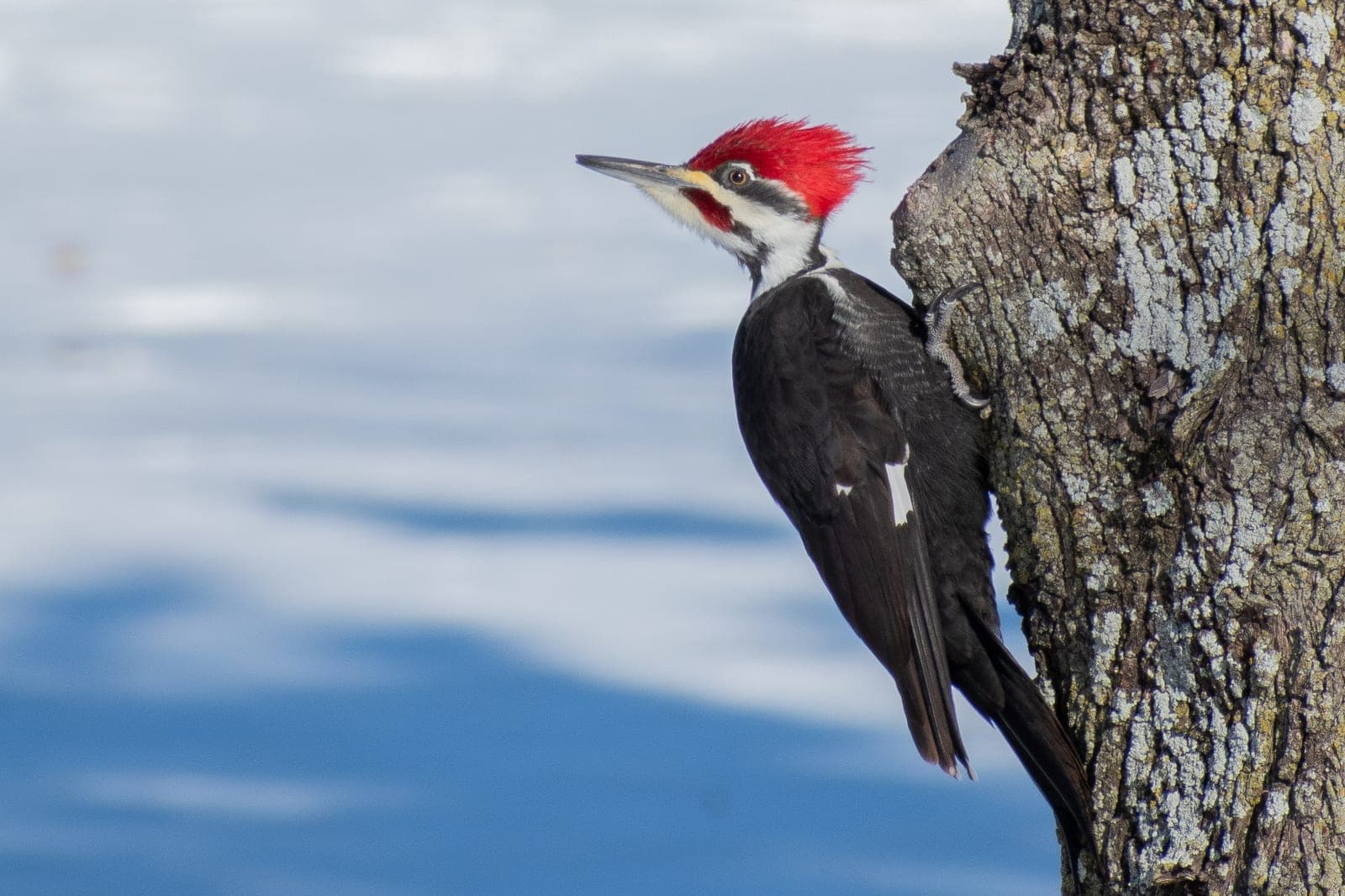
Nothing else in most of North America looks like it. The pileated is mostly black, with a tall, pointed red crest, a white line through the face and a white stripe that runs from the bill down the side of the neck. In flight its broad black wings flash large white patches underneath, and it flies with deep, strong flaps that recall a crow more than a typical bounding woodpecker. Males have a red forehead and a red mustache stripe; females have a dark forehead and a black mustache. The bill is long, dark and chisel-shaped.
- Crow-sized and mostly black
- Tall, pointed red crest
- White stripe from the face down the side of the neck
- Large white patches under the wings in flight
- Red mustache on males, black on females
- Big rectangular or oval holes chopped into dead wood
Look-alikes
Ivory-billed Woodpecker
The ivory-bill of the Southeast's old bottomland forests and of Cuba was slightly larger, with a pale ivory bill, white trailing edges on the wings and a white patch on the lower back when perched. It has not been confirmed to most experts' satisfaction in decades, and the U.S. Fish and Wildlife Service has proposed declaring it extinct.
American Crow
A pileated crossing above the canopy can pass for a crow at a distance. A crow is all black with no white in the wings and no crest, while a pileated shows bright white underwing patches with every flap.
Range & habitat
Pileated woodpeckers live year-round across the eastern United States, from Florida and East Texas north to the Great Lakes and New England, and across the forested belt of southern and central Canada to British Columbia. In the West, a separate population extends from British Columbia south through the Pacific Northwest and down the Pacific Coast into central California. They are absent from the Great Plains and most of the dry interior West. Pairs do not migrate, though individual birds occasionally wander far from their usual haunts.
Pileateds need big trees. They favor mature deciduous and mixed forests and older conifer stands, especially those with plenty of large dead trees, stumps and fallen logs. They have adapted well to second-growth forest and to fragmented woodlots and wooded suburbs, as long as some large trees remain for nesting and feeding.
Through the seasons
Spring
Pairs, which hold territories year-round and usually stay together for life, court with drumming, bill-waving and loud calls. The male does most of the work on a fresh nest cavity in a dead tree, starting in early spring.
Summer
Eggs hatch after roughly two to two and a half weeks of incubation. The young leave the nest at about 26 to 28 days, then may stay with their parents for up to two or three months before striking out on their own.
Fall
Young birds disperse to find territories of their own, while adult pairs stay on their home ground. Pileateds eat more wild fruit and nuts in fall, including the berries of poison ivy.
Winter
Carpenter ant colonies hidden deep inside trunks and logs remain the main food, and pileateds chop big holes to reach them. Piles of large fresh chips at the base of a tree, and long dark holes above them, show where one has been working.
How to find and attract pileated woodpeckers
Pileateds are big but wary, and they cover a lot of ground, so it pays to find their sign and learn their voice before trying to spot the bird itself.
- Listen for a loud, wild series of 'wuk' notes that rises and then falls, and for a slow, deep drum that lasts a few seconds and carries a long way.
- Look for fresh rectangular or oval holes and piles of big wood chips at the base of dead trees and stumps.
- Walk mature woods with large snags and fallen logs, and sit quietly near fresh excavations, where a bird may return to keep working.
- Hang suet in a large cage or tail-prop feeder on a tree trunk near woodland; pileateds visit yards with big trees nearby.
- Leave large dead trees and logs on your land where they are safe; they are both the pileated's pantry and its nest site.
- In flight, watch for a crow-sized black bird flashing white under the wings.
Diet & life cycle
What it eats
Carpenter ants are the pileated's main food and can make up as much as 60 percent of the diet. It also eats other ants, termites, wood-boring beetle larvae and other insects, which it reaches by probing, prying and chiseling into dead wood, sometimes ripping apart whole stumps and sections of fallen logs. Roughly a quarter of the diet is wild fruit, berries and nuts.
Life cycle
Pairs hold territories year-round and usually mate for life. Each year they dig a new nest cavity, mostly the male's work, usually 15 to 80 feet up in a dead tree or a dead branch of a live one, and sometimes in a utility pole. The chamber is lined only with wood chips. The female lays three to five white eggs, and both parents incubate for roughly two to two and a half weeks, with the male taking the night shift. The young fledge at about 26 to 28 days and may stay with their parents for two to three months.
Oldest on record
The oldest pileated woodpecker in the USGS Bird Banding Laboratory longevity list was a male at least 12 years and 11 months old. He was banded as an adult in Maryland in 1979 and recaptured and released there in 1991.
SourceAttracting & watching
Suet is the one feeder food pileateds reliably take. Hang it in a sturdy cage or a feeder with a tail prop against a trunk, since this big bird braces on its stiff tail while it feeds. Yards bordering mature woods have the best chance. Away from feeders, the best viewing is in older forest with plenty of dead wood, listening for calls and the heavy thud of excavation.
Conservation
Least Concern (IUCN). Clearing of eastern forests in the 1700s and 1800s caused a steep decline. As forests regrew through the 20th century, pileateds recovered and learned to use second-growth woods, and Breeding Bird Survey data show increases since 1966. Partners in Flight estimates about 2.6 million birds. They remain dependent on large dead trees for nesting and foraging, and they are protected under the Migratory Bird Treaty Act.