How to identify a golden eagle
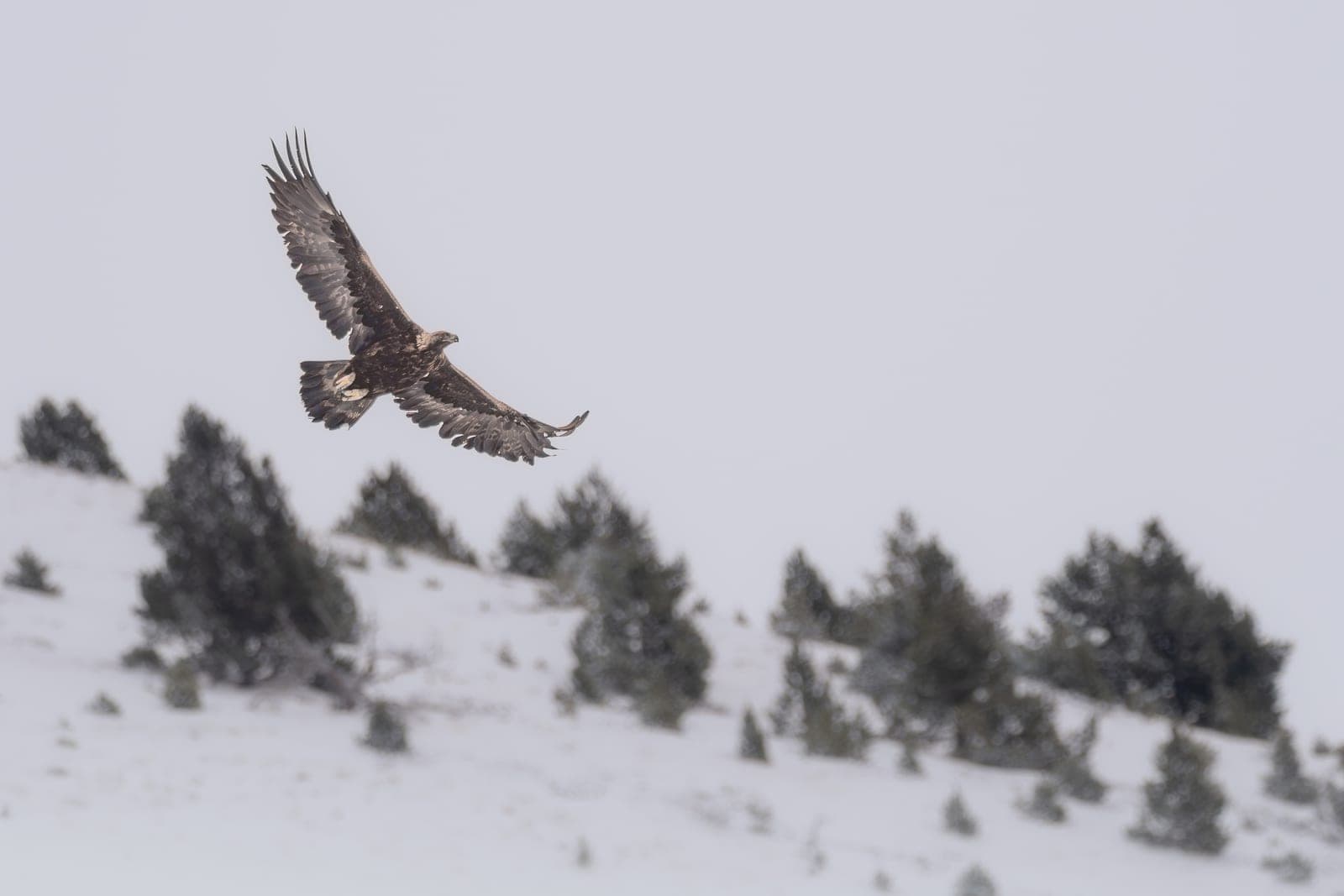
Adult Golden Eagles are dark brown all over, with a wash of tawny gold on the back of the crown and nape that gives the bird its name, grayish areas on the inner wing and a faintly banded tail. Unlike a Bald Eagle's, the legs are feathered all the way to the toes, and those leg feathers are often paler than the body. In flight the head looks small and the tail fairly long — the tail is two to three times the length of the projecting head — and the bill is noticeably smaller than a Bald Eagle's. Juveniles are darker than adults and often show clean white patches at the base of the inner flight feathers, plus a tail that is white for about two-thirds of its length and ends in a broad black band. The white fades over several molts, and full adult plumage arrives at about five and a half to six and a half years.
- Golden-tawny nape and crown on a dark brown body
- Legs feathered all the way to the toes
- Small head and fairly long tail in flight
- Juveniles: sharply defined white wing patches and a white tail with a dark band
- Smaller bill than a Bald Eagle's, dark at the tip
Look-alikes
Bald Eagle
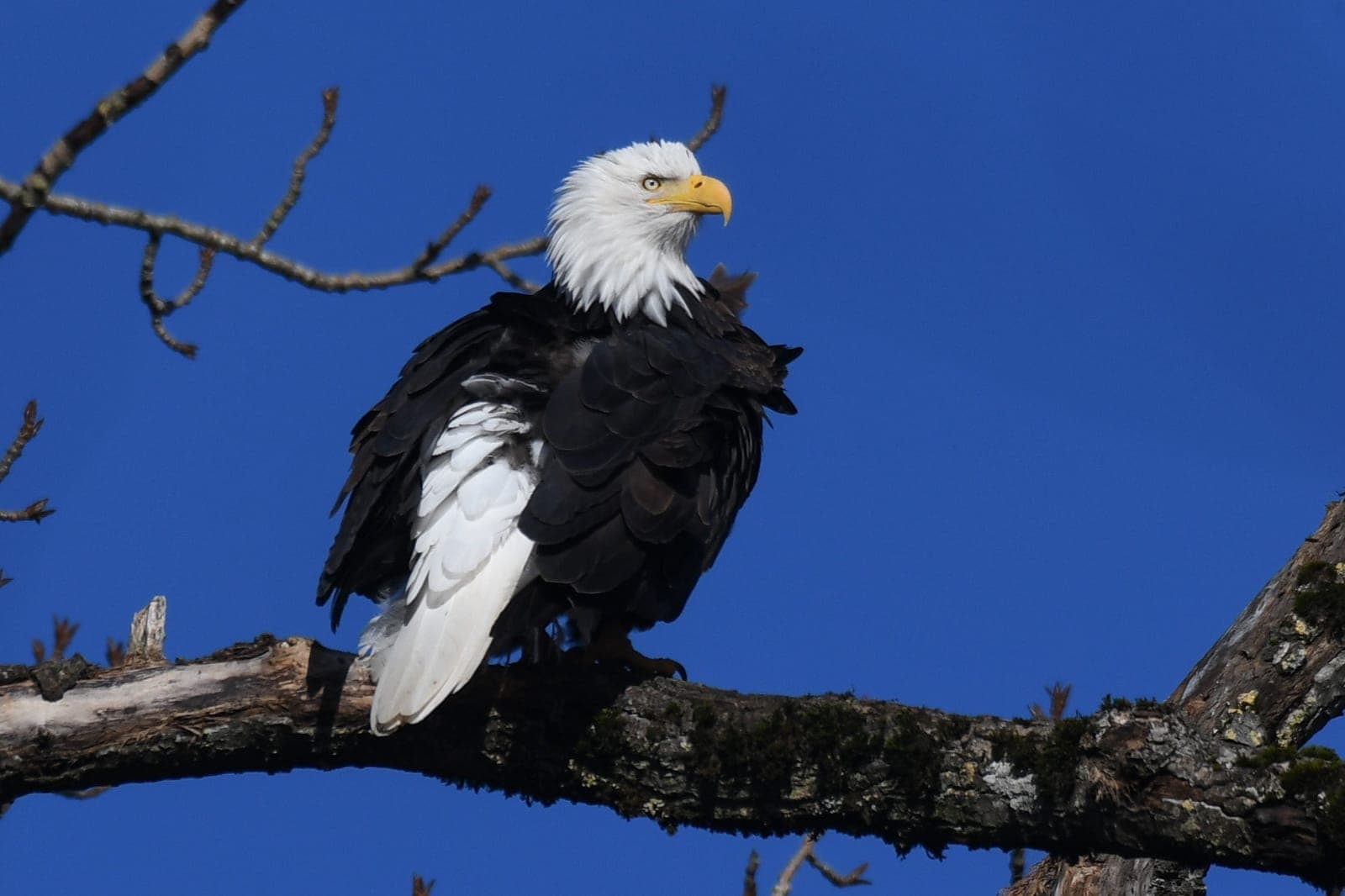
Immature Bald Eagles are the usual confusion. They have a heavier head and bill that stick out farther, bare yellow lower legs, and white splashed irregularly over the belly and wing linings rather than set in neat patches.
Full comparison →Turkey Vulture
Turkey Vultures are far lighter and rock unsteadily on wings raised in a V, with silvery flight feathers below and a tiny bare head. A Golden Eagle soars steadily, and its feathered head is obvious.
Red-tailed Hawk
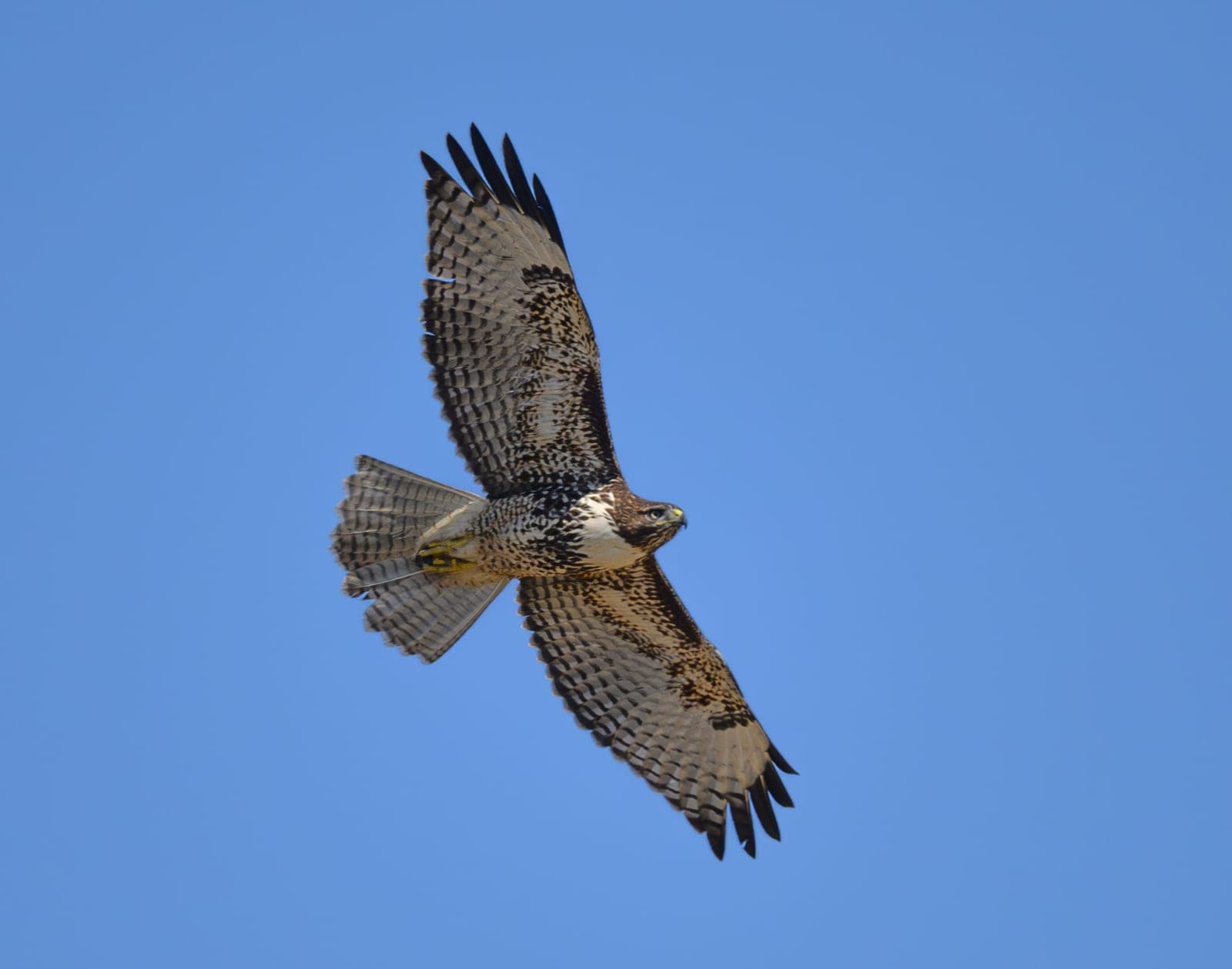
Dark red-tails are far smaller, with a short tail that is often reddish or finely barred, quicker wingbeats and no golden nape. Up close, a red-tail's bare yellow legs rule out an eagle.
Range & habitat
In North America, Golden Eagles breed across Alaska, western and northern Canada to the Ungava Peninsula of Quebec, and the western United States south through the interior West to central Mexico. As breeders they are essentially absent east of a line from North Dakota through western Nebraska and Oklahoma to West Texas. Birds from Alaska and northern Canada migrate; those from the Hudson Bay region winter in the Appalachians from central Michigan and southern Pennsylvania to northeastern Alabama, while most adults in the western United States stay year-round. The species also lives across Europe, Asia and North Africa.
Golden Eagles need open country with room to hunt and a cliff or big tree to nest on: sagebrush and grassland, desert scrub, rangeland, foothills, canyons, alpine tundra and the Arctic fringe. They avoid dense forest and cities, and pairs may desert a nest when people disturb it. Eastern wintering birds use steep river valleys, reservoirs and coastal marshes, and in the Midwest they turn up around refuges where waterfowl gather in winter.
Through the seasons
Spring
Western residents are already nesting by early spring; most clutches hold two eggs, incubated 41 to 45 days. Wintering birds head north early: in southwestern Idaho they leave between late March and mid-April, and in southwestern Canada by April or early May.
Summer
Eaglets first fly at roughly 60 to 70 days old, and many young die of starvation in their first year as they learn to hunt. In the dry Southwest, adults often move upslope to higher, cooler ground once nesting is done.
Fall
Northern birds migrate late in fall on ridge updrafts and thermals. Mount Lorette in Alberta's Rockies sees about 4,000 pass in a season, the largest Golden Eagle flight known. Eastern birds from Hudson Bay reach Appalachian wintering grounds in November and early December.
Winter
Golden Eagles spread across the West and Great Plains in winter, perching on poles, ridges and rock outcrops over open country. Many scavenge carcasses, including big-game gut piles, which exposes them to lead fragments from bullets.
How to find Golden Eagles
Golden Eagles never come to yards. Finding one means covering a lot of open country with good optics and knowing where wind, rock and prey come together.
- Glass ridgelines and cliff faces in canyon country, where eagles ride updrafts on breezy days.
- Drive rangeland and sagebrush roads in winter, checking power poles and rock outcrops for big, dark birds.
- Check prairie dog towns and ground squirrel colonies, which draw hunting eagles in the West.
- Visit Mount Lorette in Alberta in fall, or an Appalachian ridge lookout in November in the East.
- Use the golden nape and feathered legs on perched birds to rule out young Bald Eagles.
- Keep far from cliff nests; Golden Eagles may abandon nests when people get too close.
- Hunters can use copper or other non-lead bullets so gut piles do not poison scavenging eagles.
Diet & life cycle
What it eats
Golden Eagles are mammal hunters first. Ground squirrels, prairie dogs, marmots, rabbits and jackrabbits make up most of the diet in North America, with grouse and other gamebirds, snakes, lizards, large insects and carrion filling the gaps. They are strong enough to take prey as large as foxes, coyote pups and mule deer or pronghorn fawns. They hunt by soaring high or by flying low and fast along slopes to surprise prey, and pairs sometimes hunt together, with the second bird catching what the first one misses. A hunting stoop has been estimated at 150 to 200 miles per hour.
Life cycle
Golden Eagles usually pair for life and hold some of the largest territories of any bird. Most nests are on cliff ledges, some in big trees, and a pair may keep two or more alternate nests that both birds add to year after year until they become huge. The female lays one to four eggs, usually two, a few days apart, and does most of the 41 to 45 days of incubation while the male hunts. Young first fly at about 60 to 70 days. Juvenile losses are heavy — in one Rocky Mountain study half the eagles banded as nestlings were dead within two and a half years — but adults that survive can live for decades.
Oldest on record
The oldest Golden Eagle in the USGS Bird Banding Laboratory longevity records was a male at least 32 years and 10 months old. It was banded in Idaho in February 1992, in its second year, and found dead in Montana in April 2024.
SourceAttracting & watching
Golden Eagles are birds for road trips, not backyards. Winter drives through western rangeland, sagebrush and grassland, and fall visits to mountain migration lookouts, give the best odds. A spotting scope from the road is the right tool, and stopping well short of nest cliffs keeps pairs from flushing. Golden Eagles, their feathers, nests and eggs are covered by the Bald and Golden Eagle Protection Act and the Migratory Bird Treaty Act, and possessing any part of one without a permit is illegal.
Conservation
Least Concern (IUCN). The U.S. Fish and Wildlife Service estimated about 40,000 Golden Eagles in the United States in 2014 and 31,800 in the interior West using data through 2016, and considers numbers stable. That stability is fragile: people cause about three-quarters of deaths after the first year, including illegal shooting (the leading cause of adult deaths in the West, nearly 700 a year), electrocution on power poles, collisions with vehicles, wind turbines and power lines, and poisoning, including lead. Congress added the Golden Eagle to the Bald Eagle Protection Act in 1962.