How to identify a hairy woodpecker
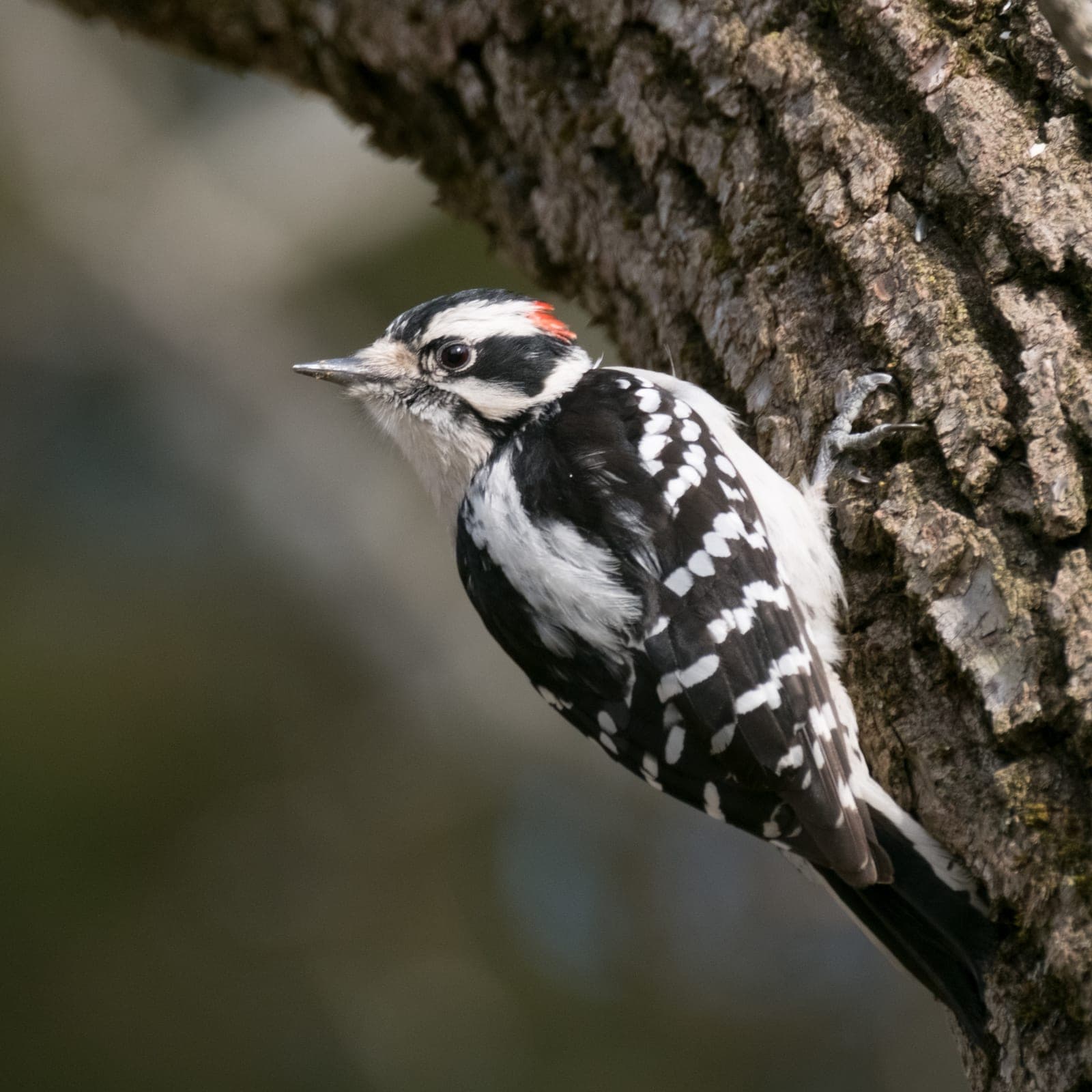
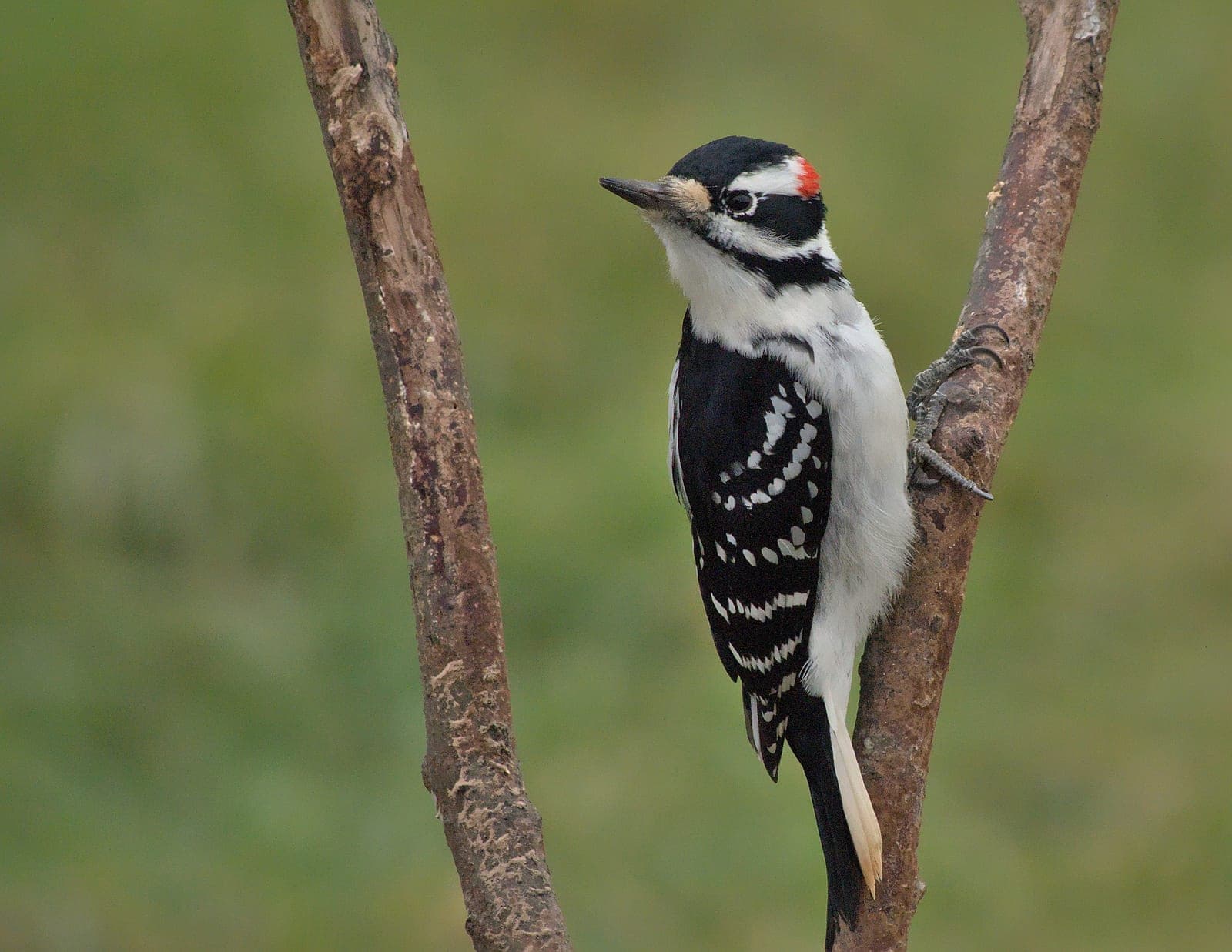
Hairies share the downy's pattern almost feature for feature: a long white stripe down a black back, black wings spotted with white, a face striped in black and white, and plain pale underparts. What separates them is proportion. A hairy is roughly robin-sized, with a long, straight, chisel-tipped bill nearly as long as its head, and its white outer tail feathers are clean, without the black bars of a downy. Adult males have a red patch on the back of the head; females do not. Plumage varies by region: western birds show less white spotting on the wings, and the underparts range from bright white to smudgy brown depending on the subspecies.
- Long, stout bill nearly as long as the head
- Clean white outer tail feathers without black bars
- White stripe down the middle of a black back
- Robin-sized body, clearly larger than a downy
- Sharp, loud 'peek' call and a rattle held on one pitch
Look-alikes
Downy Woodpecker
A downy is about two-thirds the length, with a tiny bill far shorter than its head and black spots or bars on the white outer tail feathers. Its 'pik' call is softer, and its rattle drops in pitch toward the end.
Full comparison →American Three-toed Woodpecker
This conifer specialist of boreal and mountain forests has black-and-white barring on the sides and usually some barring across the back. Males wear a yellow cap rather than a red patch on the back of the head.
Yellow-bellied Sapsucker
Sapsuckers have a mottled back instead of a clean white stripe, a long white bar on the folded wing, a red forehead and a black bib. They drill neat rows of sap wells, which hairies sometimes visit to drink.
Range & habitat
Hairy woodpeckers breed from southern and central Alaska across forested Canada to Newfoundland, through nearly all of the lower 48 states, and south through the mountains of Mexico and Central America to western Panama, with a population in the Bahamas as well. Most are permanent residents. Birds from the northern edge of the range sometimes move well south in winter, and some western mountain birds shift to lower elevations when snow comes.
Hairies need larger trees than downies. They live in mature deciduous, coniferous and mixed forests, wooded swamps, groves along prairie rivers and open juniper woodland in the West. From the Southwest through Mexico and Central America they keep to mountain pine forests and, farther south, cloud forest. They visit suburban yards mostly where big trees or woodland are close by, and they forage mainly on trunks and large limbs rather than twigs.
Through the seasons
Spring
Pairs often form in midwinter, frequently with the previous year's mate, and both birds drum loudly on dead limbs. In spring they excavate a new nest cavity together, typically in a hardwood in the East and in an aspen or dead conifer in the West.
Summer
Both parents feed the nestlings in the cavity for about four weeks. After fledging, the young stay with their parents and are fed for a while longer as they learn to find food on their own.
Fall
Hairies hold their territories year-round. Fall brings more berries, seeds and nuts into the diet, and it is a good time to put suet out near woodland before the cold sets in.
Winter
Leafless woods make hairies easier to spot as they pound into dead wood after beetle larvae. Listen for the heavy tapping, and if a pileated woodpecker is working nearby, a hairy may follow it to pick over the fresh holes.
How to find and attract hairy woodpeckers
Hairies are less common in towns than downies, so the best place to look is mature woodland with plenty of dead and dying trees. Learn the call first: you will usually hear a hairy before you see it.
- Listen for a sharp, ringing 'peek', louder and more emphatic than a downy's 'pik', and a fast rattle that stays on one pitch.
- Walk older forests, wooded swamps and river bottoms with standing snags, and watch for flakes of bark drifting down from a trunk.
- Offer suet or shelled peanuts at a feeder near the woodland edge; yards close to big trees get the most visits.
- Leave dead trees and large dead limbs standing where they are safe; hairies need them to feed and to nest.
- When you hear a pileated woodpecker chopping at a stump, wait nearby: hairies sometimes follow to glean insects from the fresh holes.
- Check sapsucker wells on birches and maples, where hairies stop to drink sap and pick off trapped insects.
Diet & life cycle
What it eats
Hairies are mainly insect-eaters with a taste for wood-boring beetle larvae, which they reach by pounding and excavating deeper into dead wood than smaller woodpeckers manage. They also eat other beetles, ants, caterpillars and, like the downy, the invasive European corn borer. Berries, seeds and nuts fill out the diet, and they drink sap from sapsucker wells. Males tend to forage more deliberately, staying longer in one spot.
Life cycle
Pairs usually form in midwinter, often reuniting with a mate from the year before. Both sexes dig the nest cavity, anywhere from about 4 to 60 feet up. The female lays about four white eggs, sometimes three to six. Both parents incubate for about 14 days, the male at night and the female for most of the day. The young leave the nest at 28 to 30 days, and their parents keep feeding them for some time afterward. Pairs raise one brood a year.
Oldest on record
The oldest hairy woodpecker in the USGS Bird Banding Laboratory longevity list was a male at least 15 years and 11 months old. He was banded as an adult in New York in 1995 and recaptured and released there in 2010.
SourceAttracting & watching
Suet is the surest way to bring a hairy to the yard, served in a cage or log feeder hung on or near a tree trunk; shelled peanuts and black-oil sunflower seed also work. Hairies rarely stray far from mature trees, so yards next to woodlots, parks or wooded ravines have the best odds. Standing snags and big dead limbs give them food and nest sites long after the feeder is empty.
Conservation
Least Concern (IUCN). Hairy woodpeckers are still widespread and fairly common, with about 8.9 million breeding birds according to Partners in Flight. Breeding Bird Survey data show an increase of about 0.7 percent a year from 1966 to 2019, though the species is thought to be less common than it was historically in some areas. Cutting dead snags removes nest sites, and European starlings and house sparrows sometimes take over freshly dug cavities.