How to identify a downy woodpecker
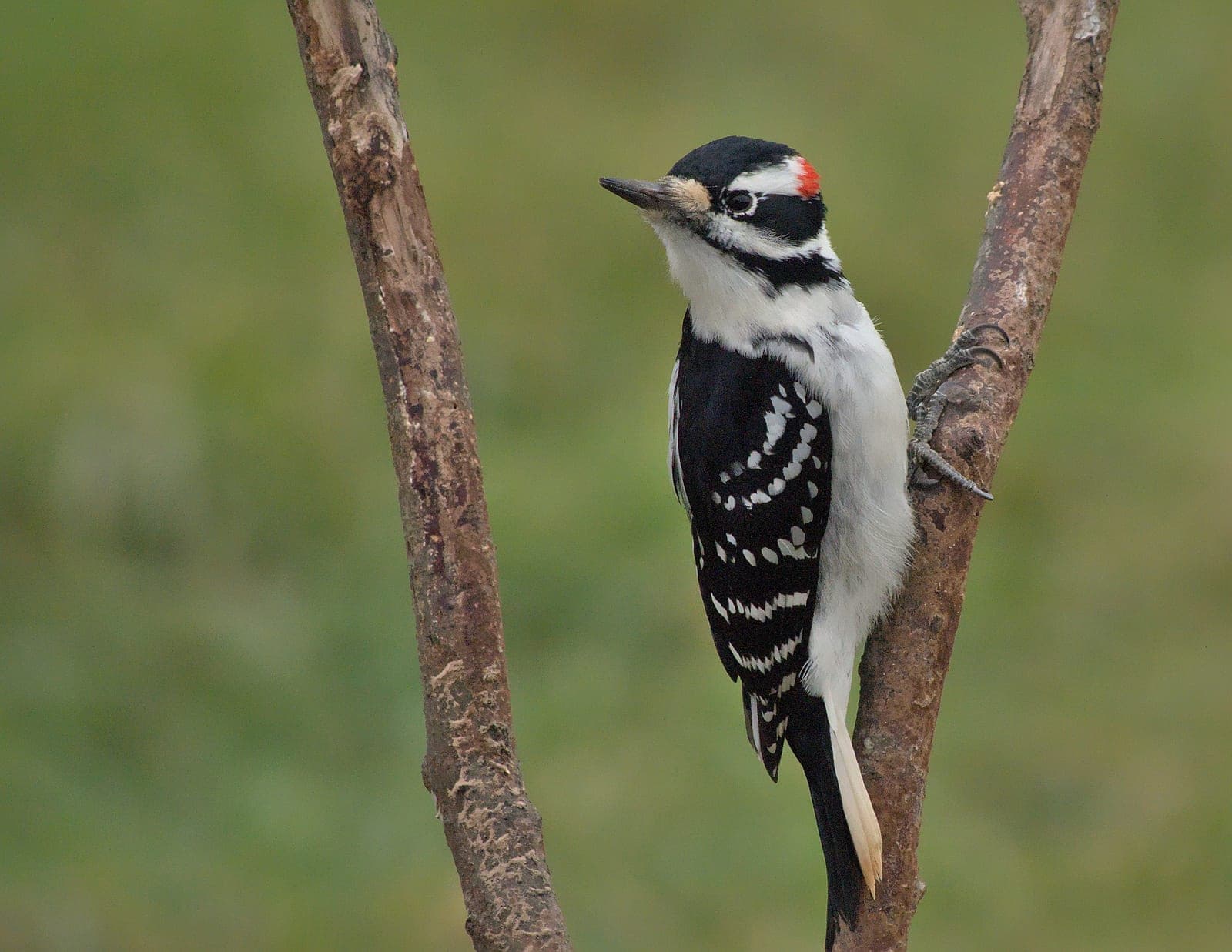
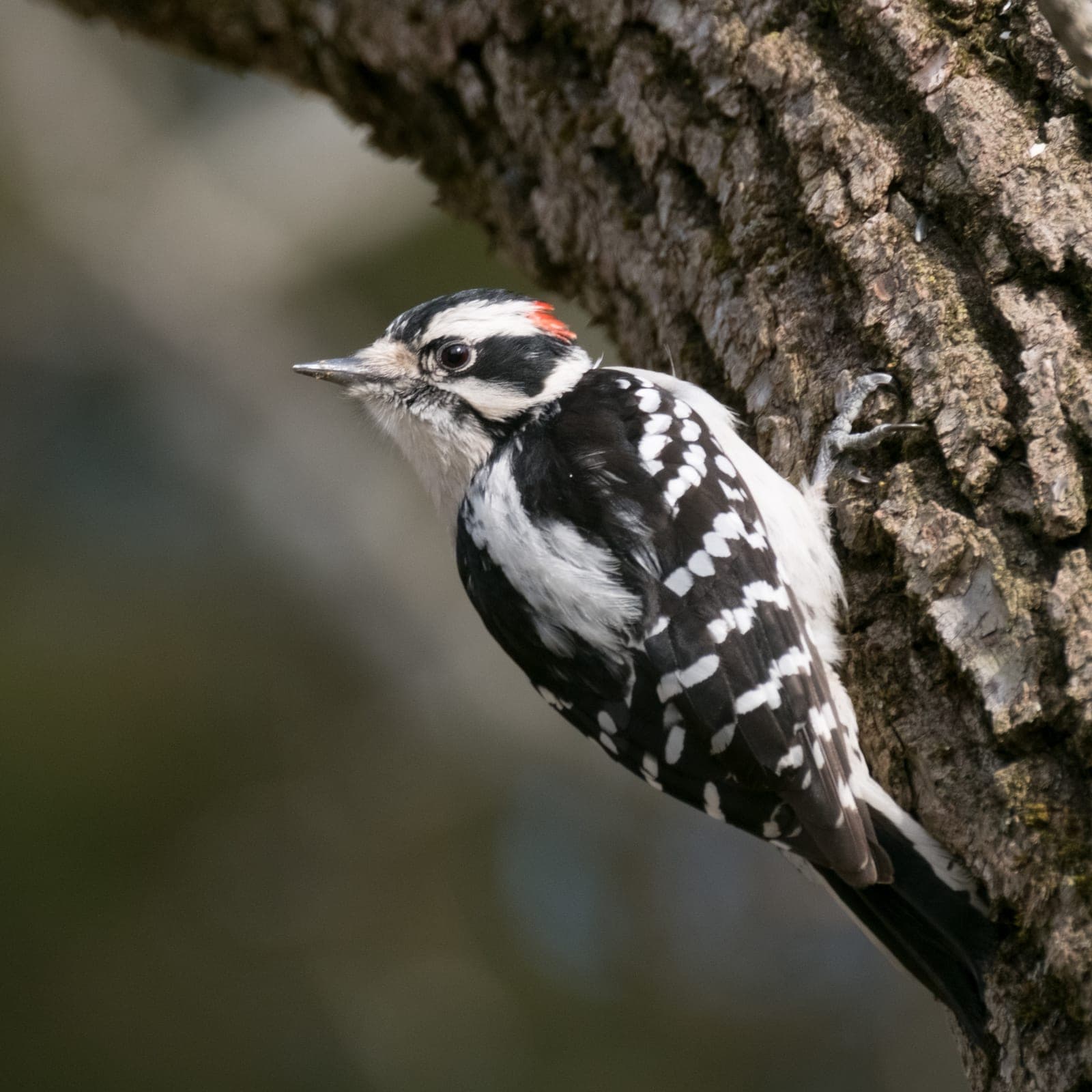
Downies are crisp black-and-white birds. A broad white stripe runs down the middle of the black back, the black wings are checkered with rows of white spots, and the face is boldly striped in black and white. The underparts are plain white or grayish white with no bars or spots. Adult males carry a small red patch on the back of the head that females lack, and juvenile males wear a red cap in summer, which fools many backyard birders. Everything about the bird is compact, especially the bill: a short, sharp spike much shorter than the head. Downies often feed on slender twigs and even weed stalks, perches a bigger woodpecker could not use. Birds in the Rocky Mountains show less white spotting on the wings than eastern birds.
- Tiny, thornlike bill much shorter than the head
- White stripe down the middle of a black back
- Black bars or spots on the white outer tail feathers
- Small red nape patch on males only
- Soft 'pik' call and a whinnying rattle that falls in pitch
Look-alikes
Hairy Woodpecker
The hairy is a near copy in pattern but clearly bigger, closer to robin size, with a long, heavy bill almost as long as its head. Its white outer tail feathers lack black marks, its call is a sharp, loud 'peek', and its rattle stays on one pitch instead of dropping like a downy's.
Full comparison →Ladder-backed and Nuttall's Woodpeckers
These small woodpeckers of the Southwest, Texas and California oak country have backs crossed by black-and-white bars like the rungs of a ladder. A downy has an unbarred white stripe down the center of its back.
Yellow-bellied Sapsucker
Sapsuckers are a little larger, with a mottled black-and-white back, a long white bar along the folded wing, a red forehead and a black bib across the chest. A downy has a clean white back stripe and no red on the forehead.
Range & habitat
Downy woodpeckers live across nearly all of the wooded United States and Canada, from central Alaska across the southern half of Canada to the Atlantic provinces and south to Florida, the Gulf Coast and California. They are missing only from the treeless Arctic and the hot deserts of the Southwest. Most birds stay on the same territory all year. Those at the northern edge of the range may move some distance south in winter, and some birds in the Rockies and other western mountains drop down into valleys for the cold months.
Downies prefer open deciduous woods and the edges of forest: woodlots, river groves, willow thickets, orchards, city parks and suburbs with mature shade trees. Where conifers dominate, in the far North and in high mountains, look for them in pockets of aspen, birch and willow instead. Their small size lets them use parts of a tree, and parts of a field, that bigger woodpeckers cannot: twig tips, saplings, shrubs and the dry stems of goldenrod and other tall weeds.
Through the seasons
Spring
Pairs settle territories in late winter, and both males and females drum in short bursts on resonant dead limbs, and sometimes on gutters or siding. Together they chisel a fresh nest hole in a dead branch, a job that takes two to three weeks.
Summer
Adults glean caterpillars, ants and beetles from bark and leaves to feed nestlings. After fledging, young downies trail their parents for a few weeks and turn up at feeders, the young males sporting red caps.
Fall
Downies stay put rather than migrate, add more seeds and wild fruit to their diet, and dig roost holes where they will spend winter nights. Mixed flocks of chickadees, titmice and nuthatches start to form, and downies tag along.
Winter
The easiest season to watch them. Downies tap and excavate more than in summer, hammer open goldenrod galls for the fly larvae inside, and visit suet feeders daily. Males feed mostly on small branches and weed stems, while females work larger limbs and trunks.
How to find and attract downy woodpeckers
Downies are easy to find once you know their voice and their habit of feeding on thin branches. In winter, follow the chatter of a chickadee flock: a downy is often traveling with it.
- Listen for the short, flat 'pik' call and the rattle that descends at the end, a sound often compared to a whinny.
- Hang a suet cake or a mesh feeder of shelled peanuts against a tree trunk; downies use both through the year, and no-melt suet dough helps in summer.
- Black-oil sunflower seed and sunflower hearts also draw them, especially during cold snaps.
- Leave dead limbs and snags standing where they are safe; downies need soft, decayed wood for nest holes and winter roosts.
- Let goldenrod and other tall weeds stand through winter in a wild corner, where downies probe the stems and galls for larvae.
- Check twigs and weed stalks, not just trunks: a small woodpecker on a thin branch is almost always a downy.
Diet & life cycle
What it eats
Downies eat mostly insects: beetles and their larvae, ants, caterpillars, and the larvae of gall-making wasps and flies dug from twigs and weed stems. They are among the birds that prey on the European corn borer, an invasive moth that costs U.S. agriculture heavily. Seeds and berries round out the diet, especially in winter, and at feeders they take suet, peanuts and sunflower seed.
Life cycle
Downy pairs form in late winter. Both sexes excavate the nest in a dead tree or dead limb, usually 12 to 30 feet up, and the entrance is often ringed with fungus or lichen that helps hide it. The female lays usually four or five white eggs. Both parents incubate for about 12 days, the male taking the night shift, and the chicks grow fast: they are nearly full-sized by about 17 days and leave the nest roughly three weeks after hatching. Most pairs raise one brood a year, and some in the South may raise two.
Oldest on record
The oldest downy woodpecker in the USGS Bird Banding Laboratory longevity list was a male at least 11 years and 11 months old. He was banded in California in 1985 and caught and released by banders again in 1996.
SourceAttracting & watching
Suet is the downy's favorite feeder food, offered in a cage or a log feeder hung near a trunk; shelled peanuts and black-oil sunflower seed are close seconds. A birdbath with fresh water helps year-round. Downies are less dependent on feeders than on habitat, so native trees and shrubs, dead limbs left in place and a patch of tall weeds left standing over winter will keep them around after the suet runs out.
Conservation
Least Concern (IUCN). Downy woodpeckers are common and widespread. Partners in Flight estimates about 13 million breeding birds, and North American Breeding Bird Survey data show a stable population since the survey began in the 1960s. Like other native woodpeckers, they are protected under the Migratory Bird Treaty Act.