How to identify a northern flicker
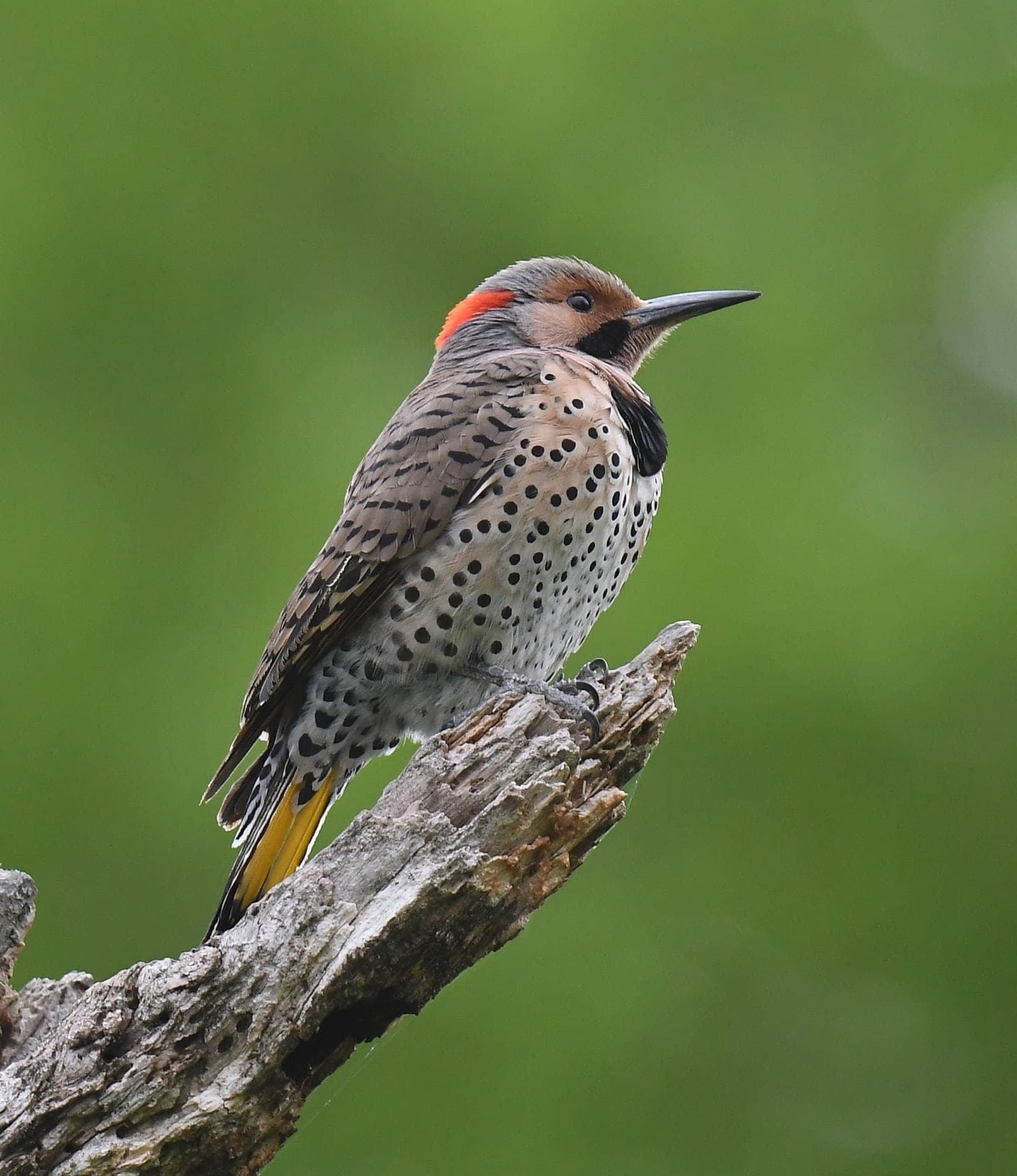
Flickers are large woodpeckers with a brown back finely barred in black, a black crescent across the upper chest and a buff to whitish belly covered in round black spots. In flight a white rump patch shows clearly, and the undersides of the wings and tail glow with color. The two main forms differ in that color and in the head. Yellow-shafted flickers of the East and North have yellow underwings, a gray crown, a tan face and a red crescent on the nape; males add a black mustache stripe. Red-shafted flickers of the West have salmon-pink underwings, a brown crown, a gray face and no red nape; males have a red mustache. The two interbreed freely on the western Great Plains and in southwestern Canada, and birds there often mix features of both.
- Brown, black-barred back with a black chest crescent and spotted belly
- Bright white rump in flight
- Yellow or salmon-red under the wings and tail
- Mustache stripe on males: black in the East, red in the West
- Often feeds on the ground, hopping across lawns and fields
Look-alikes
Gilded Flicker
The gilded flicker of the saguaro deserts of Arizona and northwestern Mexico has yellow underwings like a yellow-shafted bird but the gray face of a red-shafted one, plus a cinnamon-brown crown. It lives among giant cactus, while northern flickers favor trees.
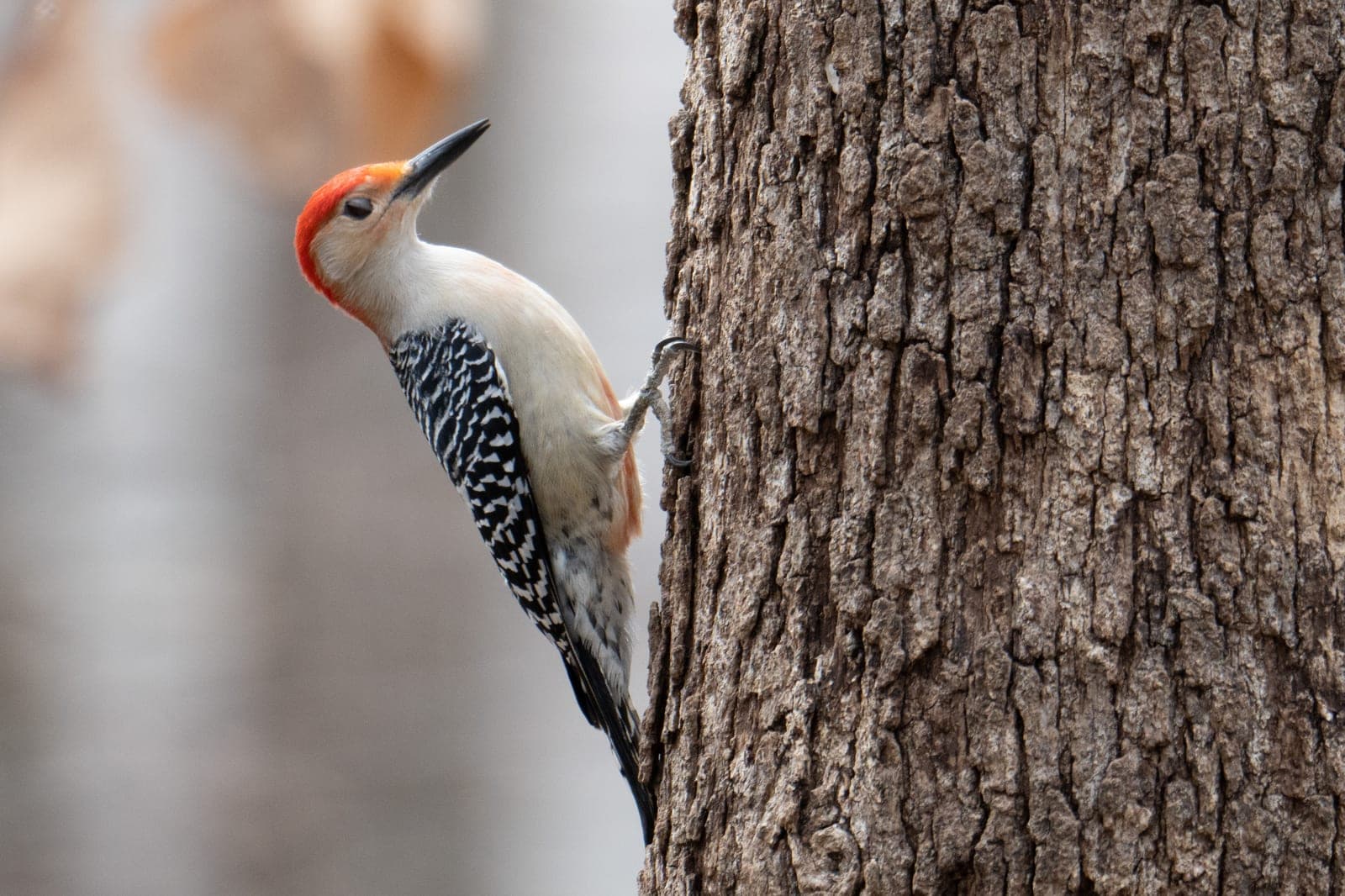
Red-bellied Woodpecker
Red-bellieds also show a white rump and red on the head, but they are gray-faced and pale below, with a zebra-barred back and no black chest crescent or belly spots. A flicker is brown and noticeably larger.
Western Meadowlark
A meadowlark flushed from grass is also brown above with a black chest mark, but its underparts are bright yellow and it flashes white outer tail feathers rather than a white rump. Meadowlarks fly with quick, stiff wingbeats and short glides; flickers bound along in deep swoops.
Range & habitat
Northern flickers breed across nearly all of wooded North America, from the tree line in Alaska and Canada south through the United States into Mexico, with resident populations in Cuba and on Grand Cayman. The red-shafted birds of southern Mexico and Central America are now treated as a separate species, the Guatemalan flicker. Yellow-shafted flickers from Alaska and Canada are strongly migratory, heading east and then south, and big daytime flights pass down the Atlantic Coast in fall. Red-shafted birds move shorter distances, often from mountains to lowlands, and some spread east onto the Great Plains in winter. Across much of the United States, flickers can be found all year.
Flickers like open country with scattered trees rather than deep, unbroken forest: woodland edges, groves, open forests, farms, parks, large lawns and towns. They need bare or short-grass ground where they can dig for ants, and dead or soft wood, or a nest box, for nesting. In the West they range from cottonwood river bottoms up into open mountain forest, and many shift to lower, milder country in winter.
Through the seasons
Spring
Migrants return north in early spring. Males and females court with loud 'wicka-wicka' calls, and both drum in short bursts, sometimes on metal chimney caps and gutters that ring loudly.
Summer
Pairs nest in a dead or soft tree and raise one brood in most areas, two in parts of the South. Adults spend long hours on the ground gathering ants and their larvae for the nestlings.
Fall
Northern birds migrate south in September and October, and large daytime flights move down the Atlantic Coast. Flickers eat far more wild fruit and berries at this season.
Winter
In the southern and central states, migrants from the North join resident birds. Flickers keep feeding on bare ground when they can, rely on berries, seeds and suet when snow covers it, and spend cold nights in tree cavities.
How to find and attract northern flickers
Look down, not up. Flickers do much of their feeding on the ground, so scan lawns, ballfields and pasture edges for a big brown bird probing the turf with its bill.
- Learn the long, loud 'wick-wick-wick' series and the single piercing 'kleeer' call, both heard far across open country.
- Watch for the white rump and a flash of yellow or salmon as a flushed bird bounds away in deep swoops.
- Skip lawn insecticides: the ants living in your grass are the flicker's main food.
- Put up a flicker box with a 2½-inch entrance hole, mounted 6 to 12 feet up and facing south or east, and pack it to the top with wood chips so the birds can 'excavate' it.
- Offer suet in winter and plant native shrubs and vines that hold berries into fall and winter.
- Leave dead trees and large stumps standing where they are safe for natural nest sites.
Diet & life cycle
What it eats
Ants are the flicker's staple: by some counts they alone make up about 45 percent of the diet, and flickers probably eat more ants than any other North American bird. A flicker digs into anthills with its curved bill, then laps up adults and larvae with a sticky tongue that can reach about 2 inches past the bill tip. Beetles, termites, caterpillars and other insects add variety, and in fall and winter wild fruit, berries, seeds and nuts become important. Flickers also go 'anting', rubbing ants over their feathers, likely because the ants' formic acid helps with preening and parasite control.
Life cycle
Both sexes excavate the nest, usually in dead or diseased wood of a pine, cottonwood, willow or similar tree, typically 6 to 20 feet up, and flickers also use nest boxes and old cavities. The female lays usually five to eight glossy white eggs. Both parents incubate for roughly 11 to 16 days, and the young leave the nest about four weeks after hatching. Most pairs raise a single brood. Few flickers live long: in one six-year study, only one or two of every 300 adults were seven years old or older.
Oldest on record
The oldest northern flicker in the USGS Bird Banding Laboratory longevity list was a male at least 9 years and 2 months old. He was banded in Florida in 1965 and found dead there in 1973.
SourceAttracting & watching
Suet draws flickers in winter, and native berry-producing shrubs bring them in during fall migration. A lawn left free of insecticides is a feeding ground in itself. NestWatch's flicker box plan calls for a 2½-inch hole, an interior about 24 inches deep, a mount 6 to 12 feet up facing south or east, and a fill of wood chips replaced each spring. European starlings compete fiercely for flicker holes, so check boxes in spring.
Conservation
Least Concern (IUCN). Flickers are still common and widespread, but the Breeding Bird Survey shows a decline of about 1.2 percent a year from 1966 to 2021, a cumulative loss of roughly 49 percent. Competition with European starlings for nest holes is one known pressure. Partners in Flight estimated about 12 million birds before the Guatemalan flicker was split off as its own species.