How to identify a peregrine falcon
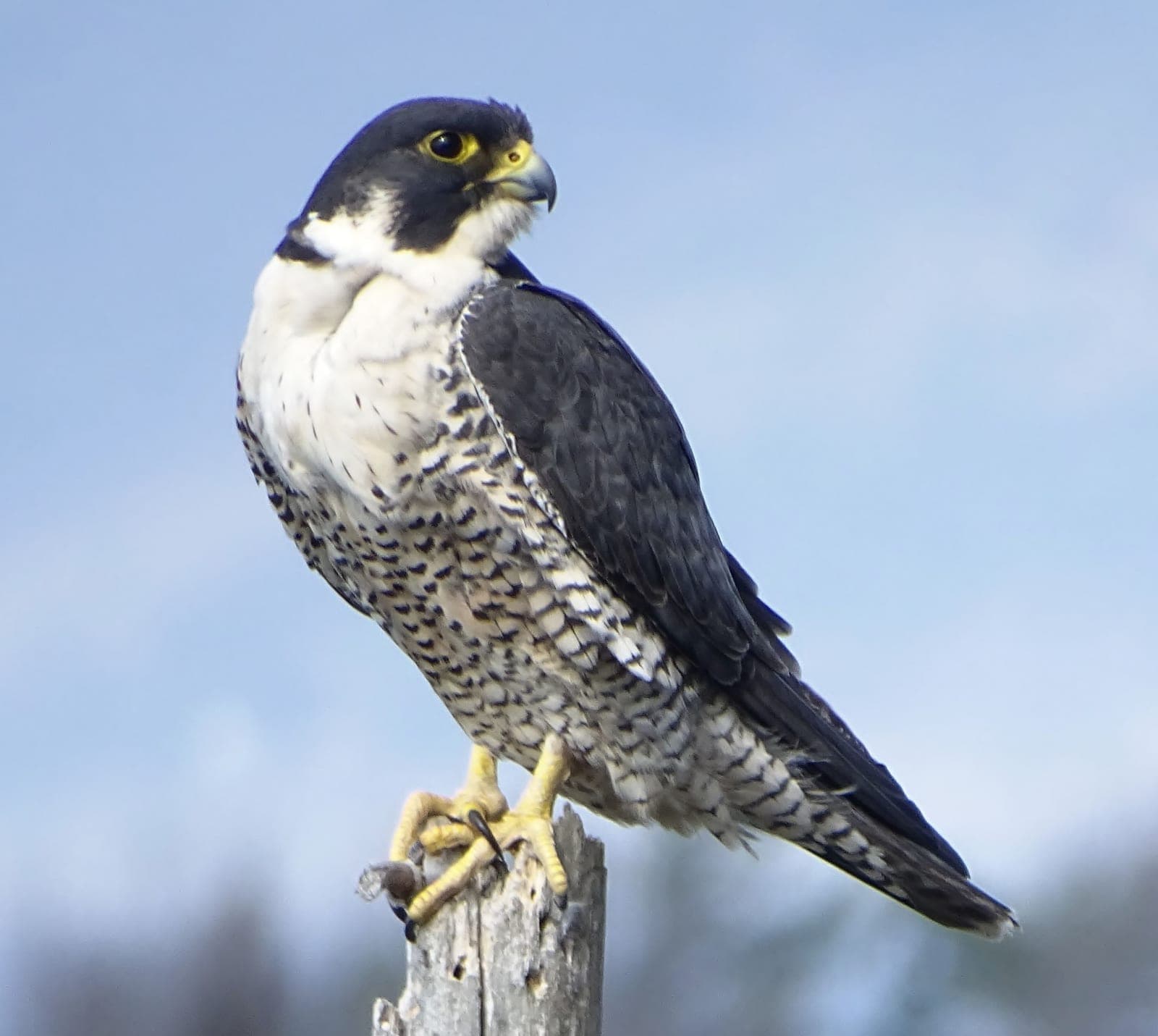
Peregrines are powerful, broad-chested falcons with long, pointed wings and a fairly short tail. Adults are slate blue-gray above and pale below, finely barred with dark gray on the belly and flanks, and the head looks hooded: a dark cap and a thick, dark wedge of a mustache below the eye stand out against white cheeks and throat. First-year birds are brown above and heavily streaked, not barred, below. Females can be up to about 30 percent larger than males. Peregrines that breed in the Arctic are paler, while the Peale's falcons of the Pacific Northwest coast and Aleutians are the largest.
- Dark hood and a thick black mustache on a white cheek
- Blue-gray back and finely barred underparts on adults
- Long, pointed wings and a broad, deep chest
- Brown and streaked below in the first year
- High-speed dives on flying birds
Look-alikes
Prairie Falcon
The prairie falcon of the arid West is sandy brown above rather than blue-gray, with a thin mustache and a pale face. In flight it shows dark patches in the 'armpits' where the wing meets the body, a mark peregrines lack.
Merlin
Merlins are far smaller, about kestrel-sized but stockier, with streaked underparts, a banded tail and a faint mustache. They fly fast and low but lack the peregrine's deep chest and bold hood.
Gyrfalcon
The Arctic gyrfalcon is bigger and bulkier, with broader wings, a longer tail and only a faint mustache, and it comes in gray, white and dark forms. It is rare south of Canada, mostly in winter.
Rock Pigeon
In fast, direct flight a pigeon's pointed wings can suggest a falcon. Pigeons have a small head and, on many birds, a white rump; a peregrine is heavier in the chest, with a dark hood and a heavy mustache.
Range & habitat
Peregrines breed on every continent except Antarctica, making them the most widespread raptor in the world. In North America they nest from the Arctic tundra of Alaska, Canada and Greenland south through the Rockies and the West into Mexico, along the Pacific Coast and the Aleutians, and, thanks to reintroduction, again across the East and Midwest, often in cities. Arctic breeders are long-distance migrants: many winter in South America, and tracked birds have covered more than 6,000 miles one way. Birds of the Pacific Northwest coast and of some temperate regions south to northern Mexico stay year-round.
Peregrines need open air to hunt and a high ledge to nest. Classic sites are cliffs above rivers, lakes and seacoasts, but skyscrapers, bridges, smokestacks and towers serve just as well, and cities supply a steady diet of pigeons. In migration and winter they hunt over beaches, barrier islands, estuaries, marshes and mudflats where shorebirds and ducks gather, and over other open country.
Through the seasons
Spring
Pairs reclaim their nest ledges in late winter or spring and court with high, looping flights and food passes. The female lays her eggs in a bare scrape in gravel or debris; peregrines build no nest.
Summer
The female does most of the month-long incubation while the male hunts. Chicks fledge at roughly six weeks, and many city pairs are watched through public webcams as the young take their first flights.
Fall
Arctic peregrines move south along the coasts in September and October. At the Florida Keys Hawkwatch, counters tallied 1,506 migrating peregrines on a single day in October 2015, a world single-day record.
Winter
Many migrants winter in Central and South America, while others winter along southern U.S. coasts, hunting ducks and shorebirds. Many city peregrines in the North stay put all winter and keep hunting pigeons.
How to find and watch peregrine falcons
Peregrines never visit feeders, but they are easier to see than most raptors once you know where they nest. Start with your nearest city skyline or river bluff, and check whether a state agency or local group runs a nest webcam.
- Scan tall downtown buildings, bridges and power-plant stacks; many cities have a known pair, and state wildlife agencies often publish nest locations or webcams.
- Check cliffs above big rivers, lakes and seacoasts for a crow-sized bird perched on a ledge, or for a streak of whitewash below a favorite perch.
- Listen near nests for a harsh, repeated 'kak-kak-kak'; away from the nest peregrines are mostly silent.
- Visit a coastal hawk watch from late September through October, when Arctic migrants move south along the shore.
- Watch flocks of shorebirds, ducks or pigeons: a sudden panic often means a peregrine is overhead.
- Give nests plenty of space and respect seasonal closures at climbing cliffs, which protect nesting pairs from disturbance.
Diet & life cycle
What it eats
Peregrines eat birds, almost all caught in the air. Prey ranges from songbirds and shorebirds up to ducks, gulls, loons and even geese, and in cities pigeons are the staple. A peregrine often climbs high, then folds its wings and stoops, striking with its feet at tremendous speed; it also chases prey in level flight. The U.S. Fish and Wildlife Service puts the stoop at about 200 mph, Audubon more cautiously at well over 100 mph, and the often-quoted 242 mph comes from a single measurement reported in a National Geographic television program; radar studies have not confirmed speeds that high. Small mammals are taken now and then, and insects and carrion rarely.
Life cycle
Peregrines build no nest. The female scrapes a shallow hollow on a cliff ledge, a building or a bridge and lays usually three or four eggs, whitish to reddish-brown and heavily marked. She does most of the incubation, which lasts about 29 to 33 days, while the male brings food. The chicks fledge at about 39 to 49 days. Peregrines usually begin breeding at one to three years old, and pairs often mate for life. First-year mortality is high, but adults survive much better from year to year.
Oldest on record
The oldest peregrine falcon in the USGS Bird Banding Laboratory longevity list was a female at least 20 years and 5 months old. She was banded as a nestling in Minnesota in June 2003 and found dead in Iowa in November 2023.
SourceAttracting & watching
Peregrines never come to yards and should never be fed or approached at the nest. The best viewing is at city nest sites, many with public webcams run by wildlife agencies and conservation groups; at river and coastal cliffs where parks post nesting closures; and at coastal hawk watches in fall. A spotting scope helps, since peregrines often sit for long stretches on a ledge or tower between hunts.
Conservation
Least Concern (IUCN). DDT and related pesticides thinned eggshells and caused breeding failure from the 1940s into the 1970s. By 1970 peregrines no longer nested in the eastern United States, and North America held only 324 known pairs in 1975. After the 1972 DDT ban and the release of more than 6,000 captive-raised falcons, the U.S. Fish and Wildlife Service removed the American peregrine from the endangered list on August 25, 1999, with at least 1,650 breeding pairs in the United States and Canada. It remains protected under the Migratory Bird Treaty Act; in Canada, COSEWIC assessed the main anatum/tundrius population as Not at Risk in 2017 and the Peale's subspecies as Special Concern.