How to identify a american kestrel
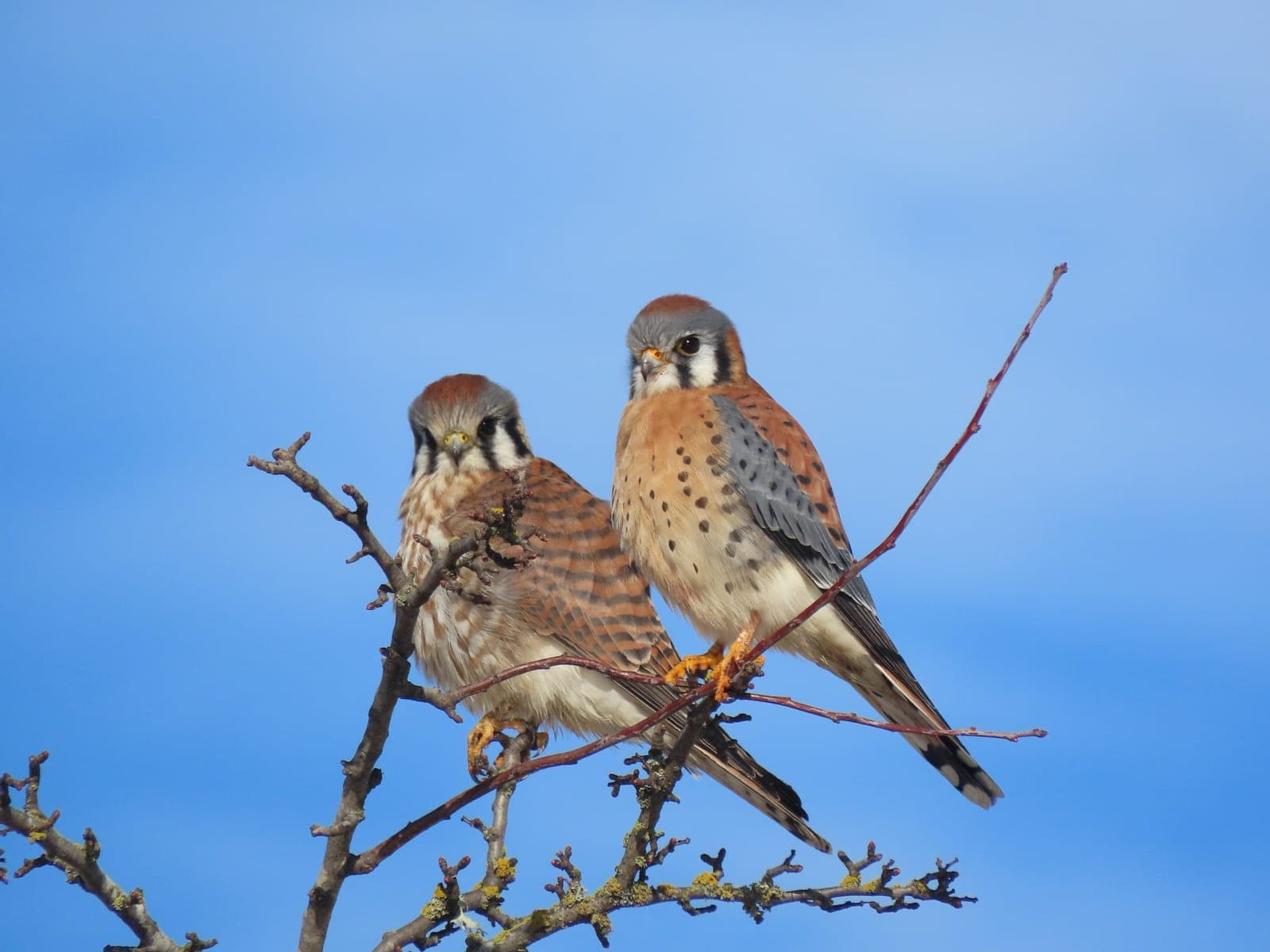
Kestrels are slim and long-tailed, with the long, pointed wings of a falcon. Both sexes have a pale face with two narrow black vertical marks on each side, one below the eye and one farther back, a blue-gray crown, and two dark spots on the back of the neck that look like a second pair of eyes. The sexes differ more in color than in size. Males have blue-gray wings set against a rusty back and a rusty tail with a broad black band near the tip. Females are rusty on the back and wings alike, barred with black, with a barred rusty tail and brown streaks on creamy underparts. Perched kestrels often pump the tail up and down.
- Two black vertical face stripes on each side
- Rusty back and tail; males have blue-gray wings
- Dark 'false eye' spots on the back of the neck
- Long, pointed wings and a long tail
- Hovers over fields and pumps its tail when perched
Look-alikes
Merlin
Merlins are stockier and darker, heavily streaked below, with a dark tail crossed by pale bands and only a faint mustache mark. They fly fast and low with powerful wingbeats and rarely hover; a kestrel looks lighter and more buoyant and shows rusty tones above.
Peregrine Falcon
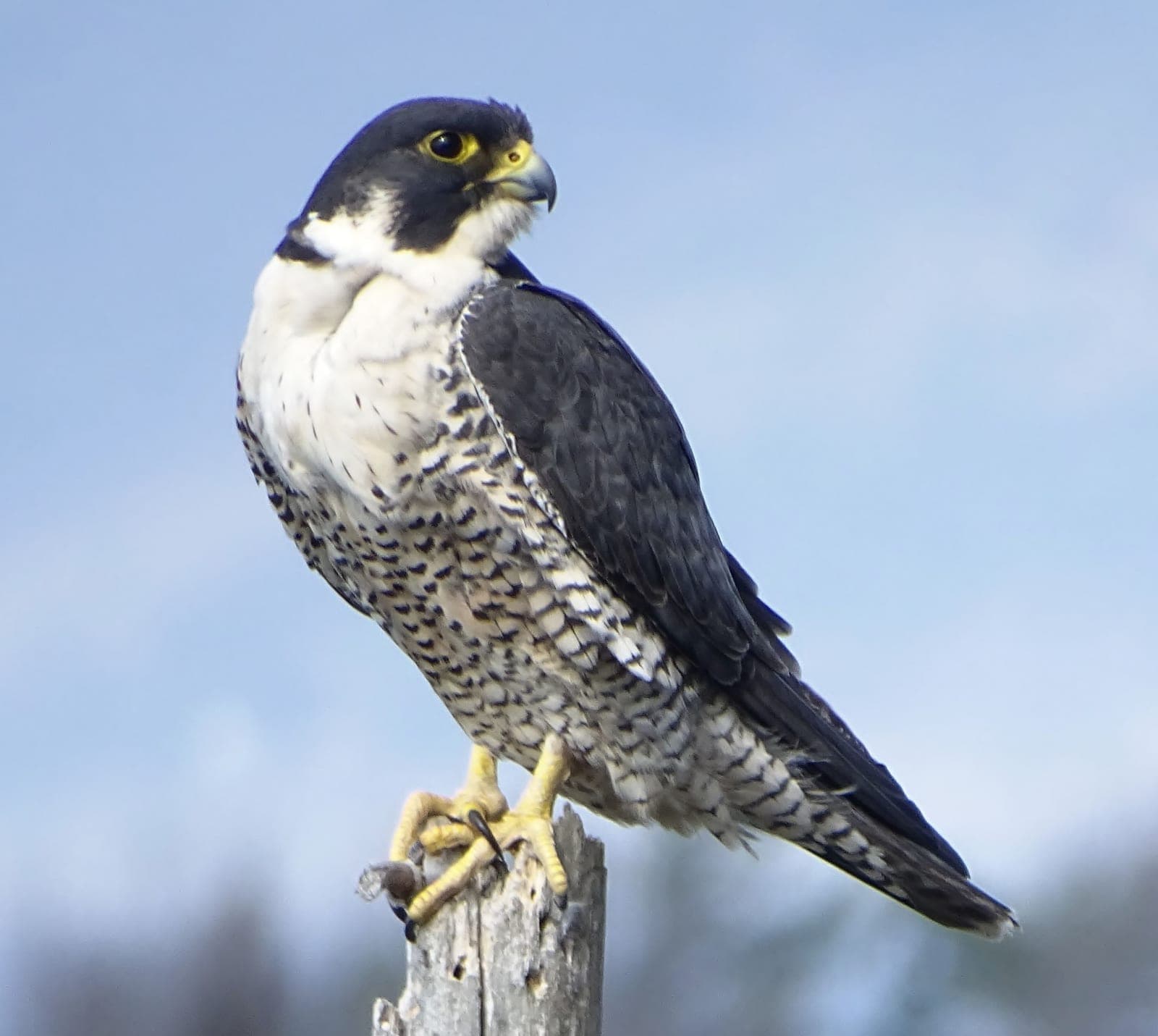
A peregrine is crow-sized and many times heavier, with a blue-gray back, a dark hooded head and one thick black mustache. A kestrel is about the size of a mourning dove and shows rusty orange on the back and tail.
Full comparison →Sharp-shinned Hawk
This small hawk has short, rounded wings and a long, square-tipped tail, and flies with a few quick flaps and a glide. A kestrel's wings are long and pointed, and it often hovers, which a sharp-shinned hawk does not.
Range & habitat
Kestrels breed from central Alaska and across Canada to Nova Scotia, through nearly all of the United States and Mexico and into the Caribbean, and other subspecies range through Central and South America to Tierra del Fuego. Birds from Canada and the northern states migrate south in fall, the southernmost North American populations stay all year, and those in between make shorter partial migrations. Young birds may travel farther than adults, and females tend to winter farther south than males.
Kestrels need open ground with short vegetation for hunting, plus perches to hunt from: pastures, hayfields, grasslands, deserts, forest clearings, roadsides and the open edges of towns and suburbs. In the breeding season they also need a cavity, which limits them to places with old trees, cliffs, buildings or nest boxes. In winter, females tend to use more open country than males.
Through the seasons
Spring
Northern birds return as fields green up. Males court with steep dives and calls and pass food to the female in flight, and the pair claims a tree hole, crevice or nest box.
Summer
The female does most of the month-long incubation while the male hunts for both. Young leave the nest at about four weeks and are fed by their parents for up to two weeks more as they learn to catch grasshoppers and other large insects.
Fall
Migration runs mainly in September and October, and kestrels stream past hawk watches along ridges and coastlines. Juveniles often travel farther south than adults.
Winter
Wintering kestrels spread across open country in the southern and central United States and Mexico, with females often in the most open habitats. When insects are scarce they hunt more voles, mice and small birds from wires and fence posts.
How to find and attract American kestrels
Drive or bike quiet rural roads through open farmland and scan every wire, fence post and dead snag. A small, long-tailed bird sitting upright and pumping its tail is very likely a kestrel.
- Listen for the shrill 'killy-killy-killy' call, often given by excited birds and near the nest.
- Watch for a small falcon hanging in place over a field on fast wingbeats, then dropping onto prey.
- Put up a kestrel nest box with a 3-inch entrance hole, mounted 10 to 20 feet up on a tree or a sturdy wooden pole in open country.
- Space boxes well apart and place them where open fields surround them; never mount one on a utility pole without the utility's permission.
- Leave dead trees with old woodpecker holes standing; they are natural kestrel nest sites.
- Avoid rodent poisons and broad-spectrum insecticides, which cut into prey and are suspected in the species' decline.
Diet & life cycle
What it eats
In the warm months kestrels eat mostly large insects: grasshoppers above all, plus beetles, dragonflies, moths and caterpillars. They also take voles, mice and the occasional bat, small birds up to about the size of a quail, lizards, frogs, spiders and crayfish. Individual kestrels often specialize in one kind of prey. Most hunting is done from a perch, swooping down onto prey on the ground, and they can also catch insects, birds or bats in midair.
Life cycle
Kestrels nest in cavities they cannot dig themselves: old woodpecker holes, natural tree hollows, crevices in cliffs, banks and buildings, saguaro cactus holes in the Southwest, and nest boxes. The female lays usually four or five eggs, white to pale reddish-brown with darker spots. She does most of the 26- to 32-day incubation while the male brings her food. The young fledge at about 28 to 31 days. Females average slightly larger than males. Most wild kestrels live fewer than five years, though a few survive far longer.
Oldest on record
The oldest American kestrel in the USGS Bird Banding Laboratory longevity list was a male at least 14 years and 8 months old. He was banded as an adult in Utah in 1987 and found dead there in 2001.
SourceAttracting & watching
Kestrels do not visit feeders, but a well-placed nest box can bring a pair to a farm, ranch or other property with open fields. The box needs open ground around it and a clear flight path to the entrance, and a side door makes yearly cleaning and checks easy. To watch kestrels, scan wires and fence posts along rural roads, especially during fall migration and in winter across the southern and central states.
Conservation
Least Concern (IUCN). Kestrels remain the most common falcon in North America, with about 9.2 million mature birds worldwide, but surveys show declines of roughly 1 to 2 percent a year since the 1960s. A USGS-led continental study estimated a 29 percent drop between 1986 and 2019 and pointed to fewer insects, second-generation rodenticides, neonicotinoid insecticides and predation as possible causes, on top of lost habitat and nest cavities. Florida lists the southeastern subspecies as state threatened.