How to identify a great horned owl
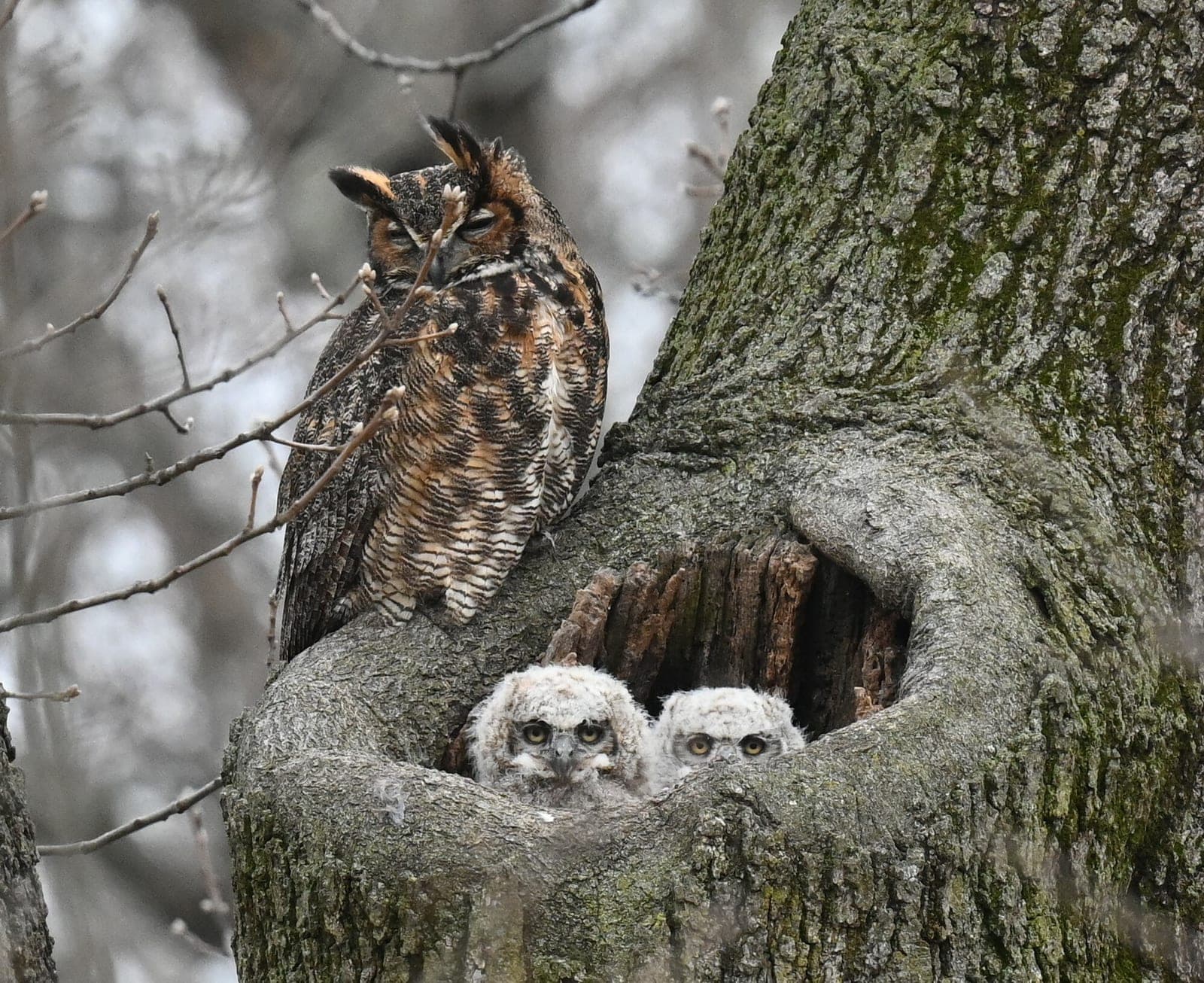
A big, barrel-shaped owl with long feather tufts — the 'horns' — set wide on a broad head, the Great Horned Owl is mottled gray-brown above and finely barred crosswise across the whole underside. The facial disk is rusty, brown or gray and rimmed in black, the eyes are large and yellow, and a white throat patch shows clearly when the owl hoots. Color varies with region: some western and northern birds are pale and washed-out, while others are dark and richly rufous. The tufts are only feathers, called plumicorns, and have nothing to do with hearing; the real ear openings are hidden on the sides of the head, the left one slightly larger than the right. Females are larger than males, averaging about 3.5 pounds against 2.7.
- Long ear tufts set wide apart on a broad head
- Large yellow eyes in a rusty to gray facial disk rimmed in black
- White throat patch, puffed out when hooting
- Fine crosswise barring across the entire underside
- Deep, stuttering hoots: hoo, h'HOO, hoo, hoo
Look-alikes
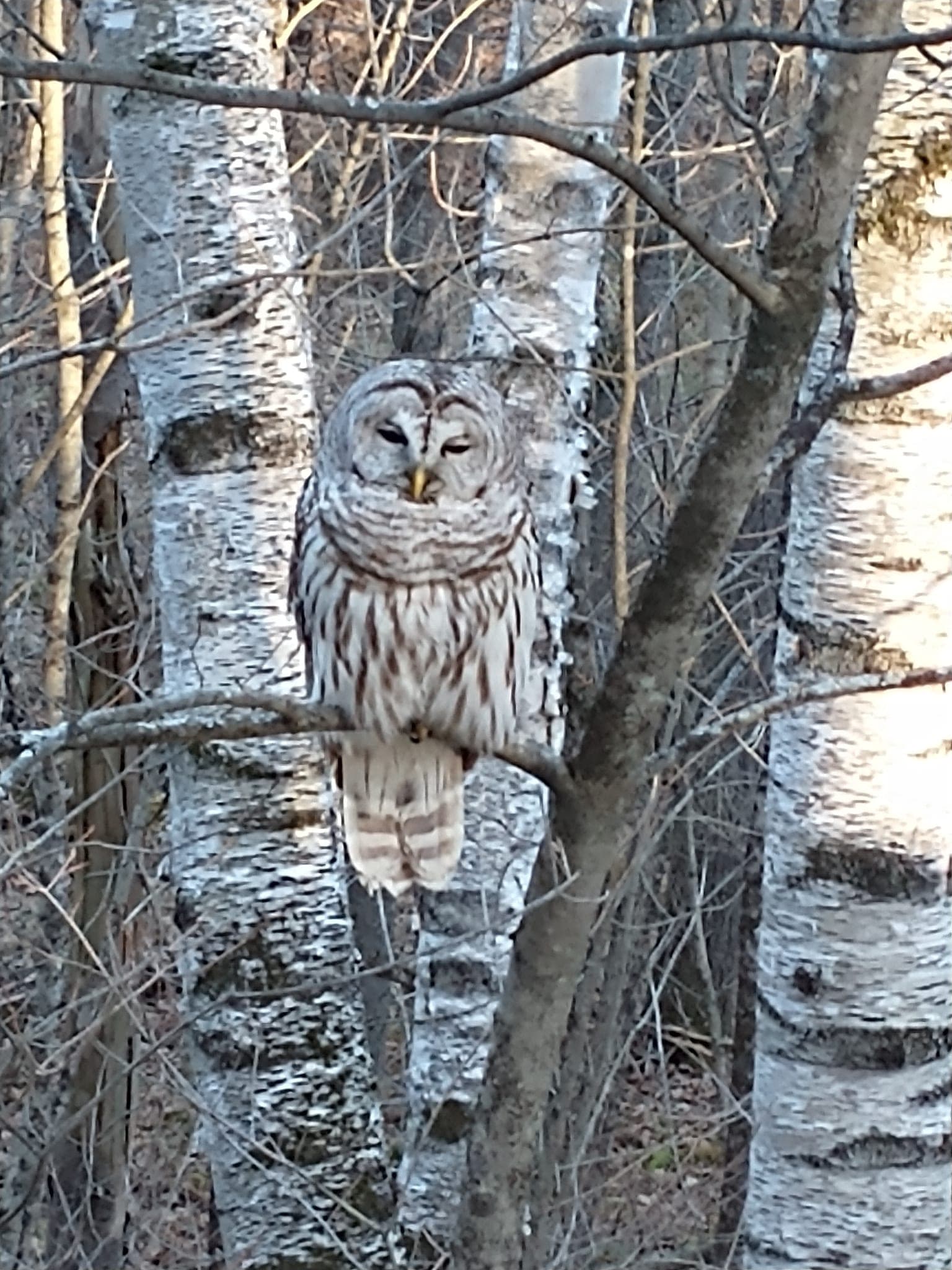
Barred Owl
Barred Owls have no ear tufts, dark brown eyes and lengthwise brown streaks on the belly, and they give a loud 'who cooks for you' call rather than a soft, deep stutter.
Full comparison →Long-eared Owl
Long-eared Owls are much smaller and slimmer, with tufts set close together near the center of the head, orange eyes and a rusty face. They roost hidden in dense conifers, often in groups in winter.
Eastern Screech-Owl
Screech-owls also have ear tufts but are only about eight or nine inches long. They give soft whinnies and long trills instead of hoots.
Range & habitat
Great Horned Owls live across nearly all of North America, from the edge of the Arctic tundra in Alaska and Canada south through every Lower 48 state and Mexico into Central America; related horned owls continue through South America. They are permanent residents almost everywhere, often holding a single territory for life. Young birds disperse widely, and some northern owls wander south in fall and winter.
Few birds use a wider range of habitats. Great Horned Owls live in forests, woodlots, swamps, deserts, farmland, suburbs and city parks — anywhere with some trees, cliffs or heavy brush for cover next to open ground for hunting. They prefer a mix of woods and openings over unbroken forest, which favors the Barred Owl, and during nesting they avoid open tundra and treeless grassland. Urban owls in some cities nest earlier and higher than their rural neighbors.
Through the seasons
Spring
Eggs laid in winter hatch after 28 to 35 days, so by early spring across much of the country, gray, downy owlets sit up in old hawk and crow nests. At about five weeks they leave the nest to clamber around nearby branches, which is when well-meaning people try to 'rescue' them.
Summer
Young owls fly at about nine to ten weeks and spend the summer trailing their parents, begging loudly at night. The adults keep feeding them for months, and some young are still begging in October.
Fall
Most juveniles drift out of their parents' territory in late fall or early winter. Courtship runs from October into December, with males hooting hard to hold territory and attract or reclaim a mate, and pairs answering each other in duets.
Winter
Pairs are settled by December or January, and egg laying begins remarkably early: late November to early January in southern Florida, late December to early February across much of the Southeast, and later farther north. A female incubating through a snowstorm is a classic winter sight.
How to find and attract Great Horned Owls
Great Horned Owls are common but hidden by day. Winter evenings, when they hoot most, and bare trees, which expose nests, make the cold months the best time to find them.
- Listen at dusk from October to February for a pair dueting; the female's voice is noticeably higher.
- Scan old Red-tailed Hawk, crow and heron nests in late winter for ear tufts above the rim.
- Follow the racket when crows mob something in the woods; it is often a roosting owl.
- Look for whitewash and piles of pellets under big conifers, which owls use as day roosts.
- Turkey hunters: owl hoots at first light can make a roosted gobbler shock-gobble and give away his tree.
- Leave healthy owlets on the ground or on low branches alone; the parents keep feeding them.
- Skip rodent poisons, which kill owls that eat poisoned mice and rats.
Diet & life cycle
What it eats
Great Horned Owls have the most varied diet of any raptor in the Americas, with more than 500 prey species recorded. Rabbits, hares, voles, mice and rats are the staples — in the boreal forest, snowshoe hares can make up three-quarters or more of the diet at the peak of the hare cycle — but the owl also takes ducks, geese, grouse and quail, other owls and hawks, snakes, frogs, scorpions and even fish. Thanks to a poor sense of smell, it is one of the few predators that routinely kills skunks, and it will attack porcupines. Its feet can clamp down with at least 300 pounds per square inch. Small prey is swallowed whole, and fur and bones come back up later as pellets.
Life cycle
Great Horned Owls never build their own nest. They take over old stick nests of Red-tailed Hawks, crows, herons and squirrels, or use cliff ledges, caves, broken snags and even the ground, usually 15 to 70 feet up when in trees. Pairs typically stay together year after year. The female lays two or three eggs, sometimes one to five, and does most of the 28 to 35 days of incubation while the male hunts. Young leave the nest at about five weeks, fly at nine to ten weeks and may depend on their parents into fall. Adults have few natural enemies besides eagles and other horned owls; most deaths now come from cars, wires, buildings, electrocution and poison.
Oldest on record
The oldest Great Horned Owl in the USGS Bird Banding Laboratory longevity records was at least 28 years and 10 months old. It was banded as an adult in Ohio in April 1997 and found dead in Ohio in April 2025.
SourceAttracting & watching
Great Horned Owls cannot be drawn to a feeder, but they thrive near people when big trees, woodlots and open ground for hunting are left alone. A property with tall conifers for roosting and a field or meadow nearby is ideal, and leaving old hawk and crow nests in place gives them somewhere to nest. Shutting chickens and small pets in at night prevents conflicts. Owls are protected under the Migratory Bird Treaty Act, and their feathers, nests and eggs may not be taken or kept without a permit.
Conservation
Least Concern (IUCN). Great Horned Owls remain widespread and common, with numbers holding up well in most areas. They were once shot and trapped heavily — in one study of banded young owls, most of those later found dead had been shot or trapped — and today most deaths are human-caused: vehicle strikes, collisions with wires and buildings, electrocution and secondary poisoning from rodent bait. The Great Horned Owl is the provincial bird of Alberta.