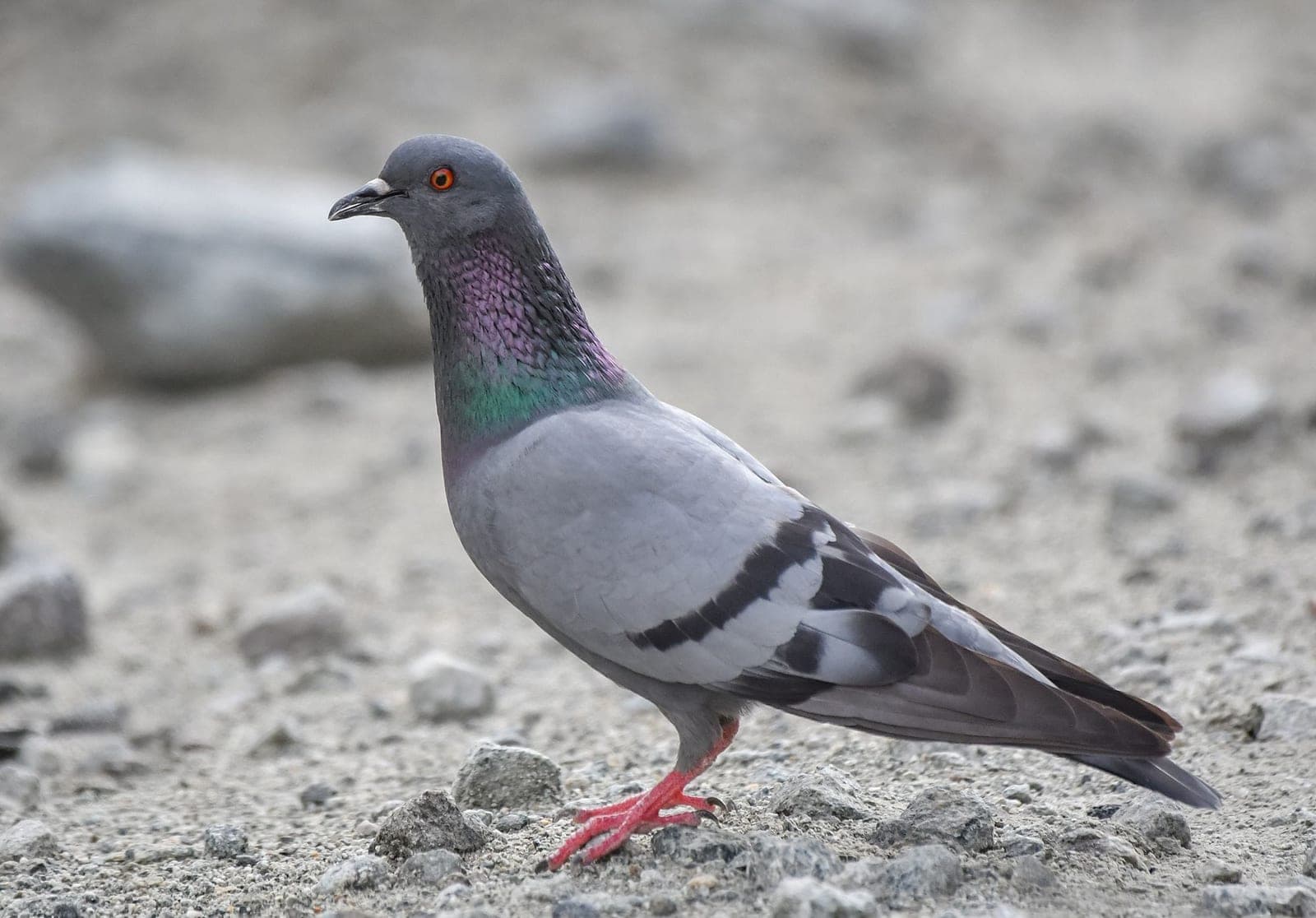
How to identify a rock pigeon
The wild-type rock pigeon is a plump, small-headed bird, blue-gray overall with a darker head and chest, a glossy green-to-purple sheen on the neck, two black bars across each pale gray wing, a white patch on the lower back and a dark band at the tip of the tail. In flight it shows clean white underwings. Thousands of years of domestic breeding mean feral flocks also include checkered, reddish-brown, white, black and patchwork birds, all the same species. The bill is short and gray-black, with a whitish fleshy patch called a cere at the base, larger on domestic and feral birds; the iris is red-brown and the feet are red to pink.
- Two black bars across each pale gray wing
- White patch on the lower back of wild-type birds
- Iridescent green-and-purple neck
- Dark band at the tip of the tail
- Bright white underwings in flight
Look-alikes
Band-tailed Pigeon
This native pigeon of western oak and conifer forests has a yellow bill with a dark tip, yellow feet, a white crescent on the back of the neck and a pale band across the end of the tail. It has no black wing bars or white rump, and it avoids city streets.
Mourning Dove
Mourning doves are slimmer and brownish, with a long, pointed tail edged in white and scattered black spots on the wings. They lack the rock pigeon's wing bars, white rump and glossy neck.
Eurasian Collared-Dove
Another introduced species, the collared-dove is pale sandy gray with a narrow black half-collar on the back of the neck and a long, square-ended tail with a broad pale tip. It has no wing bars.
Peregrine Falcon
A pigeon in fast flight, wings swept back, can suggest a falcon. A peregrine is heavier in the chest, with a dark hood and a thick black mustache, and it hunts pigeons rather than flocking with them.
Range & habitat
Rock pigeons are native from western and southern Europe and North Africa east into South Asia. Domestic birds traveled the world on European ships, and in North America the species now lives wherever there are buildings, bridges or farms, from southern Canada across the United States into Mexico. It is scarce or absent in unbroken forest, open desert far from towns and the Arctic. Rock pigeons do not migrate; most spend their lives in the same neighborhood or farm district, although trained homing birds can find their way back from long distances.
Wild rock doves nest on sea cliffs and in rocky gorges and mountains, and city buildings, bridges, barns, grain elevators and highway overpasses make a near-perfect substitute. Feral pigeons are most abundant in cities and around farms, especially where spilled grain or handouts are easy to find. In a few places flocks have gone back to wild habits and nest on cliffs far from people.
Through the seasons
Spring
Courtship is in full swing. Males puff out their glossy necks, fan their tails and strut in circles around females, bowing and cooing, and pairs add twigs to nests they have used before.
Summer
Pigeons can nest in any month, but spring and summer are the peak. A pair may raise brood after brood through the season, often reusing the same nest, and the young are fed on crop milk by both parents.
Fall
Flocks gather around harvested grain fields, rail yards, docks and city squares, where waste grain and scraps are easy to find. Courtship and even nesting continue on warm days.
Winter
Pigeons ride out cold weather in sheltered nooks under bridges and eaves and keep breeding during mild spells. Wintering peregrine falcons hunt them in many cities, so watch for a flock that suddenly bunches and veers.
How to find and watch rock pigeons
Finding pigeons is easy; really looking at them is the interesting part. Spend ten minutes with a city flock and you will see complex courtship, a surprising range of plumage and a few skilled fliers.
- Visit a plaza, train station or bridge and sort the flock by pattern: blue-barred, checkered, red, white and pied birds are all the same species.
- Watch a courting male: listen for the soft, rolling coo and look for the puffed, iridescent neck and the bowing, turning strut.
- Check barn rafters and highway underpasses in spring for twig-platform nests, and watch from a distance.
- Scan nearby skylines and bridges, since where pigeons gather, peregrine falcons often hunt.
- To keep pigeons off a backyard feeding station, use tube or caged feeders with small perches and clean up spilled seed under the feeders.
Diet & life cycle
What it eats
Rock pigeons are seed-eaters that forage by walking on the ground, often in flocks. In the country they eat waste grain, grass and weed seeds and occasional berries or acorns, with a few earthworms and insects. In cities many live largely on bread, popcorn and other human food. Unlike most birds, pigeons can keep their bills in the water and drink continuously without tipping the head back to swallow.
Life cycle
Pairs often stay together for life. The nest is a loose platform of twigs and grass on a sheltered ledge, beam or cliff, reused and built up over many broods. The female usually lays two white eggs, and both parents incubate for about 16 to 19 days. Both also make 'crop milk', a rich secretion from the lining of the crop, to feed the squabs, which leave the nest at about 25 to 32 days. Because crop milk frees them from depending on seasonal foods, pigeons can breed year-round and may raise five or more broods a year.
Attracting & watching
Pigeons need no encouragement: spilled grain and handouts bring them almost anywhere, and some cities discourage feeding them because big flocks foul sidewalks and buildings. For watching, a bench in a city square offers close views of courtship and plumage variety. A bridge or tall building with resident peregrine falcons gives a chance to see predator and prey together, especially in fall and winter.
Conservation
Least Concern (IUCN). Rock pigeons are abundant worldwide, with estimates of roughly 120 million to 140 million birds. As an introduced species in the United States, they are excluded from the Migratory Bird Treaty Act, and the U.S. Fish and Wildlife Service lists them among nonnative birds the act does not protect. Breeding Bird Survey data show long-term declines in parts of North America, possibly linked to loss of farmland, cleaner cities and pest control. State and local rules on pigeons vary.