How to identify a osprey
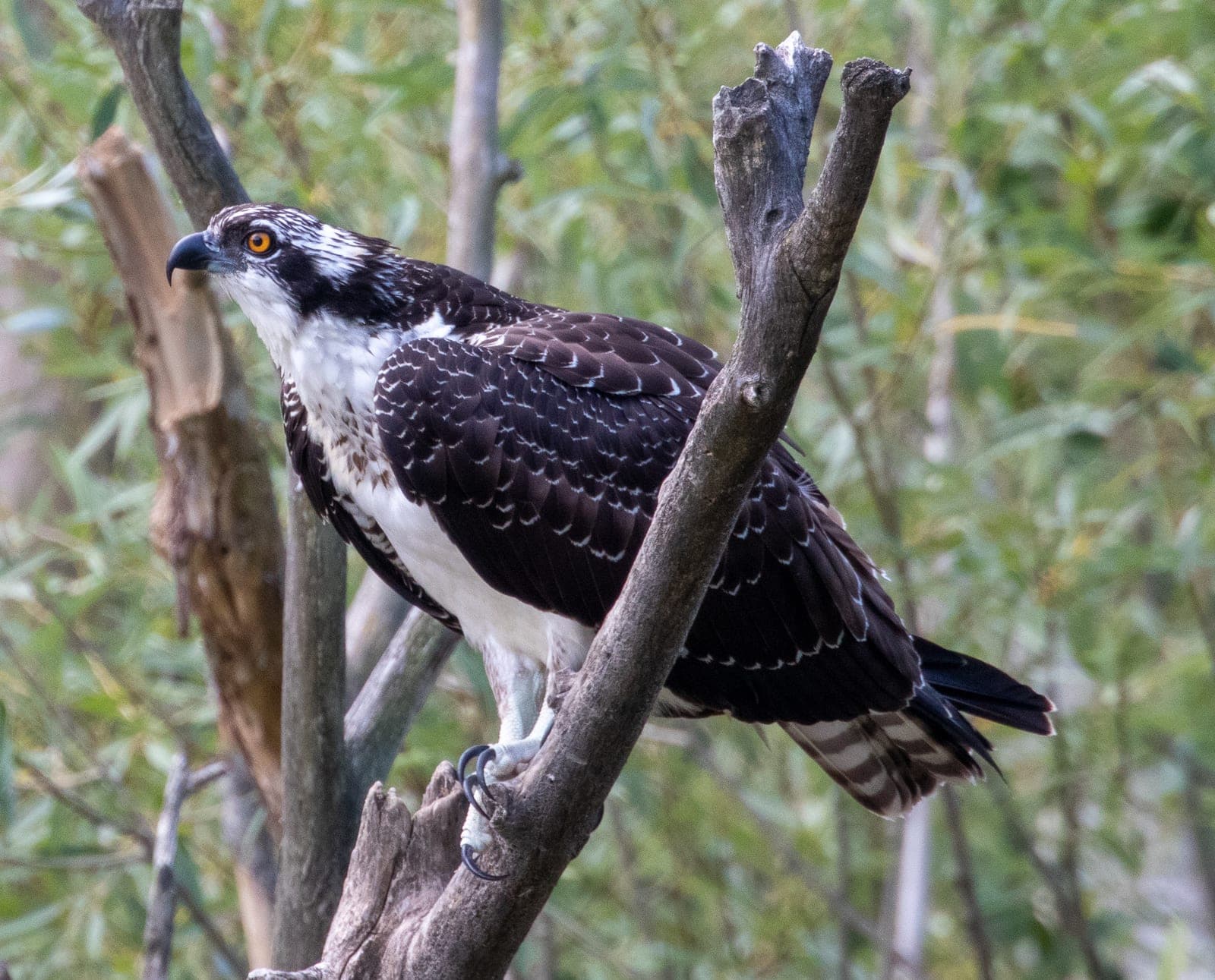
Ospreys are dark brown above and bright white below, with a white head crossed by a broad dark stripe running back through the yellow eye. Females often show a 'necklace' of brown streaks across the chest, though many birds are hard to sex. In flight the wings are long and fairly narrow for a raptor, bent at the wrist into a shallow M, with black patches at the wrists on an otherwise pale underwing; from far off an Osprey can look more like a big gull than a hawk. Juveniles resemble adults but have pale, scaly edges on the back feathers. A fishing Osprey is unmistakable: it hangs on beating wings over the water, then drops with its feet thrown forward and often vanishes completely beneath the surface before laboring back into the air.
- White underparts and head with a dark stripe through the eye
- Long, crooked wings held in a shallow M
- Black wrist patches under the wings
- Hovers, then plunges feet-first into the water
- Carries fish head-first, lined up with its body
Look-alikes
Bald Eagle
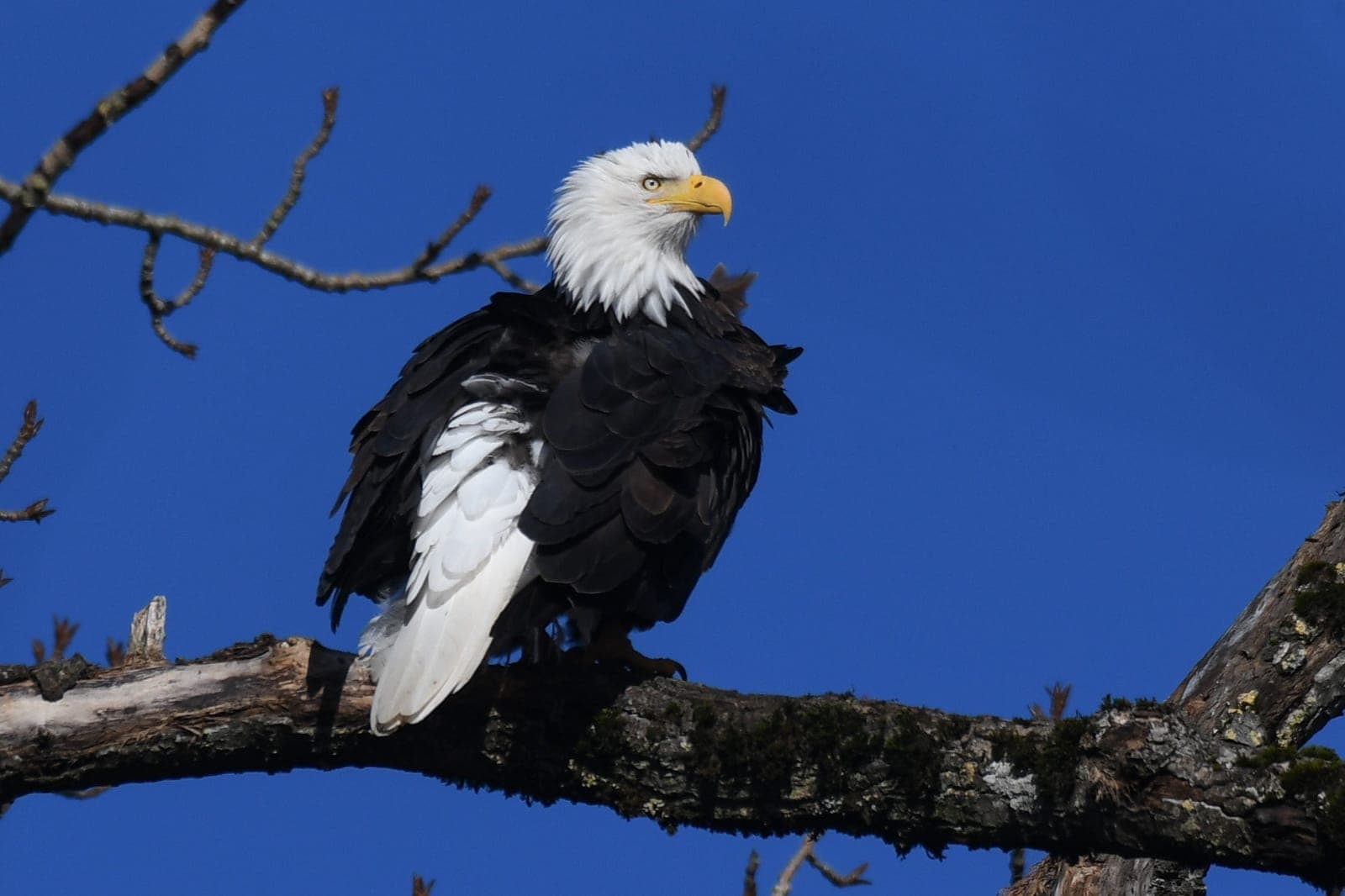
Bald Eagles are far bulkier, with flat, plank-like wings and dark bodies, and adults have a solid white head with no eye stripe. They snatch fish from the surface or steal them instead of plunging in.
Full comparison →Large gulls
At a distance the crooked wings fool people. Gulls have white bodies and pale gray backs, lack the dark eye stripe and wrist patches, and never plunge feet-first into the water.
Range & habitat
Ospreys breed from Alaska and Newfoundland across most of Canada, around the Great Lakes, along the Atlantic and Gulf coasts to Florida, and on lakes, reservoirs and rivers through much of the West. Some are permanent residents in southern Florida, but nearly all other North American breeders winter in Central and South America, with a few staying in Florida and California. Worldwide the species occurs on every continent except Antarctica, making it one of the most widespread birds of prey on Earth.
Any water with plenty of fish near the surface will do: coastal estuaries and salt marshes, large lakes, reservoirs and rivers. Ospreys are most numerous around big coastal estuaries, and the Chesapeake Bay supports what is described as the largest breeding population in the world, roughly 8,000 to 10,000 pairs. They need tall, open-topped nest sites near water — dead or broken-topped trees, utility poles, channel markers, duck blinds and purpose-built platforms — and migrants sometimes cross deserts and mountains far from any water.
Through the seasons
Spring
Ospreys return from the tropics in early spring, and pairs reclaim and rebuild last year's nest. Males court with high circling flights and repeated dives near the nest, often carrying a fish or a stick, before the female lays one to four eggs.
Summer
Incubation runs 36 to 42 days, mostly by the female, while the male fishes for the family. The young make their first flights at about 50 to 55 days, and late summer is prime viewing as juveniles practice fishing and adults hunt all day.
Fall
Ospreys head south from late summer into fall, traveling singly rather than in flocks and often following coastlines, lakeshores, rivers and mountain ridges. Coastal hawk watches see a steady stream of them as they leave the continent.
Winter
Most North American Ospreys spend the winter fishing rivers, lakes and coasts in Central and South America. In the United States, wintering birds are mostly limited to southern Florida and parts of California.
How to find and attract Ospreys
Ospreys are easy to watch wherever there is fishable water and somewhere to nest, and they are one of the few raptors people can actually attract — with a nest platform.
- Scan over shallow bays, lake flats and river shallows for a long-winged bird hovering 30 to 130 feet up.
- Check channel markers, light towers and dead treetops near water for bulky stick nests.
- Listen for loud, whistled chirps, often given when a bird flies in carrying a fish.
- On waterfront property, a sturdy platform on a tall pole near open water can draw a nesting pair.
- Set platforms well away from power lines, which can electrocute large birds.
- Pick up discarded fishing line, which Ospreys weave into nests and can get tangled in.
- Watch nests from shore or a boat at a distance; adults circling and calling overhead mean back off.
Diet & life cycle
What it eats
Fish make up about 99 percent of the Osprey's diet. Typical catches are live fish of roughly 4 to 14 inches and a few ounces to about ten ounces, though Ospreys can handle fish up to around four pounds. The species depend on the water: flounder, smelt and mullet on the coast; suckers, bullheads and gizzard shad inland. An Osprey hunts by sight from about 30 to 130 feet up, hovers briefly, then dives with its talons thrown forward. Its feet are built for the job, with an outer toe that swings backward so it can grip with two toes in front and two behind, spiny pads under the toes and backward-facing scales on the talons. It closes its nostrils as it hits the water and carries its catch head-first to cut drag.
Life cycle
Ospreys usually mate for life and return to the same nest year after year, adding sticks and lining until the pile becomes huge. Both sexes build. The female lays one to four creamy, reddish-spotted eggs and does most of the 36 to 42 days of incubation, while the male brings fish. Chicks hatch at only about two ounces and fly at about 50 to 55 days, raising one brood a year. Most Ospreys begin breeding at three to four years old; where nest sites are scarce, as on the crowded Chesapeake Bay, some do not start until five to seven.
Oldest on record
The oldest Osprey in the USGS Bird Banding Laboratory longevity records was at least 25 years and 2 months old. It was banded as a nestling in Virginia in June 1973 and found dead in Virginia in August 1998.
SourceAttracting & watching
Ospreys are the rare raptor that can be invited in. A sturdy platform on a tall pole near open water — a lake shore, marsh edge or bay — gives a pair the open-topped nest site they look for, and once a pair settles, the nest can be watched from a respectful distance for years. Ospreys, their nests and their eggs are protected under the Migratory Bird Treaty Act, so an active nest cannot be moved or removed without a federal permit.
Conservation
Least Concern (IUCN). Egg collecting and shooting hurt Ospreys in the late 1800s and early 1900s, then DDT and related pesticides thinned eggshells and crashed populations in the 1950s and 1960s; the Chesapeake Bay population fell to an estimated 1,450 pairs by the early 1970s. After DDT was banned in 1972 and nest platforms went up, numbers climbed back across North America, and the Chesapeake now holds roughly 8,000 to 10,000 pairs.