How to identify a house wren
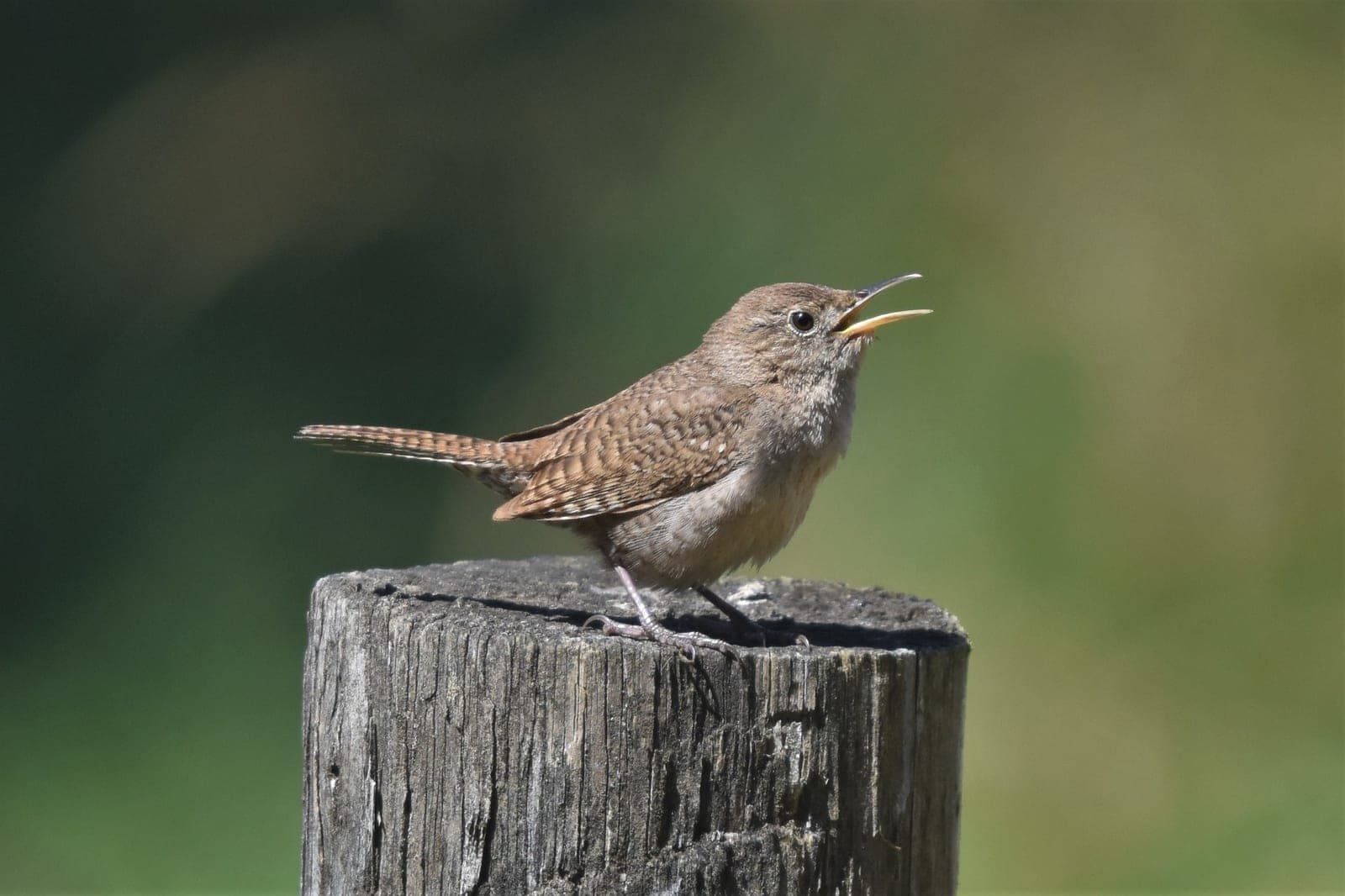
House Wrens are tiny, round-bodied songbirds with a thin, slightly curved bill and a short tail that is often cocked up over the back. They are plain gray-brown to warm brown above and paler buff-gray below, with fine black barring on the wings and tail and often faint bars on the flanks. The face is unmarked except for a faint pale eyebrow and a thin, pale eyering, which sets them apart from wrens with bold white eyebrows. Birds in the Arizona mountains can be warmer buff on the throat. House Wrens are hyperactive, bouncing through shrubs, brush piles and fences, and their song is a long, gurgling cascade that rises and then tumbles down; their scold is a harsh, buzzy chatter.
- Small, plain brown wren with no bold eyebrow
- Fine black barring on wings and tail
- Short tail often cocked upward
- Thin, slightly curved bill
- Loud, bubbling song that rises then falls
Look-alikes
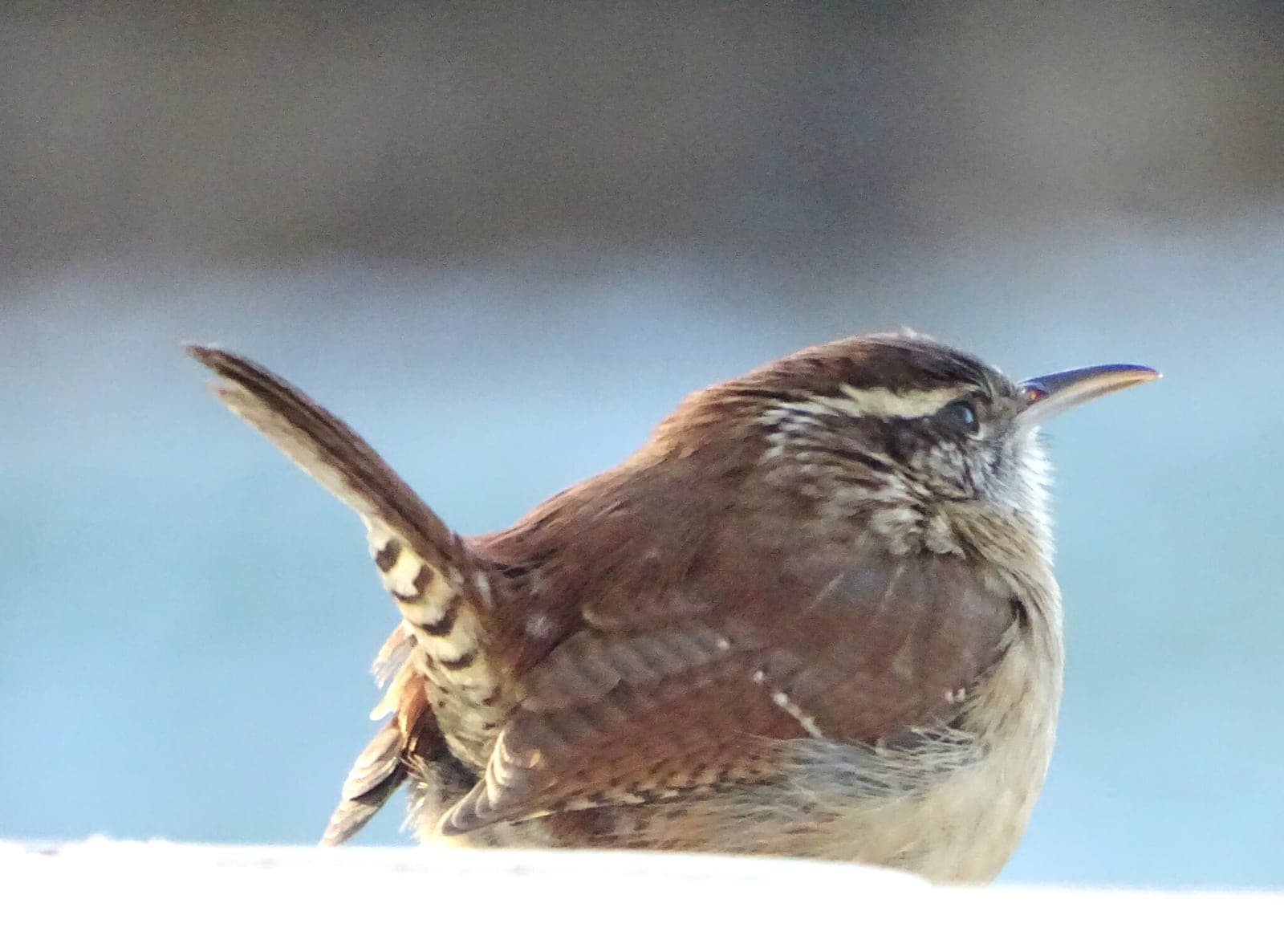
Carolina Wren
Carolinas are bigger and richer rusty-brown, with a bold white eyebrow and warm buff underparts. They stay year-round in the East and sing a loud, rolling 'teakettle-teakettle.'
Bewick's Wren
Bewick's Wrens have a long, flicking tail with white corners and a striking white eyebrow over grayish-brown upperparts. They are found mainly in the West and Southwest.
Winter Wren
Winter Wrens are smaller and darker, with a stubby tail and heavily barred belly and flanks. They creep along the forest floor and sing a long, tinkling song, and are seldom found around houses.
Range & habitat
House Wrens breed across southern Canada and much of the United States and into Mexico. Most migrate, wintering in the southern United States and Mexico. Until 2024 the House Wren was treated as one species reaching all the way to Tierra del Fuego; the eBird/Clements checklist now splits it into the Northern House Wren of North America, which keeps the name Troglodytes aedon, and the Southern House Wren, which ranges from southern Mexico through Central and South America, plus five Caribbean island species.
House Wrens like semi-open places with trees and shrubs: suburban yards, parks, orchards, farm woodlots, open forest, streamside groves and mountain pine-oak woods. Densities are highest in floodplain forests of the western Great Plains, where old woodpecker holes are plentiful. Anything with a hole will do for a nest. In winter they keep to thickets, streamside brush and other dense, low cover.
Through the seasons
Spring
Most House Wrens return from late April to May, males slightly ahead of females. Males sing almost constantly and pack twigs into nest boxes and cavities across their territories.
Summer
Pairs raise two broods, rarely three, and some females leave the first brood with the male while they nest again with another male. Parents shuttle insects to big broods all day.
Fall
House Wrens grow quiet and slip away to the south from about September to early October, skulking in brush along the way.
Winter
Wintering birds stay low in thickets and streamside brush from the southern states into Mexico. A harsh scolding chatter from a brush pile is often the only sign of them.
How to find and attract House Wrens
Few birds take to a birdhouse faster than a House Wren. A small box with a 1-inch hole near shrubs or trees is usually claimed within days of the males' return in spring; after that, just listen for the song.
- Put up a wren box with a 1-inch entrance hole, about 8 inches deep inside.
- Mount it 5 to 10 feet up on a building, tree or pole, within about 100 feet of shrubs or trees.
- Space wren boxes about 100 feet apart, as NestWatch recommends.
- Put boxes meant for bluebirds or swallows at least 100 feet away from wren boxes, in more open ground.
- Leave brush piles and dense shrubs for the insects and spiders wrens hunt.
- Skip insecticides; House Wrens feed their young almost entirely on insects and spiders.
- Watch the female inspect the male's stick-filled cavities in spring; she makes the final choice.
Diet & life cycle
What it eats
House Wrens are insect hunters that forage at every level, though usually low, searching leaves, twigs, bark and the ground. They eat beetles, true bugs, grasshoppers, crickets, caterpillars, moths and flies, and catch many spiders, plus some millipedes and snails. They are almost entirely insect-eaters, so seed feeders hold little for them.
Life cycle
The male claims a territory by singing and builds stick foundations in several cavities, then shows them to a female. She picks one, sometimes throwing out sticks she does not like, and finishes it with a soft cup of grass, plant fibers, hair, feathers and spider cocoons. Clutches are usually six or seven white eggs heavily dotted with reddish brown, sometimes three to ten. The female incubates for about 12 to 15 days while the male brings food, and both parents feed the young, which leave the nest after about 12 to 18 days. House Wrens often puncture the eggs of other cavity-nesting birds nearby, including other wrens, and fill other nests with sticks.
Oldest on record
The oldest House Wren in the USGS Bird Banding Laboratory longevity table was at least 9 years old. It was banded as a nestling in New York in June 1984 and recaptured and released there in June 1993.
SourceAttracting & watching
A small nest box with a 1-inch hole, 5 to 10 feet up near shrubs, is all it usually takes to host a pair. Brush piles, dense shrubs and a pesticide-free yard supply the insects and spiders they eat. Keep boxes for bluebirds, swallows and chickadees well away from wren boxes. House Wrens are easy to watch around yards, parks and farms from late spring through summer. They are protected under the Migratory Bird Treaty Act.
Conservation
Least Concern (IUCN). House Wrens are widespread and common, with Partners in Flight estimating about 190 million birds. The Breeding Bird Survey shows some regional declines, but overall numbers were stable to slightly increasing from 1966 to 2019. In the 1800s they declined in places after introduced House Sparrows began taking their nest sites.