Birds · Side by side
European Starling vs Common Grackle
How to tell them apart
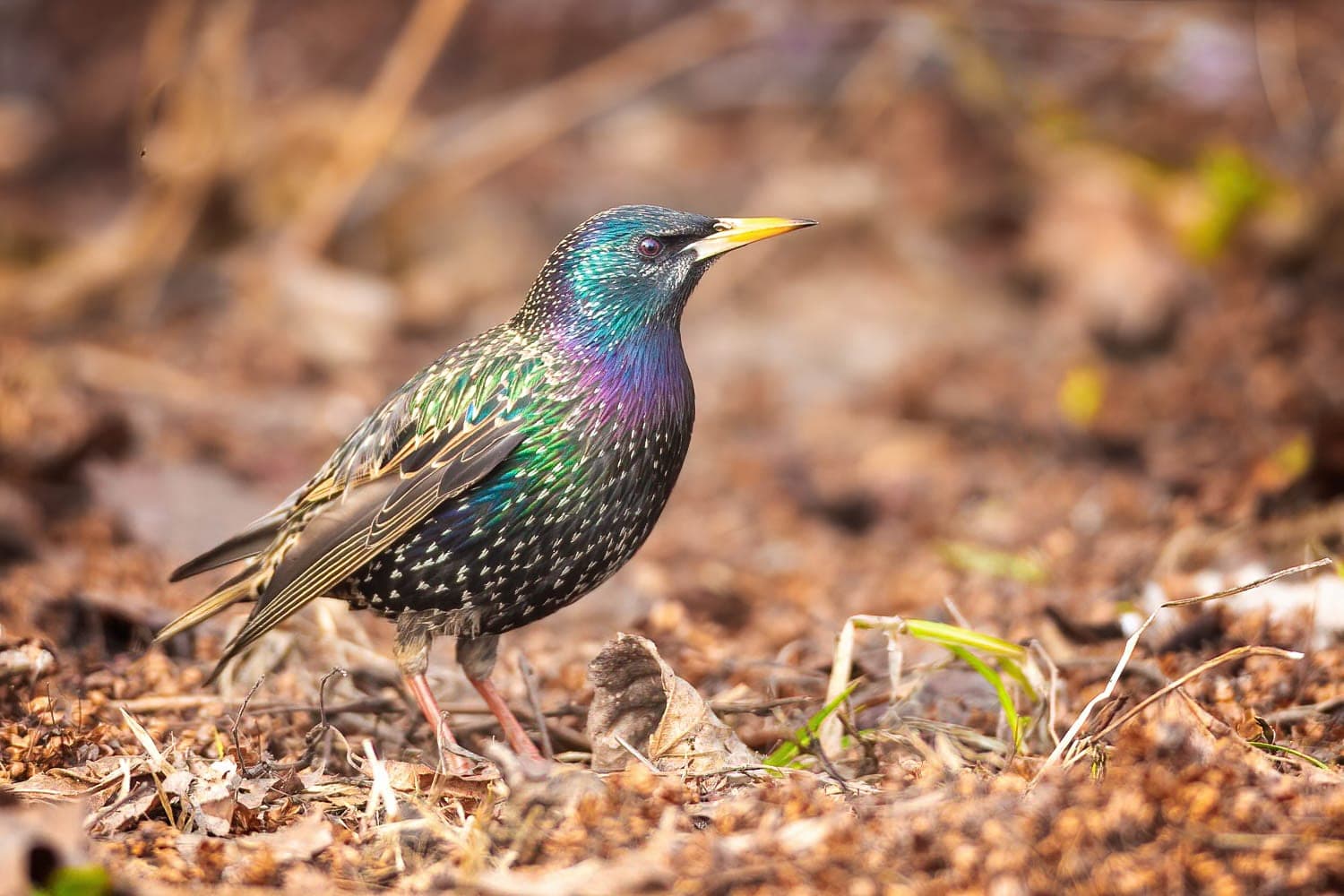
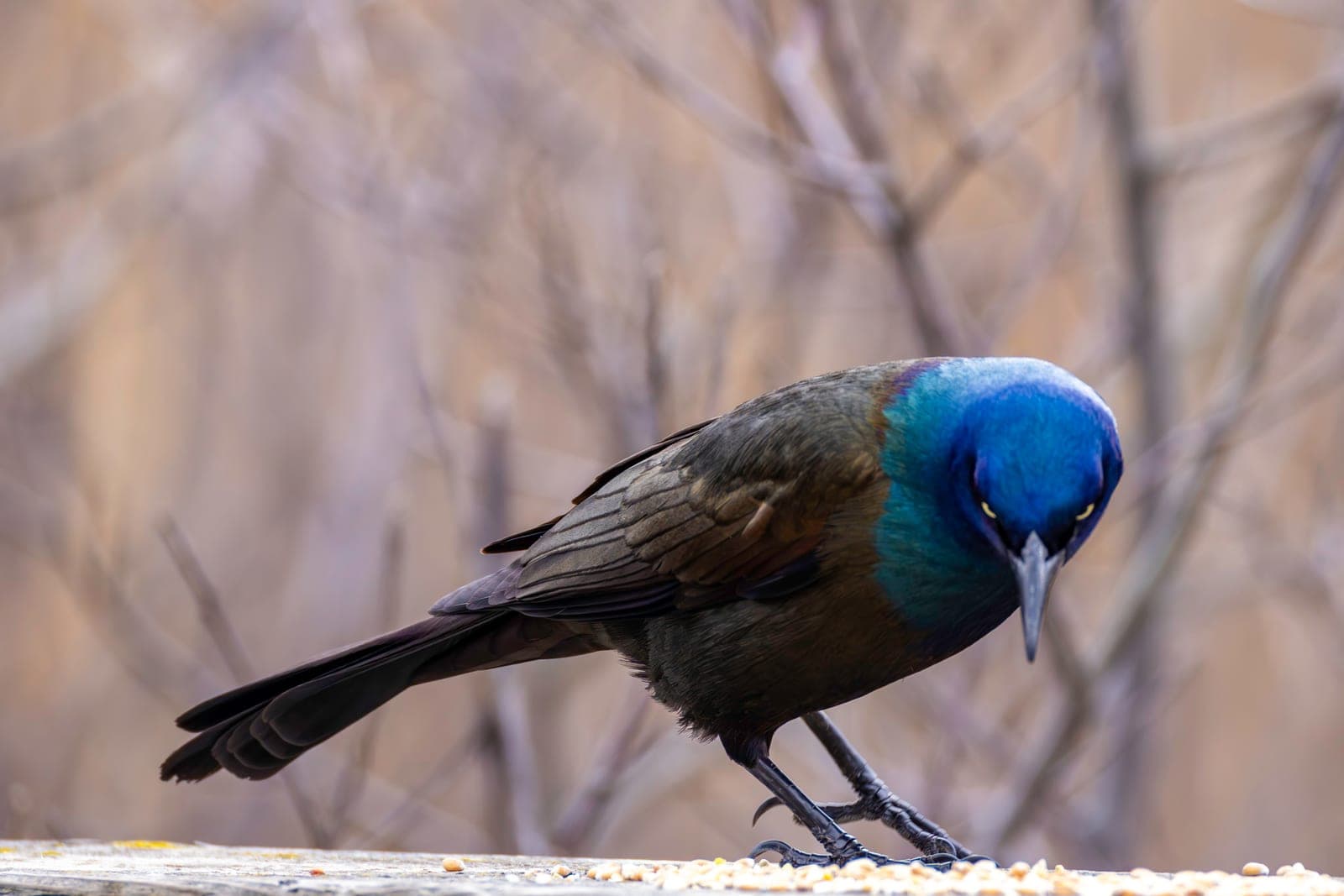
Quick answer
Look at the tail and the eye: a common grackle has a long, keel-shaped tail and pale yellow eyes, while a European starling has a short, square tail, dark eyes and, in spring and summer, a bright yellow bill.
European starlings and common grackles are the dark, glossy birds that walk across lawns and parking lots and crowd platform feeders in flocks. Both shine purple and green in the sun, and they often feed and roost together, so they are easy to confuse. One is a native blackbird; the other is an introduced species from Europe. Here is how to tell them apart.
Key differences
| Trait | European Starling | Common Grackle |
|---|---|---|
| Length | 8–9 in, stocky | 11–13.4 in, lanky |
| Tail | Short and square | Long and keel-shaped, often held in a V |
| Eyes | Dark at every age | Pale yellow in adults |
| Bill | Yellow in breeding season, dark in winter; slender and pointed | Dark all year; long, heavy and slightly curved |
| Plumage | Glossy purple-green in spring; covered in white spots in fall and winter | Blue-purple head with a bronze or purple body; no spots |
| Flight shape | Short, pointed triangular wings and a stubby tail | Longer wings and a long tail trailing behind |
| Nest | Cavities: tree holes, nest boxes, building gaps | Open cup in dense trees, especially conifers |
| Origin and legal status | Introduced from Europe; not protected by the Migratory Bird Treaty Act | Native; protected by the Migratory Bird Treaty Act |
Seasonal looks that fool people
Starlings change more through the year than grackles do. In fall, a starling grows new feathers with bright white tips that make it look spangled with stars, and its bill turns dark. Over winter the white tips wear away, and by spring the bird is a glossy purple-green with a yellow bill, the base blue in males and pink in females. Juvenile starlings in summer are plain gray-brown with dark bills. Grackles stay much the same all year, although juveniles have dark eyes and molting adults in late summer can look ragged and short-tailed, which is when they are easiest to mistake for a starling.
Native versus introduced
North America's starlings descend largely from about 60 birds released in New York's Central Park in 1890. They now number well over 100 million across the continent and compete with native cavity nesters such as bluebirds and Red-headed Woodpeckers for nest holes. Because they are introduced, starlings are not protected under the Migratory Bird Treaty Act. The common grackle is a native blackbird protected by that law, even though a federal depredation order lets it be controlled where it seriously damages crops. Both species have declined since the 1960s, but only the grackle is now listed as Near Threatened.
Voices and behavior
Starlings are gifted mimics: their songs mix whistles, clicks, rattles and wheezes with copied bits of other birds' calls and other sounds. Grackles have a short, creaky song often compared to a rusty hinge, plus loud 'chack' calls. Both walk rather than hop, but starlings keep probing the soil with their bills as they go, while grackles stride along with a high-stepping strut. In winter, both join huge mixed roosts with red-winged blackbirds and cowbirds, and starlings form the swirling flocks known as murmurations.
By the numbers
The traits the daily bird game compares for each.
| Clue | European Starling | Common Grackle |
|---|---|---|
| Group | Starlings | Blackbirds & orioles |
| Colors | Black | Black, Blue |
| Habitat | Backyards | Backyards |
| Region | Nationwide | Eastern |
| Length | 9 in | 12 in |
| Wingspan | 14 in | 16 in |
| Diet | Omnivore | Omnivore |
FAQ
Are starlings and grackles related?
Not closely. Grackles belong to the New World blackbird family, Icteridae, while starlings are in the Old World starling family, Sturnidae, which also includes mynas.
Why do starlings have white spots in winter?
Their fresh fall feathers have white or buff tips. The tips wear off over the winter, so by spring the same bird looks glossy black with little or no spotting, without molting.
How can I keep starlings and grackles off my feeders?
Switch to safflower or nyjer, avoid suet and scattered seed on the ground, and use tube or caged feeders with short perches. Nest boxes with entrance holes 1 1/2 inches or smaller keep starlings out.
Which one lives longer?
The USGS banding records favor the grackle: the oldest known common grackle was at least 23 years old, while the oldest known European starling was about 15 years and 3 months old.
Could you tell them apart from a few clues? Test yourself in today's puzzle.
Play the daily bird game