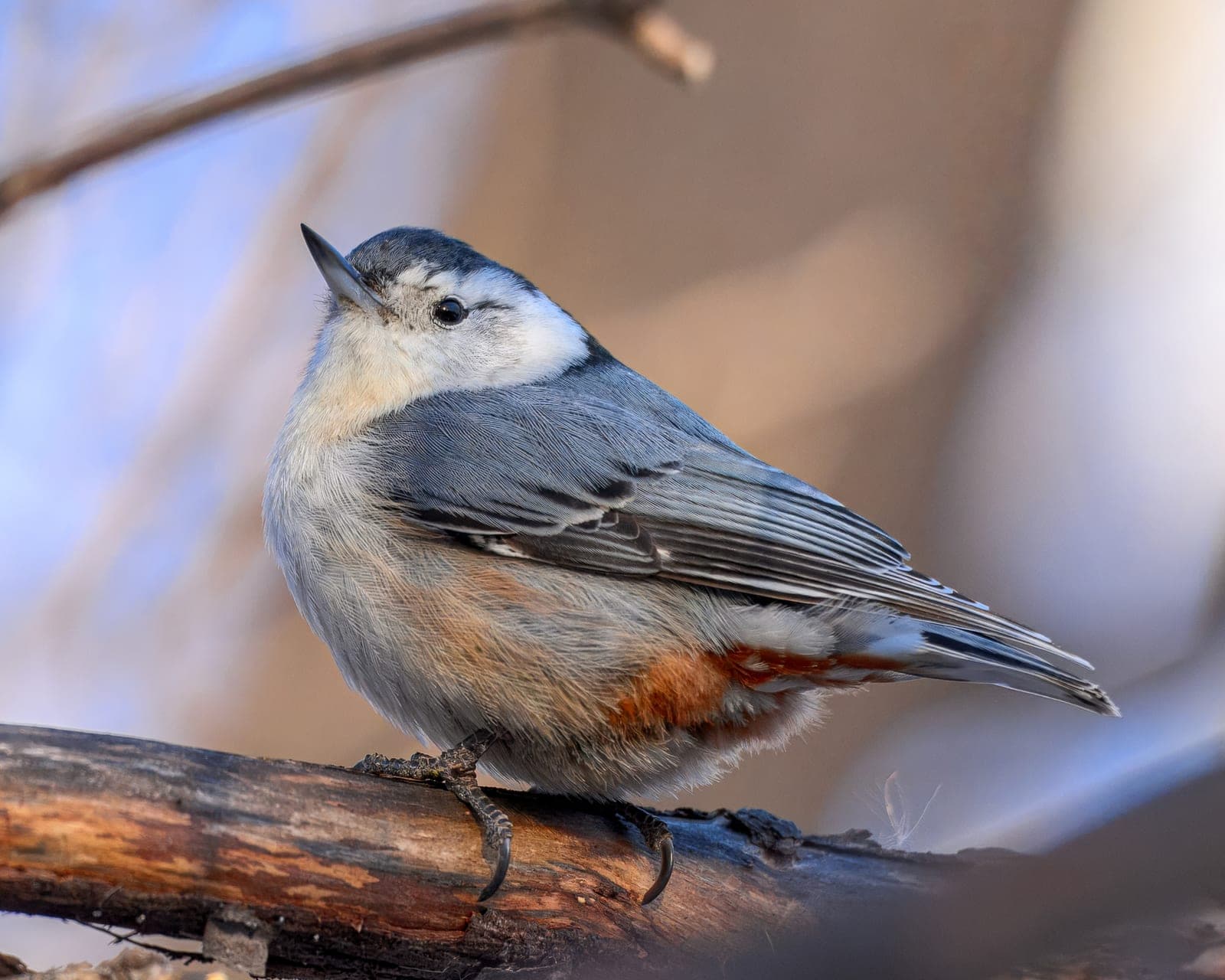
How to identify a white-breasted nuthatch
Nuthatches are chunky, big-headed and nearly neckless, with a short tail and a long, straight, slightly upturned bill. The back and wings are soft blue-gray. The face and underparts are clean white, and the black eye sits alone on the white face. A narrow cap runs from the bill down the back of the neck: glossy black on males, and often gray on females in the East, though females in some regions have black caps too. The lower belly and undertail are washed with chestnut. In flight, white patches show near the corners of the short tail.
- Climbs headfirst down trunks and along the undersides of limbs
- Black or gray cap and nape over an all-white face
- Blue-gray back with a short tail
- Long, thin, slightly upturned bill
- Chestnut wash under the tail
Look-alikes
Red-breasted Nuthatch
Red-breasted Nuthatches are smaller, with a black stripe through the eye under a white eyebrow and rusty-orange underparts. They favor conifers and give a higher, tinny 'yank' like a toy horn.
Black-capped Chickadee
Chickadees also have a black cap, but they wear a black bib, have a longer tail and a tiny bill, and flit through twigs instead of creeping along trunks.
Downy Woodpecker
Downy Woodpeckers are black and white with a white stripe down the back and white-spotted wings, and males have a red patch on the nape. They hitch up trunks braced on a stiff tail and never climb down headfirst.
Brown Creeper
Brown Creepers are streaky brown above with a thin, curved bill, and they spiral up tree trunks, then fly down to the base of the next tree to start again.
Range & habitat
White-breasted Nuthatches live year-round from southern Canada across most of the lower 48 states, south to northern Florida and the Gulf Coast, and through the mountains of the West into southern Mexico. They are scarce or absent wherever big trees are few, such as much of the open Great Plains, sagebrush country and low deserts. Birds in the East, the interior West and the Pacific states differ in voice, and ornithologists have debated splitting them into separate species.
Nuthatches need big trees. They live in mature deciduous and mixed forest, woodlots, river groves, oak and pine-oak woodland in the West, and leafy suburbs, parks and cemeteries with large old trees. They prefer edges and open woods over unbroken conifer forest, and they rely on large natural cavities or old woodpecker holes for nesting, so dead limbs and old trees are important.
Through the seasons
Spring
Courtship starts in late winter: the male bows, spreads his tail, droops his wings and sways, and feeds the female. Pairs settle into a tree cavity, and the female builds the nest.
Summer
Adults feed the young entirely on insects and spiders. After fledging, families move through the woods together, and young birds learn to forage on trunks and limbs.
Fall
Nuthatches cache seeds one at a time in bark crevices across their territory. In occasional years, some birds from the North and West move south, though far less often than Red-breasted Nuthatches do.
Winter
Pairs join mixed flocks with chickadees, titmice, kinglets and woodpeckers, and visit feeders often. Seeds can make up more than half the winter diet, and in severe cold several birds may roost together in a cavity.
How to find and attract White-breasted Nuthatches
Listen for the nasal 'yank-yank' and scan big trunks and limbs for a gray bird moving headfirst downward. In winter, check any flock of chickadees and titmice; a nuthatch pair is usually close by.
- Offer black-oil sunflower seed, shelled peanuts and suet; nuthatches often fly off and wedge a seed into bark.
- A suet feeder on a tree trunk suits their climbing style perfectly.
- Keep large, mature trees, especially oaks, and leave dead limbs where safe for natural cavities.
- Nest boxes are rarely used, but a large box on a tree in mature woods can occasionally attract a pair.
- Watch for a nuthatch wedging an acorn or sunflower seed into bark, then hammering it open with its bill.
- Learn the song, a series of low, whistled notes that sounds quite different from the nasal call.
Diet & life cycle
What it eats
In summer, White-breasted Nuthatches eat mostly insects and spiders gleaned from bark: caterpillars, beetles and their larvae, ants, scale insects and more. As fall arrives, acorns and other nuts and seeds take over, and they can make up more than 60% of the winter diet. Nuthatches wedge large seeds into bark and hammer them open, and they store food in crevices around their territory.
Life cycle
Pairs hold a territory together all year and may mate for life. They nest in a large natural cavity or an old woodpecker hole, usually 15 to 60 feet up. The female builds a simple cup of bark fibers, grass, twigs and hair inside. Both birds may sweep the nest entrance with a crushed insect held in the bill, a habit that may leave scents that discourage squirrels. The female lays five to nine eggs and incubates them for about 12 to 14 days while the male feeds her. The young fledge at roughly two to three and a half weeks old, and pairs raise one brood a year.
Oldest on record
The oldest White-breasted Nuthatch in the USGS Bird Banding Laboratory's longevity table was banded as an adult in Colorado in January 1962 and found dead there in March 1971, at least 9 years 9 months old.
SourceAttracting & watching
Nuthatches are steady feeder birds wherever big trees grow nearby. Black-oil sunflower seed, peanuts and suet are the best foods, and a suet cage on a trunk is ideal. They visit birdbaths year-round. Unlike chickadees, they seldom use nest boxes, so keeping mature trees with cavities and dead limbs is the best way to keep them nesting in the neighborhood.
Conservation
Least Concern (IUCN). White-breasted Nuthatches are common, with about 10 million birds, and Breeding Bird Survey data show increases of more than 1% a year between 1966 and 2019. Local declines have been linked to the removal of the dead trees and large old trees they need for nesting. They are protected under the Migratory Bird Treaty Act.