How to identify a black-capped chickadee
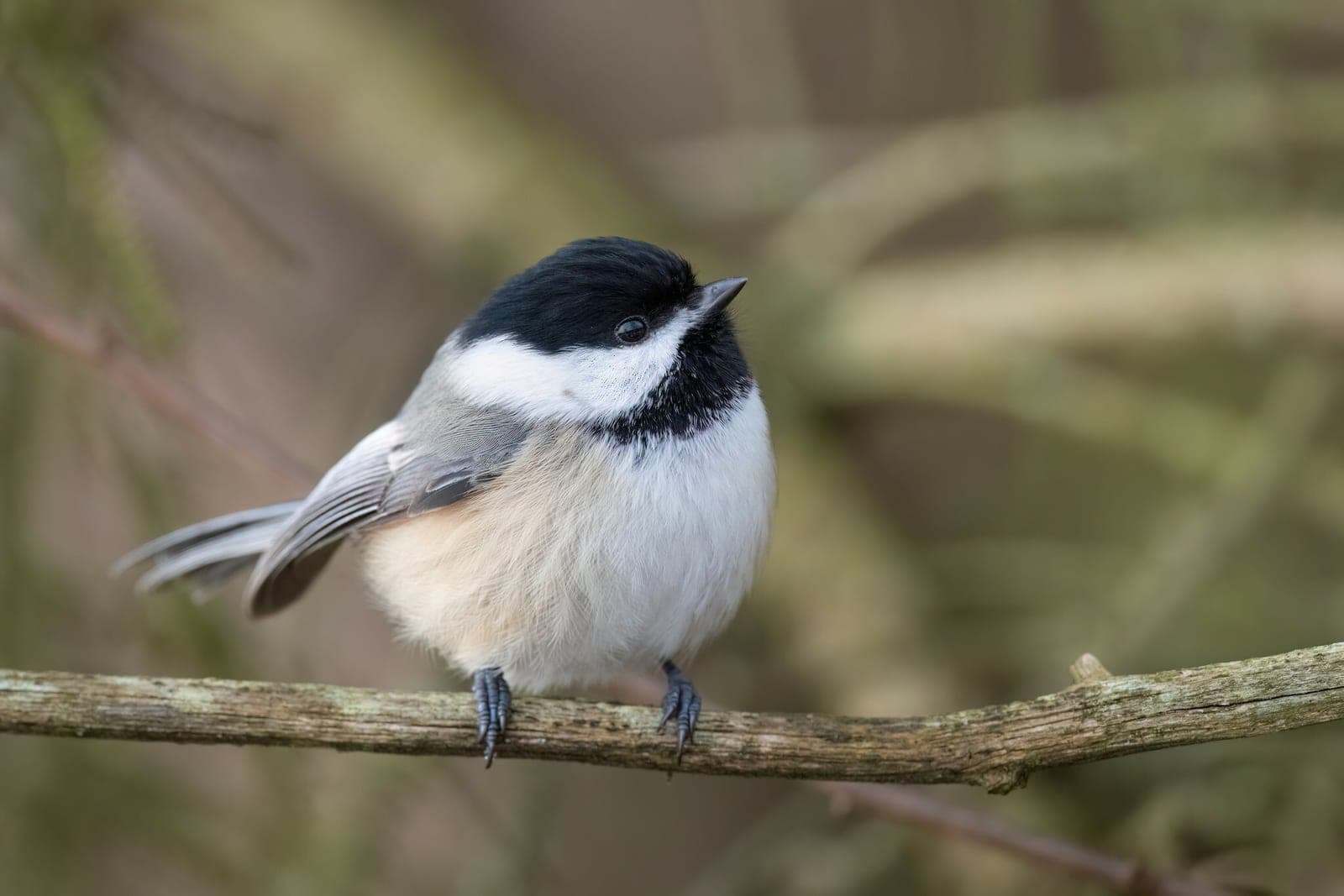
A chickadee is round-bodied and big-headed, with a short neck, a small black bill and a fairly long, narrow tail. The cap and the bib under the chin are solid black, and the cheeks between them are bright white. The back is soft gray, the underparts whitish with buffy or peach-washed flanks, and the gray wings show crisp white edges on the folded feathers. Males and females look alike. Chickadees rarely sit still: they flit between twigs, hang upside down to pick at bark and buds, and dart to a feeder, grab one seed and fly off with it.
- Solid black cap and black bib
- Bright white cheeks between cap and bib
- Buffy wash on the flanks
- Clean white edges on the folded wing feathers
- Says its name: 'chick-a-dee-dee-dee'; song a whistled 'fee-bee'
Look-alikes
Carolina Chickadee
The Carolina Chickadee of the Southeast is nearly identical but slightly smaller, with grayer wing edges, a neater lower edge to the bib, and a faster, higher song with more notes. Where the two meet they hybridize and can learn each other's songs, so location is often the best clue.
Mountain Chickadee
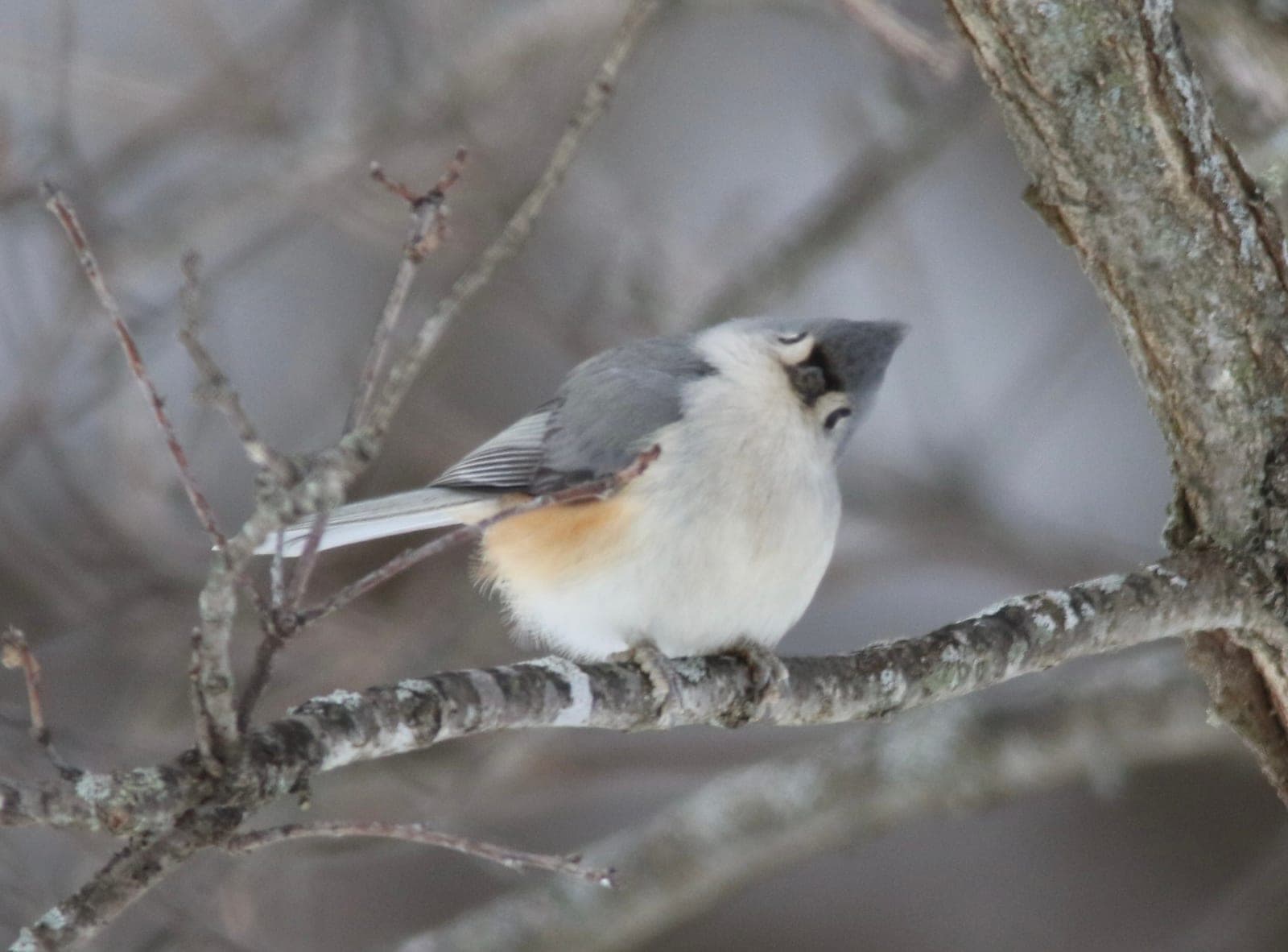
Mountain Chickadees of western conifer forests have a white stripe over the eye that breaks up the black cap. Black-capped Chickadees never show that eyebrow.
Boreal Chickadee
Boreal Chickadees of northern spruce forests have a brown cap, brown flanks and a wheezy, nasal call. The cap is never black.
House Sparrow
A male House Sparrow also has a black bib, but its crown is gray, its back is streaked brown and chestnut, and it has a thick, finch-like bill. It hops on the ground far more than a chickadee.
Range & habitat
Black-capped Chickadees live year-round from western and central Alaska across the forested parts of Canada to Newfoundland, and south across the northern half of the lower 48 states. In the East the southern edge runs roughly through the central Midwest, Pennsylvania and New Jersey, with birds farther south along the high Appalachians; the Carolina Chickadee replaces them across the Southeast. In the West they reach south through the Rockies into northern New Mexico.
These chickadees favor deciduous and mixed woods, especially edges and open woods with birches, alders, willows and cottonwoods. They avoid pure conifer forest where Mountain or Boreal Chickadees take over. They do well in suburbs, parks and farm woodlots as long as there are trees with soft, rotting wood for nest holes.
Through the seasons
Spring
Winter flocks break up and pairs claim territories, and the whistled 'fee-bee' song rings out from late winter on. Nesting runs from about late April through June.
Summer
Adults feed their young mostly caterpillars. By midsummer family groups roam the woods together, and recently fledged chickadees, with short tails and fluffy plumage, beg noisily from parents.
Fall
Chickadees store seeds and insects in bark, curled leaves and needle clusters, and the brain region that handles spatial memory grows in fall. In some years large numbers move south in irruptions, mostly through the Northeast.
Winter
Chickadees form the core of mixed flocks with nuthatches, kinglets, creepers and woodpeckers. On cold nights they let their body temperature drop by as much as about 12°C (around 20°F) to save energy, then refuel at dawn.
How to find and attract Black-capped Chickadees
Chickadees are usually the first birds to find a new feeder and the bravest around people. In winter woods, follow the 'chick-a-dee' calls; other small birds are often traveling with them.
- Black-oil sunflower seed is the favorite, followed by hulled sunflower, peanuts and suet.
- Tube feeders, hoppers and suet cages all work, since chickadees cling easily.
- Put up a nest box with a 1 1/8-inch entrance hole, about 5 to 20 feet up near trees, before early spring.
- Leave dead or dying trees and stubs standing where safe; chickadees dig nest holes in soft, rotting wood.
- Plant native trees and shrubs such as birch, willow and oak that host the caterpillars chickadees feed their young.
- With patience, many chickadees learn to take sunflower seeds from an outstretched hand.
Diet & life cycle
What it eats
Chickadees eat mostly insects and spiders in summer, especially caterpillars, with only a small share of plant food. In winter they rely on a mix of insect eggs and pupae picked from bark and twigs, plus seeds and berries, and plant food can make up about half the diet. They also peck fat from dead animals. Chickadees store food one item at a time in hundreds of separate spots and can find them again weeks later.
Life cycle
Pairs form in fall and stay together in the winter flock. In spring both birds dig out or enlarge a cavity in soft, rotting wood, or take an old woodpecker hole or a nest box, usually 5 to 20 feet up. The female builds a cup of moss lined with hair and fur and lays six to eight tiny eggs, covering them with nest material when she leaves. She incubates them for about 12 to 13 days while the male brings her food. The young leave the nest at about 12 to 16 days old. Most chickadees live only two or three years.
Oldest on record
The oldest Black-capped Chickadee in the USGS Bird Banding Laboratory's longevity table was banded as a young bird in New York in November 2009 and recaptured and released there in March 2021, at least 11 years 9 months old.
SourceAttracting & watching
Chickadees are the easiest feeder birds to attract: black-oil sunflower seed, peanuts and suet will bring them in almost anywhere within their range, all year. They take readily to nest boxes with a 1 1/8-inch hole, and a heated or open birdbath helps in winter. Native trees that feed caterpillars are what really sustain them in nesting season.
Conservation
Least Concern (IUCN). Black-capped Chickadees are common and widespread, with about 43 million birds. Breeding Bird Survey data show a slight overall increase between 1966 and 2019, with small western declines outweighed by eastern gains. Window collisions and outdoor cats kill many. They are protected under the Migratory Bird Treaty Act.