How to identify a snowy owl
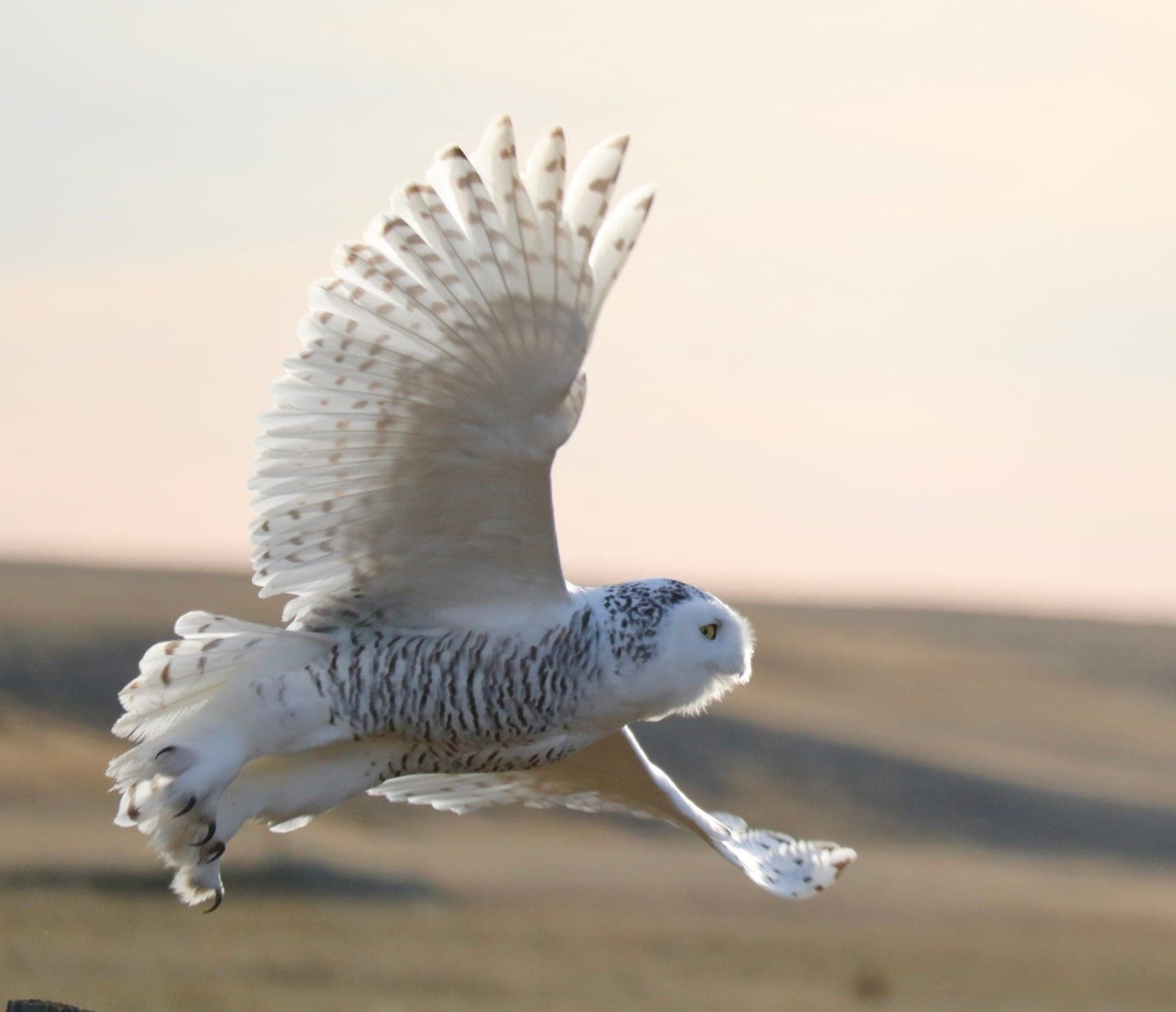
Snowy Owls are big, bulky, round-headed owls with yellow eyes and tiny ear tufts that are almost never visible. Adult males are nearly pure white, sometimes with a few dark spots, and tend to get whiter with age. Females and young birds are barred with dark brown across the body and wings, and young females are the darkest of all, so a heavily marked bird is often a first-winter female. The legs and toes are buried in thick white feathers, the longest toe feathering of any owl. Unlike most owls, Snowies are often active by day, and they like to sit on the ground, a fence post, a dune or a rooftop, where they can pass for a lump of snow or a pale rock.
- Big white owl with yellow eyes
- Dark barring heaviest on young females, nearly absent on old males
- Round head without visible ear tufts
- Legs and feet thickly feathered in white
- Sits on open ground or low perches in daylight
Look-alikes
Barn Owl
Barn Owls look white at night but are much smaller and lankier, with a heart-shaped white face, dark eyes and a golden-buff back. They hunt after dark and roost hidden in barns and cavities, not out in the open.
Great Horned Owl
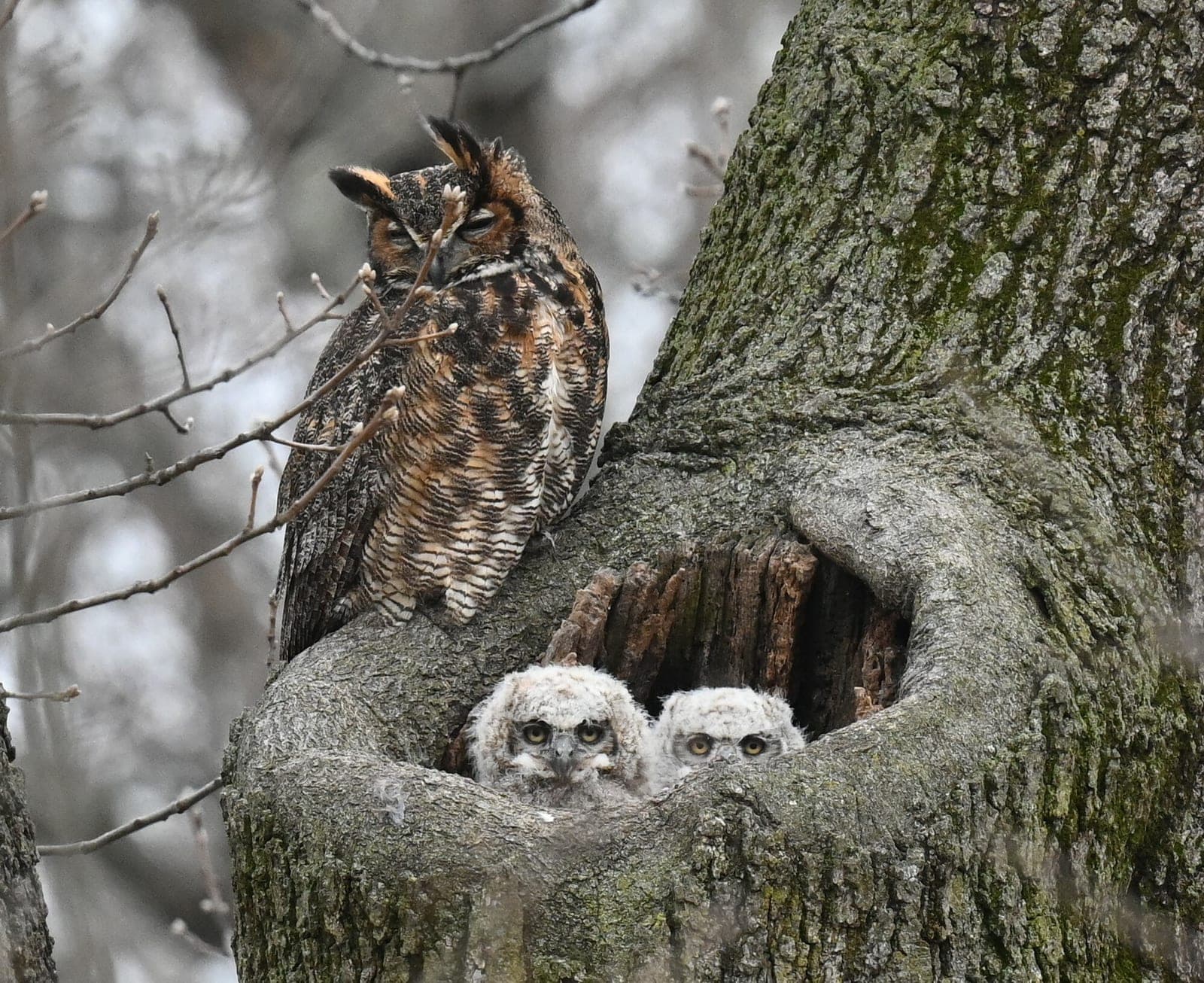
Pale northern Great Horned Owls can look washed-out, but they have long ear tufts, a barred gray-buff body and a white throat bib, and they usually perch in trees.
Range & habitat
Snowy Owls breed on Arctic tundra around the top of the world, in North America from western and northern Alaska across northern Canada to Greenland, mostly north of 60 degrees north. In winter they spread across the Canadian prairies, the northern Great Plains, the Great Lakes region and the Northeast coast, and in irruption years some reach far beyond. Many also spend part of the winter out on ice floes in the Bering Sea, the Atlantic and even the Great Lakes.
On the breeding grounds Snowy Owls use open, rolling tundra, from hilly country to wet coastal flats, nesting on a rise with a wide view. In winter they look for places that resemble home: big, flat, treeless country such as farm fields, prairies, coastal dunes, salt marshes, lakeshores and frozen lakes. Airports are favorite wintering sites; Boston's Logan International Airport holds one of the most reliable wintering groups in the United States, and some airports trap and relocate owls to prevent bird strikes.
Through the seasons
Spring
Wintering owls head back north in late winter and spring. On the tundra, males claim territories with far-carrying hoots and display flights, and where lemmings are plentiful pairs settle in quickly; where lemmings are scarce, many skip nesting altogether.
Summer
Nesting runs through the short Arctic summer under nearly round-the-clock daylight. Females lay 3 to 11 eggs depending on prey, and incubate for 31 to 33 days while males hunt. Chicks leave the nest at two to three weeks, before they can fly, and fly well at about seven weeks.
Fall
Young owls leave the tundra in fall, and first-year birds tend to travel farther south than adults. After a big breeding season with plenty of lemmings, unusually large numbers of juveniles head south, setting up an irruption winter.
Winter
Winter is Snowy Owl season for most birders. In irruption winters such as 2011–12 and 2014–15, owls appear far south of their usual range, and roughly nine in ten of those that can be aged are first-winter birds.
How to find Snowy Owls
Snowy Owls cannot be attracted, but in a good winter they are surprisingly easy to find if you search the right kind of wide-open country in daylight with good binoculars.
- Check eBird and local birding reports in early winter to see whether an irruption is under way.
- Scan big open fields, shorelines, jetties, dunes and airport perimeters through the winter months.
- Look for a white lump on the ground, a fence post, a hay bale or a rooftop, especially near dawn and dusk.
- Stay in the car or well back; if the owl turns to stare at you or shifts its feet, you are too close.
- Never bait owls with mice for photos; it draws them toward roads and people.
- Report any banded or tagged Snowy Owl so researchers can track its movements and survival.
Diet & life cycle
What it eats
In the Arctic, Snowy Owls live largely on brown and collared lemmings, and in some places lemmings are nearly all they eat; nesting success rises and falls with lemming numbers. They also take voles, Arctic hares, ptarmigan, ducks, eiders, shorebirds, seabirds and small songbirds, plus fish and carrion. In winter the menu shifts to whatever open country offers: meadow voles, deer mice, pocket gophers, rats, rabbits and waterbirds. At Logan Airport, analysis of more than 6,000 pellets showed meadow voles and brown rats dominating, with many birds mixed in. Most hunting is done from a perch, watching and listening, followed by a swift chase.
Life cycle
Snowy Owls are nomads that follow the lemmings, and many skip breeding entirely in poor lemming years. The female scrapes a shallow, unlined bowl on a raised hummock with a good view and lays 3 to 11 eggs at intervals, so the chicks hatch days apart and the oldest may dwarf the youngest. She incubates alone for 31 to 33 days while the male hunts and brings food. Young leave the nest at two to three weeks, fly at about seven weeks and are fed by their parents for at least nine to ten weeks. Adult plumage takes about three to four years, and a typical lifespan in the wild is around ten years.
Oldest on record
The oldest Snowy Owl in the USGS Bird Banding Laboratory longevity records was a female at least 23 years and 10 months old. She was banded in Massachusetts in March 1992, in her second year, and caught again and released alive in Massachusetts in April 2015.
SourceAttracting & watching
Snowy Owls never come to feeders and should not be fed. Watching them is a winter road-and-shoreline game: open farmland, coastal beaches and dunes, big lakeshores and the edges of airports, scanned from a car or a public trail with a spotting scope or long lens. Many wintering owls are young birds, and every flush costs them energy. Snowy Owls are protected under the Migratory Bird Treaty Act, so harassing, capturing or keeping one, or its feathers, is illegal without a permit.
Conservation
Vulnerable (IUCN). Snowy Owls were long thought to number in the hundreds of thousands, but better surveys in the 2010s showed far fewer. A 2024 status review in Bird Conservation International estimated only 14,000 to 28,000 breeding adults worldwide, found Arctic breeding populations down by more than 30 percent over three generations, and recommended keeping the Vulnerable listing the IUCN first applied in 2017. North American numbers are thought to have fallen by roughly half since the 1960s. Climate change, which disrupts lemming cycles and sea ice, is considered the main long-term threat, while vehicle strikes, aircraft collisions, shooting and rodent poison kill wintering birds.