How to identify a barred owl
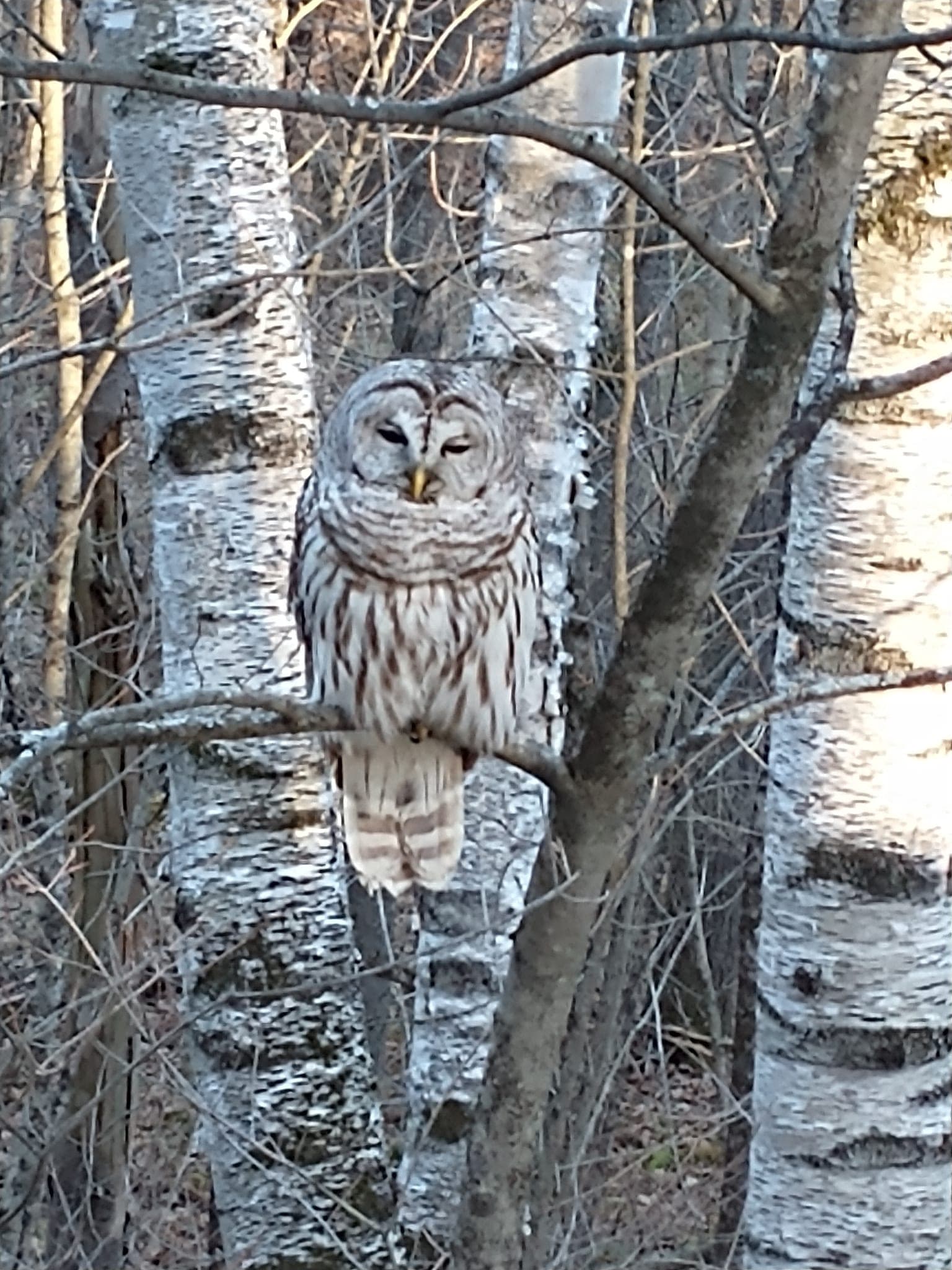
Barred Owls are large, round-headed owls with no ear tufts, gray-brown to brown above with white spots and scalloped bars. The name comes from the pattern below: crosswise bars on the throat and upper chest, then bold lengthwise brown streaks down a pale belly. The pale facial disk is marked with faint concentric rings around large, close-set dark brown eyes that look black in the field, and the bill is straw-yellow. A Barred Owl is only a little shorter than a Great Horned Owl but much lighter, and it looks softer and rounder. Southern birds average smaller than northern ones, and females are larger than males.
- Round head with no ear tufts
- Dark brown eyes that look black
- Crosswise bars on the chest, lengthwise streaks on the belly
- Yellowish bill in a pale, ringed facial disk
- Loud 'who cooks for you' call, often heard by day
Look-alikes
Great Horned Owl
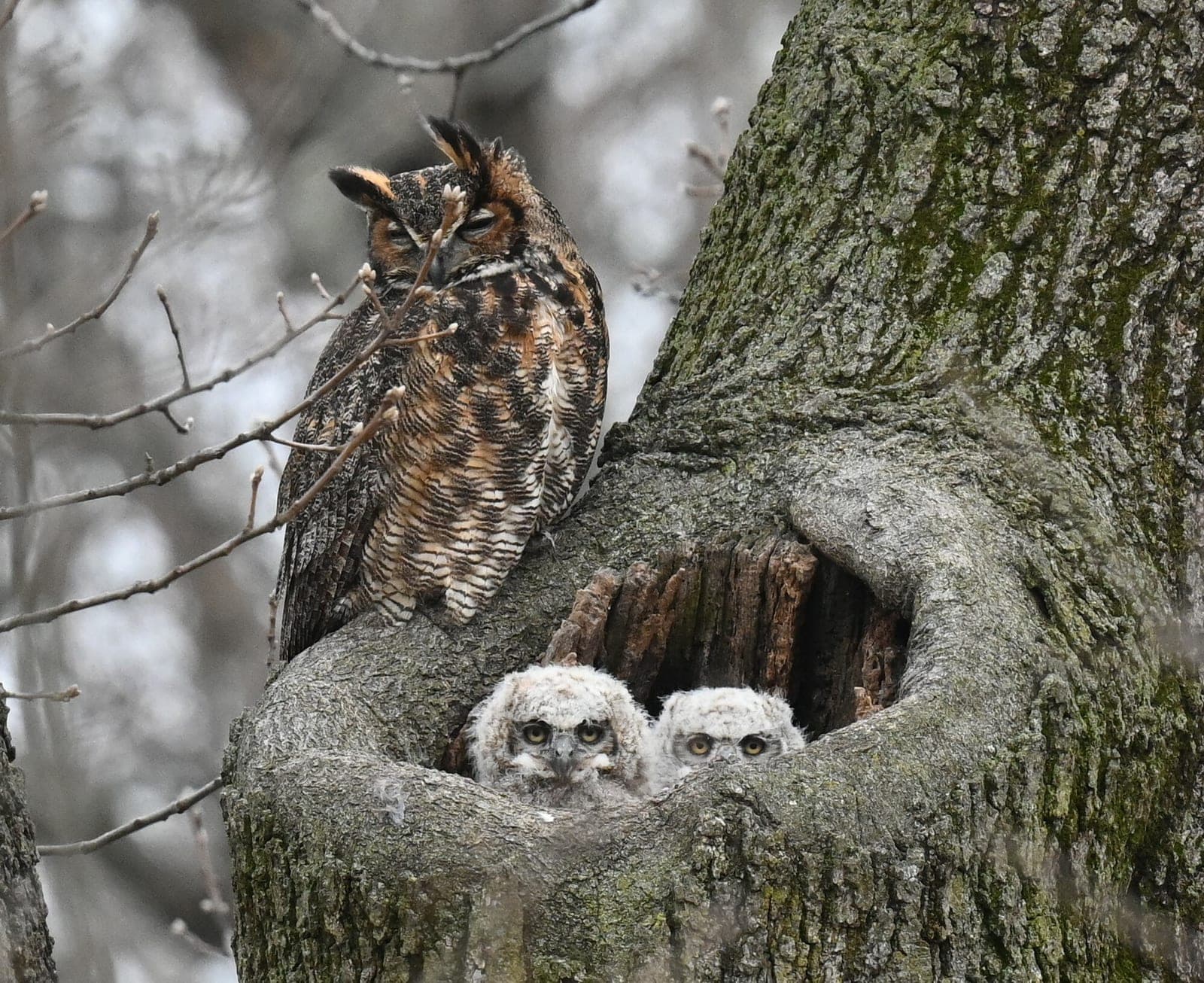
Great Horned Owls have ear tufts, yellow eyes and fine crosswise barring all the way down the belly, and they give soft, deep hoots instead of the Barred Owl's loud, rhythmic call.
Full comparison →Spotted Owl
The threatened Spotted Owl of western old-growth forests is smaller and darker brown, with white spots rather than streaks on the underparts. Where the two overlap, Barred Owls are the bigger, paler and more aggressive bird.
Barn Owl
Barn Owls share the dark eyes and missing ear tufts but are much paler, with a white heart-shaped face, a golden-buff back and white to cinnamon underparts with no bars or streaks.
Range & habitat
Barred Owls are native to eastern North America, from Nova Scotia, New Brunswick and southern Quebec west across Ontario and south to Florida and eastern Texas. Over the past century they spread west across southern Canada into Alberta and British Columbia, then south into Washington, Oregon and California; fire suppression and tree planting on the northern Great Plains created the wooded corridors they followed. They are permanent residents wherever they live.
Barred Owls like big, mature woods with water nearby: swamps, river bottoms, wooded creek valleys and damp mixed forests with large hollow trees for nesting. In the Southeast they are most common in hardwood swamps and bottomland forests; in the North and Northwest they also use mature conifers. They adapt to older suburbs with big trees and to large wooded parks. Where Great Horned Owls move in, Barred Owls tend to retreat into denser, more continuous forest.
Through the seasons
Spring
Most pairs lay two or three eggs between March and April in the North, and as early as late December in Florida. The female incubates for about four weeks, and by late spring fluffy owlets climb out of their cavities onto nearby branches before they can really fly.
Summer
Young owls make short flights by about ten weeks and keep following their parents through summer as they learn to hunt. Warm months bring frogs, salamanders and crayfish into the diet, prey that is mostly unavailable to them in winter.
Fall
Young owls gain independence and disperse in early to mid-autumn, usually within a few dozen miles. Adults stay on territory and keep defending it with loud calls and duets, as they do in every season.
Winter
Barred Owls stay put through winter, though some wander away from nesting areas. Courtship ramps up in late winter, with duets, bowing displays and copulation in February and March, and leafless woods make roosting owls easier to spot.
How to find and attract Barred Owls
Barred Owls are vocal and often active by day, which makes them among the easiest owls to find. Start with big, wet woods and your ears, then use your eyes.
- Listen at dusk and before dawn near swamps and river bottoms for the 'who cooks for you' call.
- Walk mature bottomland woods by day; Barred Owls often hunt and call in daylight.
- Look for a big, round-headed owl perched fairly low over a creek, slough or wet trail.
- A large nest box mounted high in a mature tree near water can attract a pair.
- Turkey hunters use a Barred Owl locator call at dawn to make roosted gobblers sound off.
- Use recorded calls sparingly, if at all, since playback can stress nesting owls.
- Keep big hollow trees and snags standing; cavities are the Barred Owl's preferred nest site.
Diet & life cycle
What it eats
Barred Owls are opportunists that live mostly on small mammals — voles, mice, shrews, chipmunks, flying squirrels and other squirrels, rabbits and even opossums — and they take more aquatic prey than most owls. Crayfish, crabs, fish, frogs and salamanders show up in pellets, along with snakes, lizards, many insects and birds. In one Michigan study, more than four of every five prey items were meadow voles. Barred Owls hunt mainly from a perch, gliding briefly from branch to branch until they spot prey, sometimes hovering before dropping onto it.
Life cycle
Barred Owls usually pair for life and defend the same territory year after year. They nest in large natural tree hollows and broken-off snags, or in old hawk, crow or squirrel nests where cavities are scarce; in the East they often reuse Red-shouldered Hawk nests, sometimes trading years with the hawks. The female lays two or three white eggs, rarely up to five, and incubates them for about 28 to 33 days while the male brings food. Owlets leave the nest at about five to six weeks, often before they can fly, and climb back up with bill and talons if they tumble out. They make longer flights by about 14 weeks and become independent in autumn. Most first breed at about two years old.
Oldest on record
The oldest Barred Owl in the USGS Bird Banding Laboratory longevity records was at least 26 years and 7 months old. It was banded as an adult in North Carolina in April 1993 and found injured in North Carolina in January 2019.
SourceAttracting & watching
Barred Owls will nest in large wooden boxes placed high in mature trees near water, and they settle happily into older neighborhoods with big trees, creeks and wooded parks. Keeping large hollow trees and snags, and skipping rodent poison, help most. They never come to feeders, but a quiet evening on a porch near wet woods often brings a call. Barred Owls are protected under the Migratory Bird Treaty Act; even the federal removal program in the West operates under a special permit.
Conservation
Least Concern (IUCN). Barred Owls are common, possibly up to three million strong, and may be North America's second most numerous owl after the Great Horned Owl. Their westward spread is the problem: in the Pacific Northwest and California they outcompete, and occasionally hybridize with, the Northern Spotted Owl, which is listed as threatened. In 2024 the U.S. Fish and Wildlife Service adopted a Barred Owl Management Strategy allowing trained removal specialists to take up to about 15,600 invasive Barred Owls a year in parts of Washington, Oregon and California; public hunting of Barred Owls is not allowed.