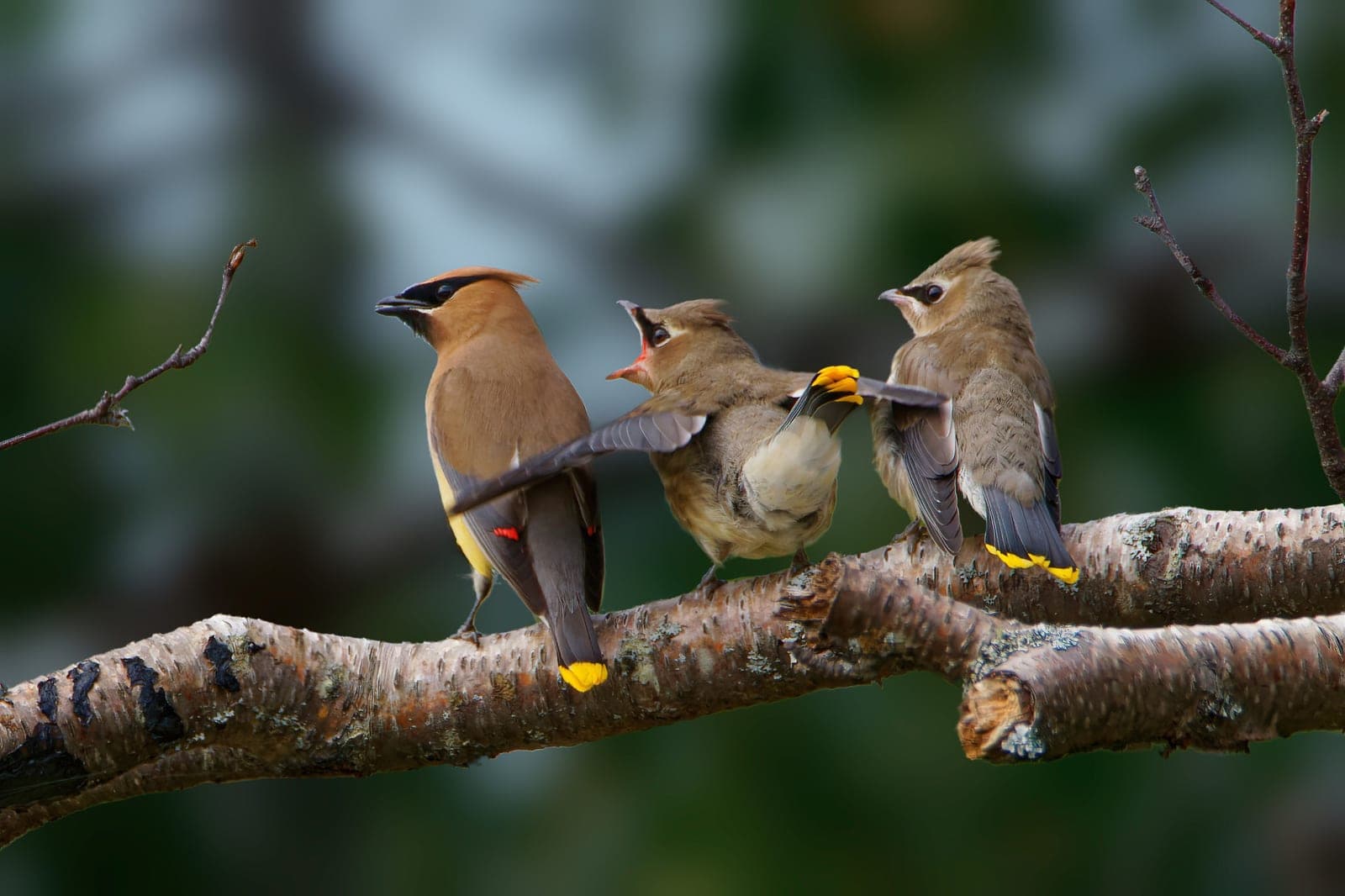
How to identify a cedar waxwing
Cedar waxwings are smaller than a robin, with a short crest that often lies flat over the back of the head, a short, wide bill and a short, square tail. The body is a smooth blend of warm brown on the head and breast fading to gray on the wings and rump, with a pale yellow belly and white under the tail. A narrow black mask, edged in white, runs through the eye. The tail ends in a bright yellow band, and adults carry small, glossy red tips on the secondary wing feathers. Sexes look alike. Juveniles in late summer are streaky and grayer, with a weaker mask but the same yellow tail tip.
- Black mask edged in white, with a short crest
- Bright yellow band at the tip of the tail
- Red, wax-like tips on the secondary wing feathers
- Pale yellow belly and white under the tail
- Thin, very high 'sree' calls from tight flocks
Look-alikes
Bohemian Waxwing
Bohemians are larger and grayer, with rusty-red feathers under the tail and white and yellow markings on the wings. Cedar waxwings have white under the tail and plain wings apart from the red tips. Bohemians are northern and western birds that occasionally join cedar flocks in winter.
European Starling
Flying flocks of waxwings, with their pointed wings and short tails, can look like small, pale starlings. Up close, starlings are dark and glossy with a long, thin bill and no crest or mask.
Northern Cardinal
Female cardinals are also crested and brownish, but they have a thick orange-red bill, red edging on the wings and tail, and no yellow tail band or black mask edged in white.
Range & habitat
Cedar waxwings breed across southern Canada and the northern half of the United States, reaching farther south along the Appalachians and in the mountains of the West. They winter from the northern states south through the southern United States, Mexico and Central America to the far northwest of South America. Movements are nomadic and depend on fruit: a region can host hundreds one winter and none the next, and across much of the northern United States they can be found in any month.
Waxwings go where the fruit is. In summer they use open woodland, forest edges, streamsides, lakeshores, overgrown fields, orchards and suburban yards with fruiting trees, ideally near water. In winter they roam any wooded or semi-open area with a good berry crop, including towns, parks and cemeteries planted with crabapple, juniper, holly and mountain-ash. They rarely spend time in dense forest interior.
Through the seasons
Spring
Winter flocks wander north slowly, and some linger south of the breeding range into late spring. Birds eat leftover fruit, flower petals and tree sap, and early courting pairs sidestep along a branch, passing a berry or petal back and forth.
Summer
Waxwings are among the latest nesters in North America, often waiting until June or later when berries ripen. Flocks hawk mayflies and other insects over rivers and lakes like swallows, and streaky juveniles appear in late summer.
Fall
Flocks of 30 to 100 or more form from August on and can clean out a fruiting tree in short order. Southward movement is irregular, following the berry supply rather than a fixed schedule.
Winter
Nomadic flocks search out redcedar, holly, hawthorn, crabapple and mountain-ash, often alongside robins. Their high, lisping calls are usually the first sign that a flock has dropped into the neighborhood.
How to find and attract cedar waxwings
Waxwings ignore seed feeders, so the way to bring them in is with fruit and water. Plant native trees and shrubs that ripen at different times, and keep your ears open for their faint, high calls.
- Plant native fruit that ripens across the seasons: serviceberry in early summer, then dogwood, viburnum, hawthorn, winterberry holly, eastern redcedar and crabapple into winter.
- Choose native shrubs over invasive Eurasian honeysuckles, which spread aggressively and can tint waxwing tail tips orange.
- Offer a birdbath or, better, moving water: waxwings drink and bathe often and are drawn to the sound of running water.
- Learn the call, a thin, high 'sree' or trill that is easy to miss and hard for some listeners to hear at all.
- In summer, scan over rivers and lakes at dusk for flocks catching insects on the wing.
- Mark nearby windows with decals or screens: flocks feeding at fruit trees often strike glass.
Diet & life cycle
What it eats
Cedar waxwings are true fruit specialists. Berries and small fruits make up most of the year's diet, including juniper and eastern redcedar cones, which gave the bird its name, plus dogwood, serviceberry, wild cherry, hawthorn, winterberry, mulberry and mountain-ash. They swallow fruit whole and pass seeds quickly, which makes them important seed dispersers. In summer they add many insects such as mayflies, beetles, caterpillars and ants, and they also eat flower petals and drink sap. Nestlings start on insects and switch to fruit within a few days.
Life cycle
Nesting starts late, usually not until summer, and pairs often nest close together in loose groups because they defend only a tiny area. The female does most of the building, making up to about 2,500 trips to assemble a loose cup of grass, twigs and plant fibers on a horizontal branch, typically 6 to 20 feet up. She lays two to six pale blue-gray eggs spotted with black or gray and incubates them for 11 to 13 days. Both parents feed the young, which leave the nest 14 to 18 days after hatching, and pairs raise one or two broods.
Oldest on record
The oldest cedar waxwing in the current USGS Bird Banding Laboratory longevity table was a male at least 7 years and 2 months old. He was banded as a second-year bird in Maryland in August 2008 and recaptured and released at a Maryland banding station in August 2014.
SourceAttracting & watching
Fruit and water are everything: a yard with native berry trees and a birdbath can host a flock for days in fall and winter. To watch them, check fruiting trees in parks and cemeteries in winter, and lakeshores and river edges on summer evenings, where flocks flycatch over the water. Waxwings are protected under the Migratory Bird Treaty Act.
Conservation
Least Concern (IUCN). Cedar waxwings are common and have held steady or increased since the Breeding Bird Survey began in 1966; Partners in Flight estimates about 64 million birds. Abandoned farm fields growing back into shrubland, ornamental fruit trees in towns and the end of DDT use have all helped. Window strikes and collisions with cars while feeding on roadside fruit kill many, and birds that gorge on overripe, fermented berries can become intoxicated.