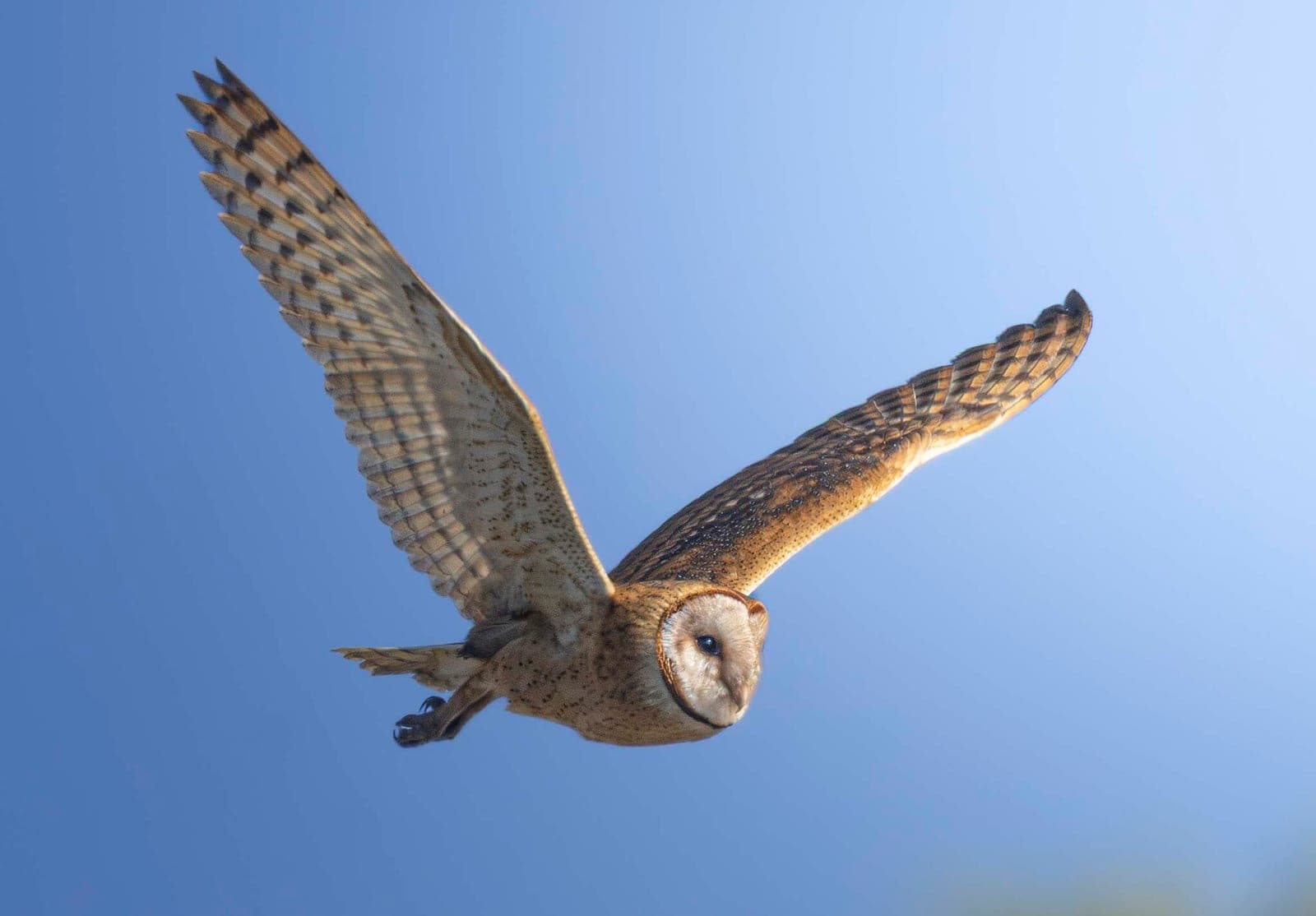
How to identify a barn owl
Barn Owls are medium-sized, long-legged owls with no ear tufts and a white, heart-shaped face around dark eyes. The upperparts are a soft golden-buff and gray, finely peppered with tiny black and white dots, and the underparts run from white to warm cinnamon, often with small dark spots. Males tend to be paler and less spotted below than females, which are also larger. In flight, especially when caught in headlights, a Barn Owl looks ghostly white, with long, rounded wings and a short, square tail, and it flies slowly and buoyantly low over open ground. A Barn Owl surprised at its daytime roost bobs its head and sways from side to side while it watches the intruder.
- White, heart-shaped facial disk with dark eyes
- Golden-buff and gray back with fine speckles
- White to cinnamon underparts, often lightly spotted
- Long legs and no ear tufts
- Harsh, hissing screech instead of a hoot
Look-alikes
Snowy Owl
Snowy Owls are far larger and bulkier, with yellow eyes and a round face, and they sit in the open in daylight in winter. Barn Owls hunt at night and roost hidden in cavities and buildings.
Barred Owl
Barred Owls share the dark eyes and lack of ear tufts but are larger and brown-gray, with bars across the chest and streaks down the belly, and they hoot loudly instead of screeching.
Short-eared Owl
Short-eared Owls also course low over fields at dusk, but they have yellow eyes set in dark patches, a streaked buff chest and dark wrist marks under the wings, and they nest on the ground rather than in cavities.
Range & habitat
The American Barn Owl ranges from southernmost Canada through much of the United States and Mexico to Central and South America and the Caribbean; barn owls as a group live on six continents. In the United States it occurs across most of the country but thins out toward the northern edge of its range, where long snowy winters hurt it. Some northern birds stay all winter, while others, possibly mostly young ones, travel long distances south in fall.
Barn Owls hunt open country: pastures, hayfields, wet meadows, marsh edges, grassland, desert and weedy field margins full of voles. They roost and nest in cavities nearby — hollow trees, cliff crevices, barn lofts, church steeples, silos, abandoned houses, bridges and nest boxes — and will dig nest holes into dirt banks where nothing else is available. They can live in towns and even cities if good hunting ground is close by.
Through the seasons
Spring
Pairs settle at nest sites, and the male courts with display flights, loud wing-claps and gifts of food. The female lays a large clutch, usually three to eight eggs, one every other day, and starts incubating with the first egg, so the owlets hatch over a long stretch.
Summer
Owlets grow fast, and a nest full of them hisses and snores loudly for food at night. They fly at about 55 to 65 days but keep coming back to the nest to sleep for weeks. Well-fed pairs may start a second brood.
Fall
Young owls disperse, often a long way: in the United States most travel about 50 to 200 miles, and some have turned up more than 1,000 miles from where they hatched. Some northern birds head south for winter.
Winter
Winter is the hard season. Long stretches of snow cover hide voles and hit Barn Owls hard at the northern edge of their range, and owls that make it through stay close to sheltered roosts in barns, silos and hollow trees.
How to find and attract Barn Owls
Barn Owls are strictly nocturnal and secretive, so most people find them by ear or by the signs they leave. Where good hunting ground exists, a nest box is the best way to bring them in.
- Listen at night near pastures and marsh edges for a long, rasping screech instead of a hoot.
- Check old barns, silos and steeples for whitewash and piles of dark, compact pellets.
- Drive rural roads slowly after dark; a pale owl crossing the headlights is often a Barn Owl.
- Mount a large nest box inside a barn, on a building or on a tall pole facing open grassland.
- Keep grassy fields, hayfields and pasture nearby, since voles in rough grass are the main food.
- Avoid rodenticides; owls that eat poisoned mice and rats can die from them.
- Clean boxes out before nesting season, and stay away while owls are using them.
Diet & life cycle
What it eats
Barn Owls are rodent specialists. In North America voles dominate the diet, with shrews second and mice, small rats and young rabbits filling in; birds, lizards, insects and frogs are minor extras. Prey is usually swallowed whole, and the fur and bones come back up as dark, compact pellets, which is why Barn Owl pellets are a staple of classroom dissections. Hunting happens mostly on the wing: the owl quarters low over open ground, listening, then drops onto prey. Its ear openings sit at different heights on each side of the head, and the dish-shaped facial disk funnels sound toward them, so it can pinpoint a rustle precisely enough to strike in complete darkness.
Life cycle
Barn Owls build no real nest; the female arranges debris into a rough hollow in a cavity, barn loft or box and lays chalky white eggs on it. Clutches average about five, ranging from two to a dozen or more, and she incubates alone for about 29 to 34 days while the male brings food, starting with the first egg so the youngest chick may be weeks behind the oldest. The male does most of the hunting at first; after two to four weeks the female starts hunting too. Young fly at about 55 to 65 days and depend on their parents until roughly 13 weeks. Pairs raise one or two broods a year, sometimes three. Most wild Barn Owls live only about four years, but big families make up for it.
Oldest on record
The oldest Barn Owl in the USGS Bird Banding Laboratory longevity records was at least 15 years and 5 months old. It was banded as a nestling in Ohio in June 1961 and shot in Ohio in November 1976. The USGS list still files North American birds under the older name Tyto alba.
SourceAttracting & watching
Barn Owls are among the few owls that take readily to nest boxes, and boxes have helped them where nest sites are scarce: Indiana's Department of Natural Resources has installed more than 400 in barns and other buildings since 1984. A box works best inside a barn or on a building next to grassland, pasture or hayfields, cleaned out before nesting season. Many farmers welcome Barn Owls as rodent control. They are protected under the Migratory Bird Treaty Act, so occupied nests and the birds themselves may not be disturbed or removed without a permit.
Conservation
Least Concern (IUCN); state-endangered in Indiana. Barn Owls remain widespread, but North American populations have declined, drastically in the Midwest and Northeast. Loss of grassland, pasture and hayfields, the replacement of old wooden barns with modern pole barns, rodenticides, vehicle collisions and predation by Great Horned Owls are all blamed. Indiana lists the Barn Owl as state-endangered, with fewer than 50 nests found statewide in a typical year and only 43 reported in 2017.