How to identify a american robin
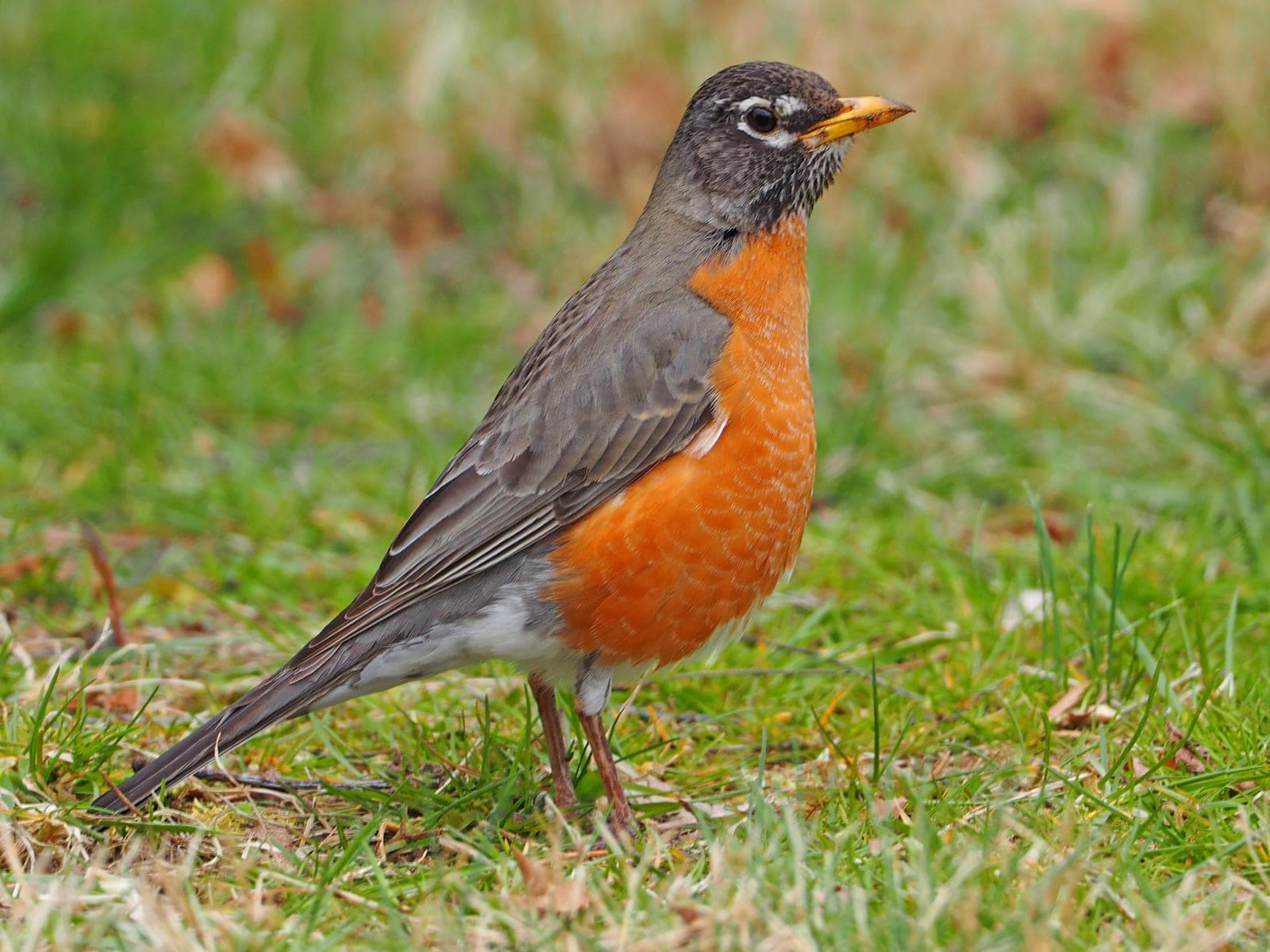
Robins are large, upright songbirds with a gray-brown back, a brick-orange breast and a white patch under the tail. The head is darker than the back, nearly black on many males, with broken white arcs above and below the eye and a white throat streaked with black. The bill is yellow, often with a dusky tip in winter. Females look similar but paler, with a grayer head and a washed-out breast. Fresh juveniles in early summer are a different-looking bird: heavily spotted with black on a pale, rusty-tinged breast and speckled with buff on the back.
- Brick-orange breast below a gray-brown back
- Dark head with broken white arcs around the eye
- Yellow bill and a white, black-streaked throat
- White under the tail and small white tail corners in flight
- Runs a few steps, stops bolt upright, then pounces
Look-alikes
Varied Thrush
This Pacific Northwest thrush has an orange stripe over the eye, orange wing bars and a dark band across its orange breast. A robin's breast is plain, and it has no eyebrow stripe or wing bars.
Eastern Towhee
Towhees show rusty orange only along the flanks, with a clean white belly between, and they scratch in leaf litter under shrubs instead of running across open grass.
Baltimore Oriole
Male orioles are smaller and blaze orange below, with a solid black hood and back, white wing bars and a sharp, pointed bill. They forage high in trees and rarely walk on lawns.
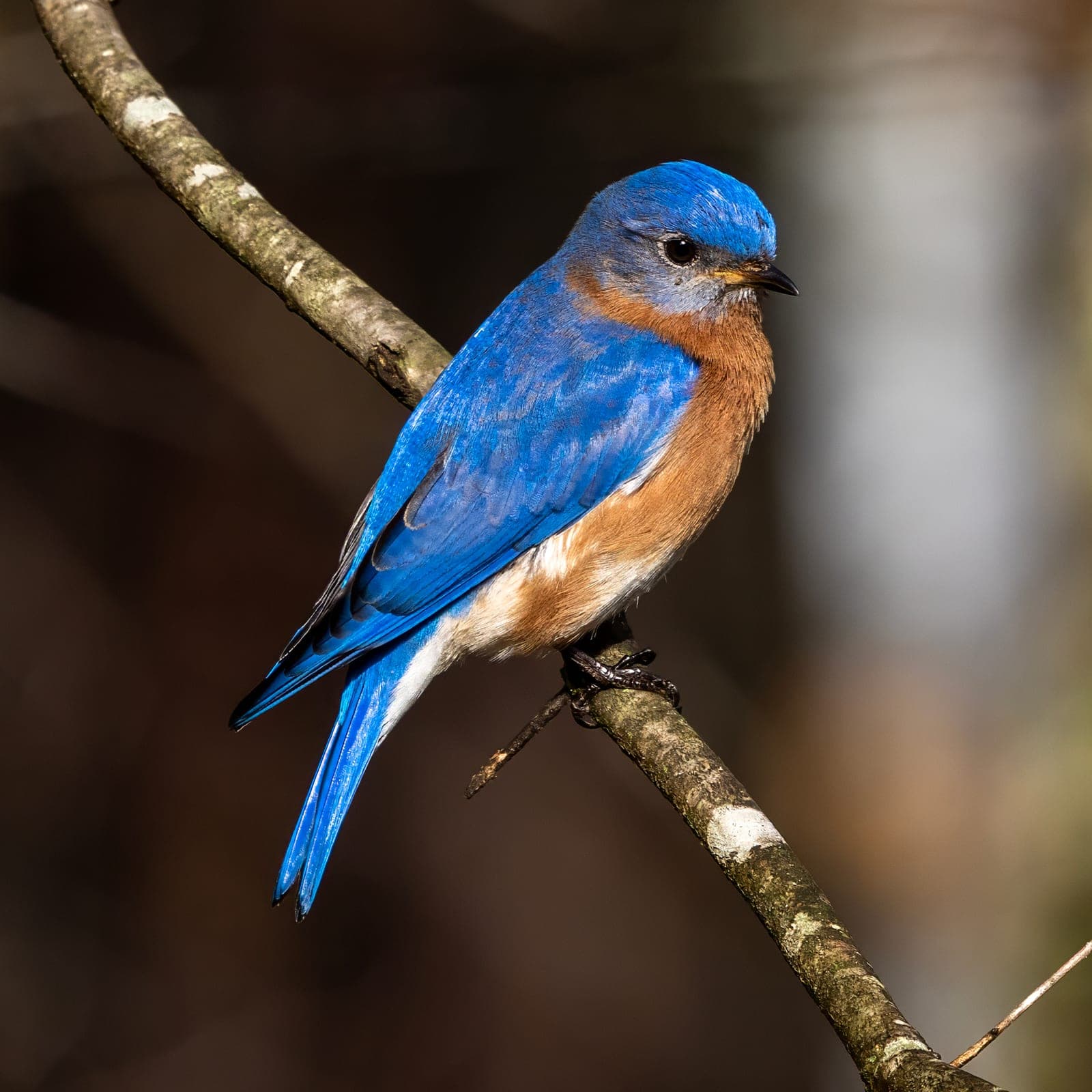
Eastern Bluebird
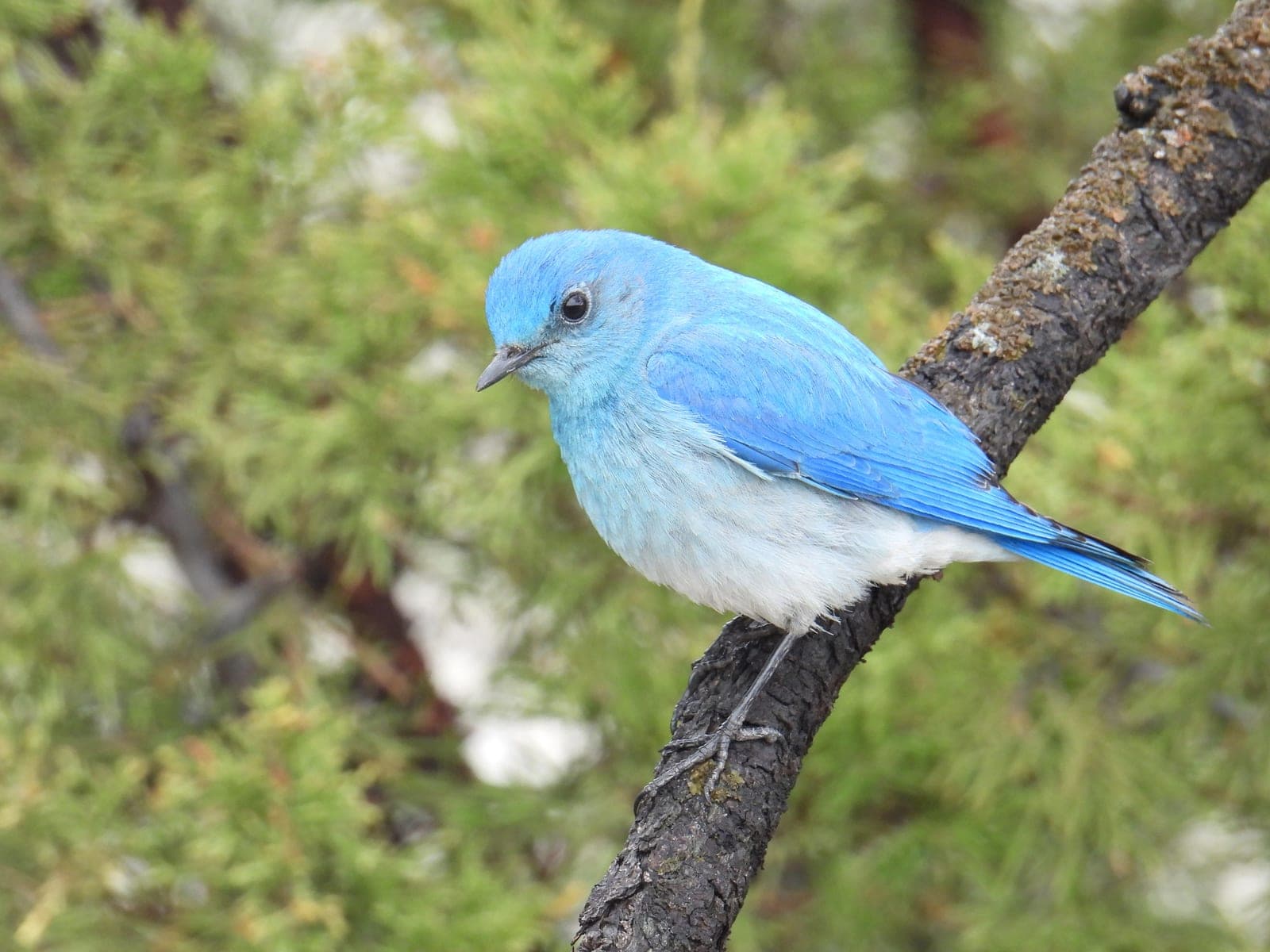
Bluebirds also have a rusty breast but are much smaller, with blue upperparts on males and blue in the wings and tail of both sexes. Spotted juvenile bluebirds always show some blue in the wings.
Range & habitat
Robins breed across nearly all of North America, from Alaska and the edge of the Canadian tundra south to northern Florida, the Gulf Coast states and the mountains of Mexico. In winter most leave Canada and the northern Plains and settle from the southern United States to central Mexico and along the Pacific Coast, but flocks regularly stay through the cold months in the northern states and southern Canada wherever berry crops hold out. Rare strays even cross the Atlantic: Britain had logged about 30 by the end of 2024.
Robins need two things to nest: trees or ledges for the nest and mud to build it. That puts them in lawns, parks, farmyards, orchards, open woodland and forest edges from sea level to timberline, and in the arid Southwest they breed mainly in mountain conifer forests rather than lowland towns. Short grass matters because robins hunt by watching the ground. In winter they shift to woods, swamps and hedgerows with heavy fruit crops and gather in large communal roosts.
Through the seasons
Spring
Males reach the breeding grounds ahead of females and claim territories with long bouts of caroling, often starting before first light. The 'first robin of spring' is frequently a bird that wintered a few miles away in the woods and only reappears on lawns when winter flocks break up.
Summer
Pairs raise two or three broods between April and July, building a fresh nest each time. Lawns fill with streaky-breasted fledglings begging from their fathers while females start the next clutch, and singing tapers off by late July.
Fall
Robins turn from worms to fruit and gather into roving flocks that strip dogwood, mountain-ash and wild grape. Many drift south, but the movement is loose and driven by food supply, so numbers in any one area swing widely.
Winter
Robins go quiet and live in nomadic flocks in wooded areas, feeding on holly, juniper, crabapple and hackberry. Evening roosts in swamps and dense conifers can hold hundreds or thousands of birds, and Christmas Bird Counts find them far north of where most people expect.
How to find and attract American robins
Robins seldom eat seed, so a typical feeder does little for them. Pesticide-free grass, water, mud and fruiting plants do far more, and a robin pair will often nest within a few feet of a busy porch.
- Keep some lawn free of pesticides and mow it short: robins find earthworms and grubs by watching open ground.
- Plant native fruit for fall and winter: serviceberry, flowering dogwood, winterberry holly, eastern redcedar, sumac and crabapple.
- Mount an open nest shelf, a small platform with a roof and no front, under an eave or on a shed wall; robins will not use an enclosed box.
- Leave a muddy patch or shallow pan of wet soil in spring so females have material for the nest cup.
- Offer a shallow birdbath year-round, heated in winter, and set out chopped apples, softened raisins or mealworms on a platform during late-winter cold snaps.
- Listen before dawn for the rising-and-falling 'cheerily, cheer-up' carol, and for sharp 'peek' and 'tut-tut' alarm notes when a cat or hawk is near.
Diet & life cycle
What it eats
Robins eat roughly 40 percent invertebrates and 60 percent fruit over a year, but the mix changes sharply with the seasons. In spring and early summer they take earthworms, beetle grubs, caterpillars, grasshoppers, snails and spiders, and nestlings are raised almost entirely on that soft animal prey. From late summer through winter they live largely on berries and wild fruit. Robins have lost the enzyme that digests table sugar, and flocks that gorge on fermented berries such as pyracantha can end up visibly tipsy.
Life cycle
The female builds the nest, usually 5 to 25 feet up in a tree fork or on a ledge of a house, barn or bridge: a sturdy cup of grass and twigs plastered with mud and lined with fine grass. She lays three to five eggs of the shade now called robin's-egg blue and incubates them for 12 to 14 days. Both parents feed the young, which leave the nest about two weeks after hatching and fly well two weeks after that. Robins can breed at one year old, but banding studies suggest only about a quarter of young survive their first year, and the average lifespan is around two years.
Oldest on record
The oldest American robin in the USGS Bird Banding Laboratory longevity table was at least 13 years and 11 months old. It was banded as an adult male in California in January 1962 and found dead in the same state in May 1975.
SourceAttracting & watching
Robins come for fruit, water and worms, not seed. A yard with native berry shrubs, an unsprayed lawn, a birdbath and an open nest shelf gives them everything they need. In fall and winter, look for flocks at fruiting trees and watch dense woods and swamps at dusk for big communal roosts. Robins are protected under the Migratory Bird Treaty Act, so leave active nests alone and keep cats indoors during the fledgling weeks.
Conservation
Least Concern (IUCN). Robins are abundant and widespread, and the North American Breeding Bird Survey shows a small long-term increase since 1966. They were once shot for food and are now protected under the Migratory Bird Treaty Act. Because they feed on lawns, robins were among the first birds killed in large numbers by DDT spraying in the 1950s, and they still serve as a warning sign for pesticide overuse. They are also a major carrier of West Nile virus, though the disease has not dented their numbers.