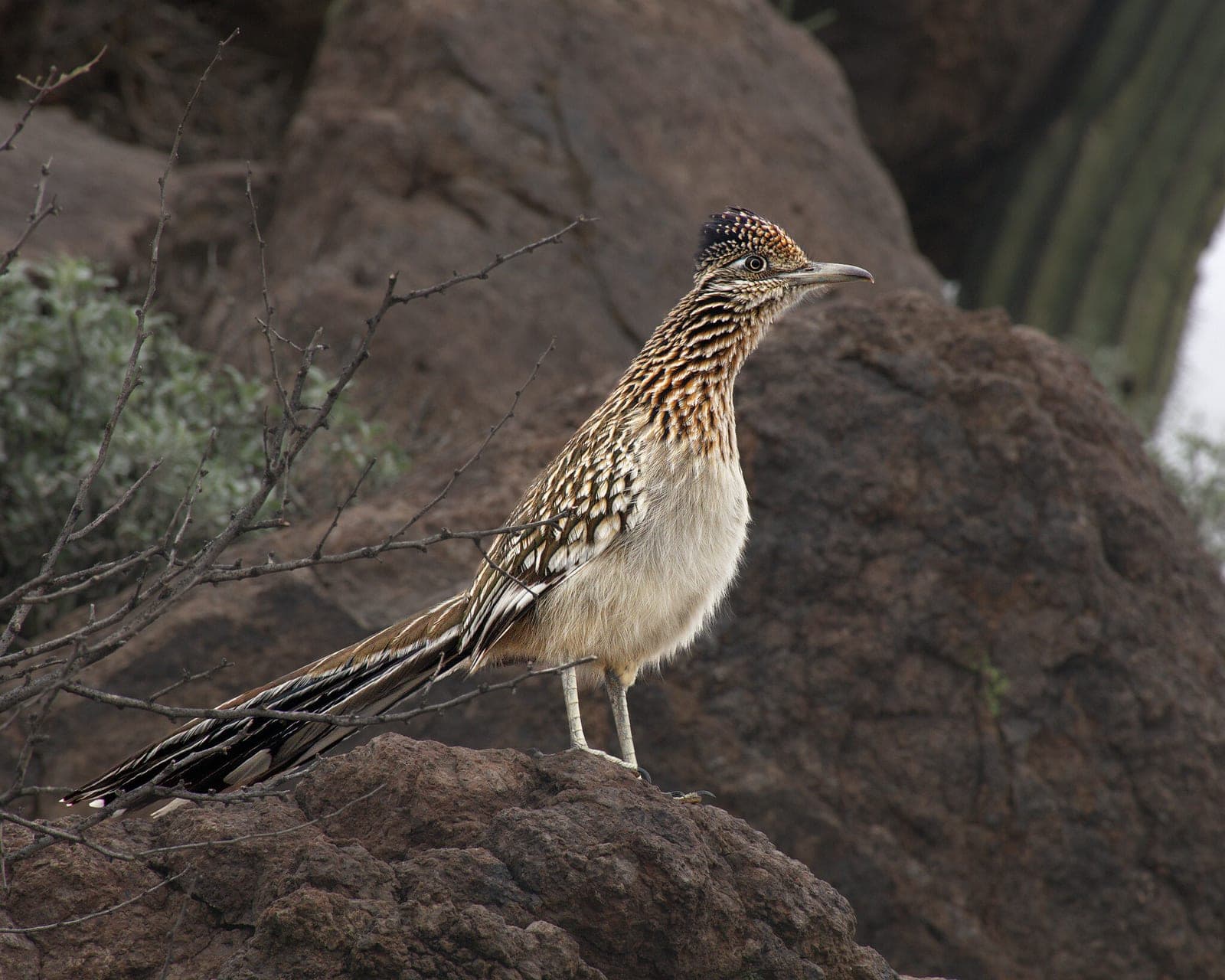
How to identify a greater roadrunner
Roadrunners are unmistakable. They are slender, streaky brown-and-white birds nearly 2 feet long, with a long, heavy, slightly hooked bill, a shaggy brown crest that it raises and lowers, and a long tail spotted with white. Feathers on the back and wings are dark brown edged in buff and white, which gives a scaly, streaked look, and the neck and chest are streaked dark on pale. Behind each eye is a bare patch of skin, blue and orange in most birds, with white replacing much of the blue on adult males. A running roadrunner keeps its body low and uses its long tail as a rudder. Each foot has two toes pointing forward and two back, so its tracks look like an X.
- Nearly 2 feet long with a long, white-spotted tail
- Long, heavy bill and a shaggy crest it raises and lowers
- Streaky brown-and-white plumage
- Bare patch of colored skin behind the eye
- Runs fast on the ground and flies only short distances
- X-shaped tracks from two forward and two backward toes
Look-alikes
Lesser Roadrunner
The only other roadrunner lives in western Mexico and Central America. It is smaller, with less streaking on the throat and chest, and the two overlap only in a small area of western Mexico. Any roadrunner seen in the United States is a greater roadrunner.
Ring-necked Pheasant (hen)
Hen pheasants also run with long tails held low, but they are plump and evenly mottled buff-brown, with a short, chickenlike bill and no crest. They favor farm fields and grassland rather than desert scrub.
Range & habitat
Greater roadrunners live year-round across the southwestern United States and northern Mexico: California, Nevada, Utah, Arizona, New Mexico, Texas and Oklahoma, a small part of Colorado, and the edges of Kansas, Arkansas, Louisiana and Missouri, then south through northern and central Mexico. They range from desert basins below sea level up to about 7,500 feet, and rarely higher. The species periodically spreads north and east, and hard winters knock the outermost birds back. Some birds, possibly young ones, wander well away from their birthplace.
Roadrunners favor dry, open country with scattered shrubs for cover: Sonoran and Chihuahuan desert scrub, chaparral, mesquite and Texas brushland. At the edges of their range they also use dry grassland, forest edges and limestone hills dotted with juniper. They also turn up around ranches and on the edges of desert towns wherever brushy cover and prey remain.
Through the seasons
Spring
Males call with a slow series of descending, dovelike coos from a perch, and courting males chase females and offer them food or nest material. Pairs, which defend territories all year, build a stick nest in a cactus, shrub or low tree.
Summer
Breeding runs from about mid-March into early September. In hot weather roadrunners are busiest from sunrise to mid-morning and again toward evening, resting in shade at midday. Pairs may raise a second brood when summer rains are good.
Fall
Young birds strike out to find territories of their own, and some wander far outside the usual range. Adults stay on their home ground, hunting grasshoppers, lizards and other prey that remain active in the warm fall days.
Winter
Roadrunners do not migrate. On cold mornings they sunbathe with their backs to the sun and feathers raised to expose dark skin, and at night they let their body temperature drop to save energy. Severe freezes can kill birds at the northern edge of the range.
How to find and attract greater roadrunners
Roadrunners are common in the right country but often appear when you are not looking for them, dashing across a dirt road or hopping onto a wall. Early morning, when they sunbathe and hunt, is the best time to look.
- Drive slowly on back roads through desert scrub, mesquite and brushland, watching for a long-tailed bird crossing ahead.
- Listen for the male's slow series of low, falling coos, plus clucks, whines and other odd calls.
- On cool mornings, check the sunny side of walls, fence posts and rocks, where roadrunners sit with back feathers fluffed to warm up.
- In a desert yard, a shallow water dish, native shrubs, cactus and rock piles that shelter lizards and insects can bring one in.
- Leave lizards and harmless snakes alone and skip pesticides; they are the roadrunner's food supply.
Diet & life cycle
What it eats
Roadrunners eat almost any small animal they can catch and swallow: grasshoppers, beetles and other large insects, scorpions, tarantulas, black widow spiders and centipedes, lizards, snakes including young rattlesnakes, mice, young ground squirrels, small birds and eggs. They hunt by walking quickly, then sprinting, and can leap straight up to snatch insects or even hummingbirds from the air. Larger prey is beaten against the ground or a rock before being swallowed whole. They do kill small rattlesnakes, though their snake-fighting fame is exaggerated. Cactus fruit and some seeds add a little plant food.
Life cycle
Pairs often stay together for years and defend a territory all year. The nest, a platform of sticks lined with grass, leaves and feathers and sometimes snakeskin or dry cow manure, sits about 2 to 12 feet up in a dense shrub, low tree or cactus. The female lays usually three to five white eggs, and both parents incubate for about 20 days, the male doing more of the work. The young leave the nest at about 18 to 21 days and are fed by their parents for up to another 30 to 40 days. Females now and then lay eggs in the nests of other birds, such as ravens and mockingbirds.
Oldest on record
The oldest greater roadrunner in the USGS Bird Banding Laboratory longevity list was a male at least 3 years and 9 months old, banded as an adult in Arizona in 1979 and recaptured there in 1982. Few roadrunners have been banded and found again, so this figure is a minimum and says little about their true life span.
SourceAttracting & watching
Roadrunners do not use seed feeders, but desert yards with water, native shrubs and lizard-rich rock piles can draw them in. Do not feed them meat scraps or pet food; they are protected under the Migratory Bird Treaty Act and find plenty of natural prey. Away from yards, watch quiet roads and trails through desert scrub and brushland early in the morning.
Conservation
Least Concern (IUCN). Roadrunners are widespread and secure across most of their range. Partners in Flight estimates about 1.4 million birds, with a slight overall increase in recent decades. Some regions, including parts of California, have seen declines as brushland is cleared and developed.