Game animals · Side by side
White-tailed Deer vs Mule Deer
How to tell them apart
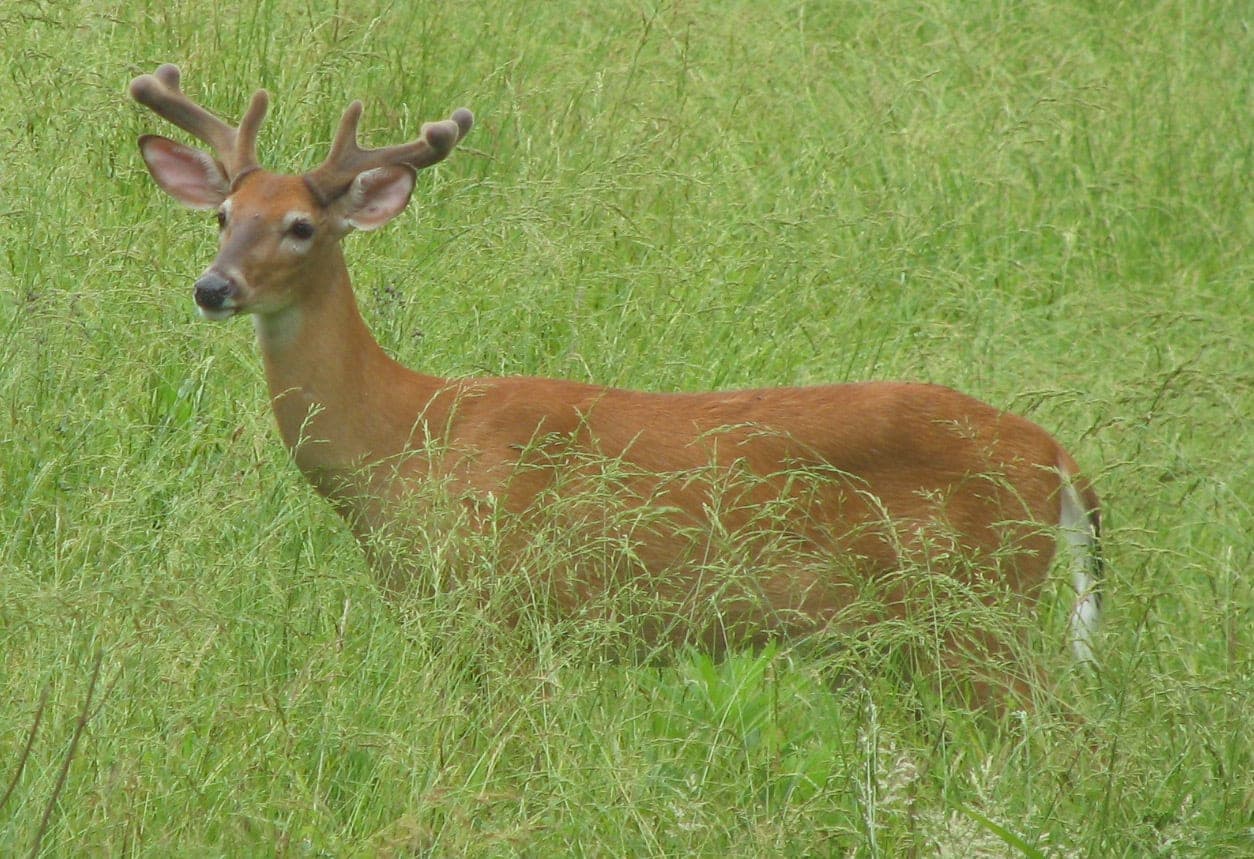
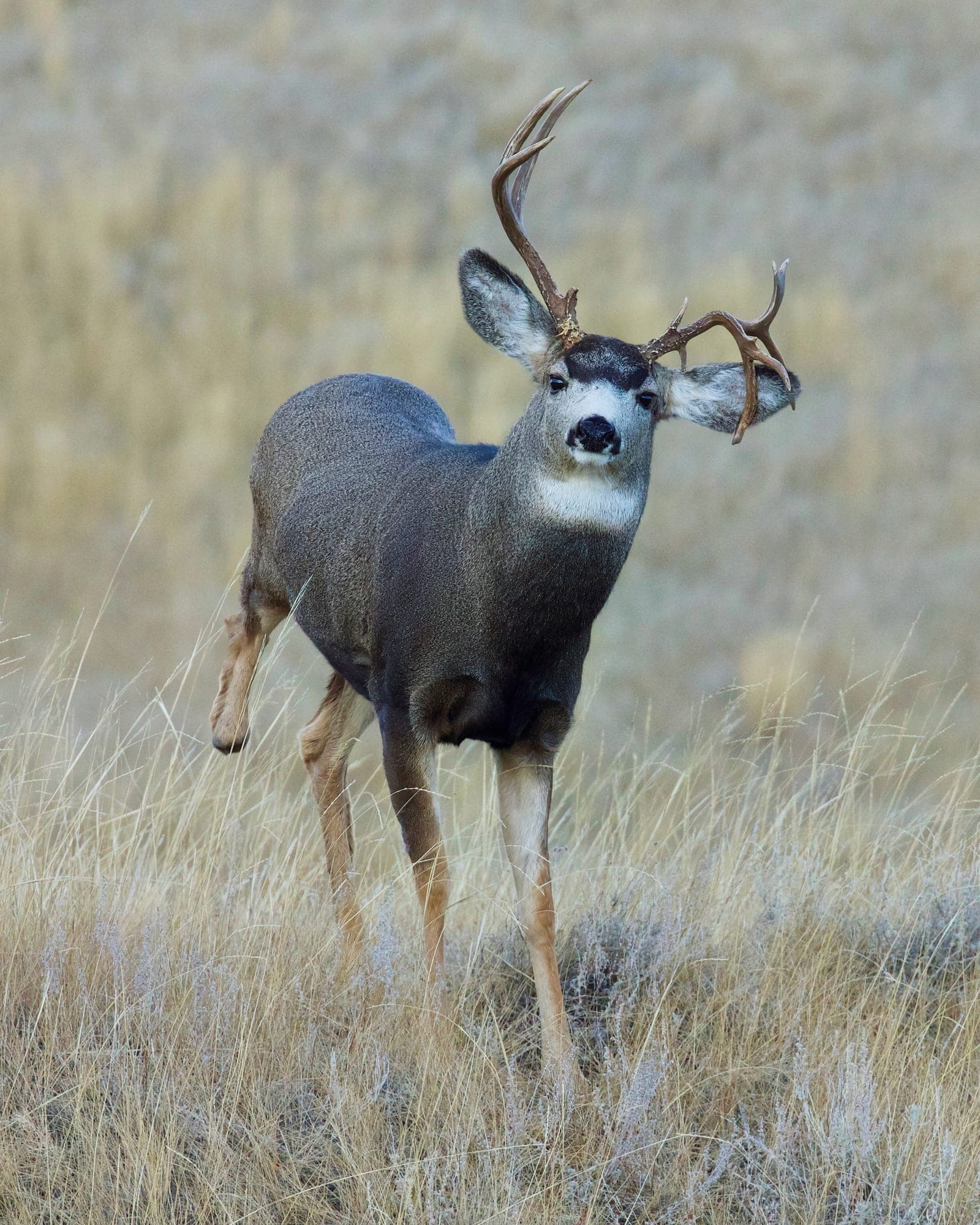
Quick answer
Look at the tail: a whitetail's is broad and brown with a white underside that flips up like a flag, while a mule deer's is thin and white with a black tip against a big white rump patch. Mule deer also have much larger ears and antlers that fork, instead of tines rising one by one from the main beam.
White-tailed deer and mule deer are North America's two native deer of the genus Odocoileus, and across much of the West they share the same river bottoms, farm fields and foothills. Many states run separate seasons or tags for each, so a quick, sure ID matters before the shot. The tail, the ears and the antlers settle it.
Key differences
| Trait | White-tailed Deer | Mule Deer |
|---|---|---|
| Tail | Broad, brown on top, white underneath; raised like a flag | Narrow and white with a black tip; usually held down |
| Rump | Brown, with white showing only when the tail goes up | Large white rump patch |
| Ears | Moderate size | Very large, mule-like |
| Antlers | Tines rise individually from forward-curving main beams | Forks that split again into Y shapes |
| Escape gait | Long, smooth, low bounds | Stiff-legged bounce with all four feet together (stotting) |
| Buck weight | 150–300 lb, heaviest in the North | About 120–330 lb, averaging around 200 |
| Rut peak | November across most of the North | Late November into mid-December |
| Range | Most of North America, scarce in the Great Basin and desert Southwest | Western North America only |
Where each lives
Whitetails cover most of the continent from southern Canada to South America and have spread west along river valleys and farmland. Mule deer belong to the West, from the western Great Plains to the Pacific. The two overlap across the plains and the Rockies, from Alberta and Saskatchewan through Montana, Wyoming, the Dakotas and Colorado to West Texas. Where they share ground, whitetails usually stick to creek bottoms, irrigated fields and brushy draws, while mule deer use the open breaks, sagebrush hills and higher, rougher country above them.
Hybrids and black-tailed deer
Whitetails and mule deer do interbreed, though rarely in the wild, and hybrids turn up most often where the two overlap, such as West Texas. Hybrids show a confusing mix of traits and tend to survive poorly. Along the Pacific coast, Columbian and Sitka black-tailed deer are subspecies of the mule deer, not of the whitetail: their tails are wider and dark across the top, which can fool hunters, but their antlers still fork like a mule deer's and their ears are still large.
Hunting each one
Whitetails live in small home ranges in thick cover, so most are taken from treestands or blinds over travel routes, often during the November rut. Mule deer live in open country and many migrate, so the classic approach is to glass from high ground and make a stalk. A spooked whitetail usually runs for cover and keeps going, while a mule deer often bounces to the next rise and stops to look back, which gives a second chance at a shot.
By the numbers
The traits the daily hunt game compares for each.
| Clue | White-tailed Deer | Mule Deer |
|---|---|---|
| Type | Big game | Big game |
| Habitat | Forest | Mountains |
| Headgear | Antlers | Antlers |
| Region | Nationwide | Western mountains |
| Typical weight | 150 lb | 200 lb |
| Diet | Herbivore | Herbivore |
FAQ
Can white-tailed deer and mule deer interbreed?
Yes, but it is uncommon in the wild. Hybrids appear mostly where the two species overlap, and they tend to have lower survival than either parent.
Which is bigger, a mule deer or a whitetail?
Mule deer average slightly larger and stockier, but big northern whitetails can match them. The typical antler records are close too: 226 4/8 points for a mule deer and 213 5/8 for a whitetail in the Boone and Crockett book.
Is a black-tailed deer a whitetail or a mule deer?
A mule deer. Columbian and Sitka black-tailed deer of the Pacific coast are mule deer subspecies with darker, broader tails and smaller bodies.
Does a white tail mean it is a whitetail?
Not by itself. A mule deer's tail is mostly white too, but it is thin and black-tipped. A whitetail's tail is brown on top and only flashes white underneath when raised.
Could you tell them apart from a few clues? Test yourself in today's puzzle.
Play the daily hunt game