How to identify a tree swallow
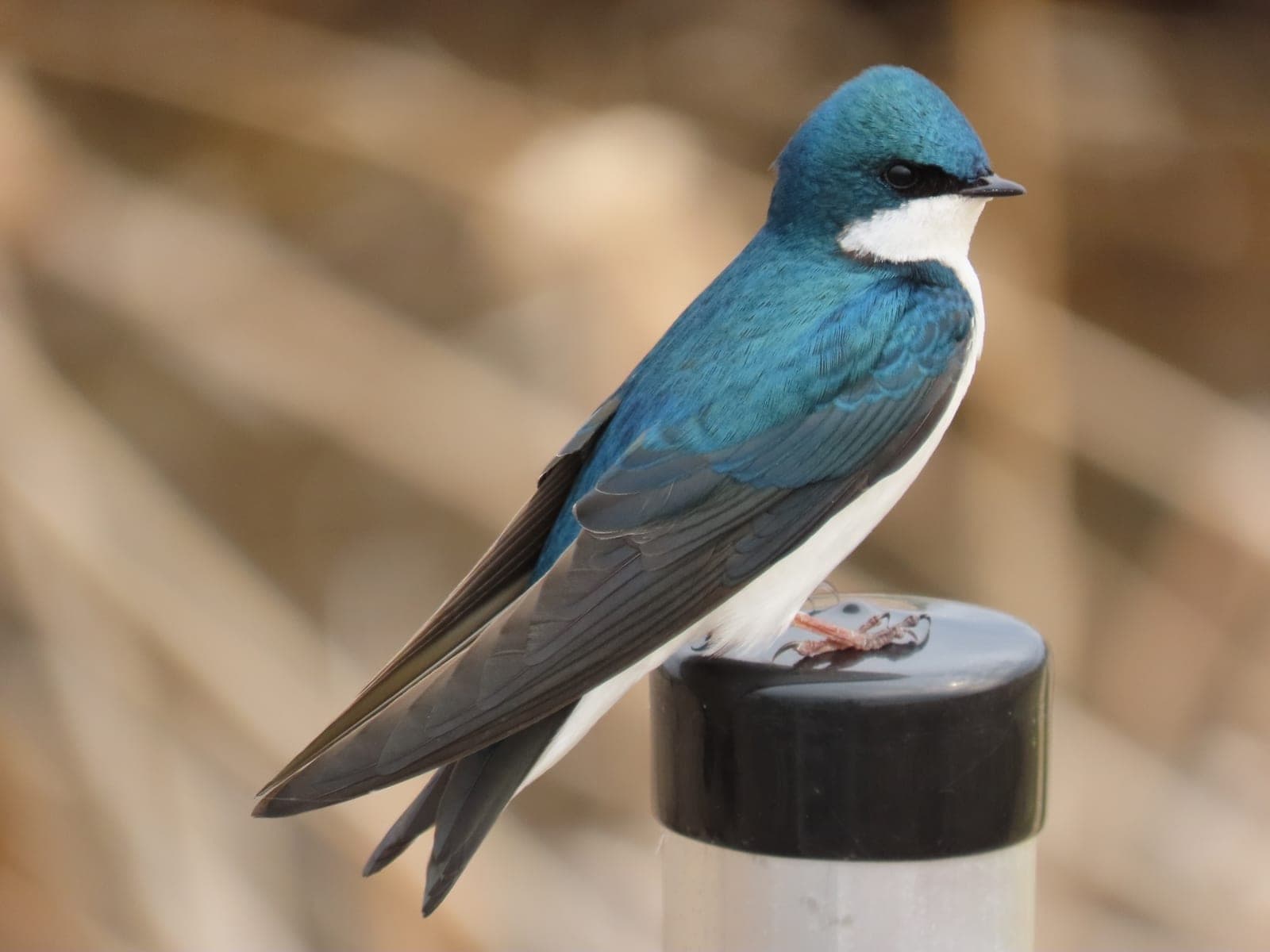
Tree Swallows are compact swallows with broad-based, pointed wings and a short, slightly notched tail. Adults are sharply two-toned: glossy blue to blue-green above, with blackish wings and tail, and clean white from chin to undertail. The dark cap comes down to the eye, so the white throat and cheek look crisp. Females are a bit duller, and one-year-old females are mostly brown above with only a few blue feathers. Juveniles are plain gray-brown above with a dusky wash across the chest, which can suggest a Bank Swallow. They forage in flight with quick flaps and glides, often low over water, and their song is a liquid, cheerful twitter.
- Glossy blue-green back over pure white underparts
- Dark cap reaching down to the eye, clean white throat
- Short, slightly notched tail, not long and forked
- Brown one-year-old females and juveniles with a dusky chest wash
- Nests in tree holes and nest boxes
Look-alikes
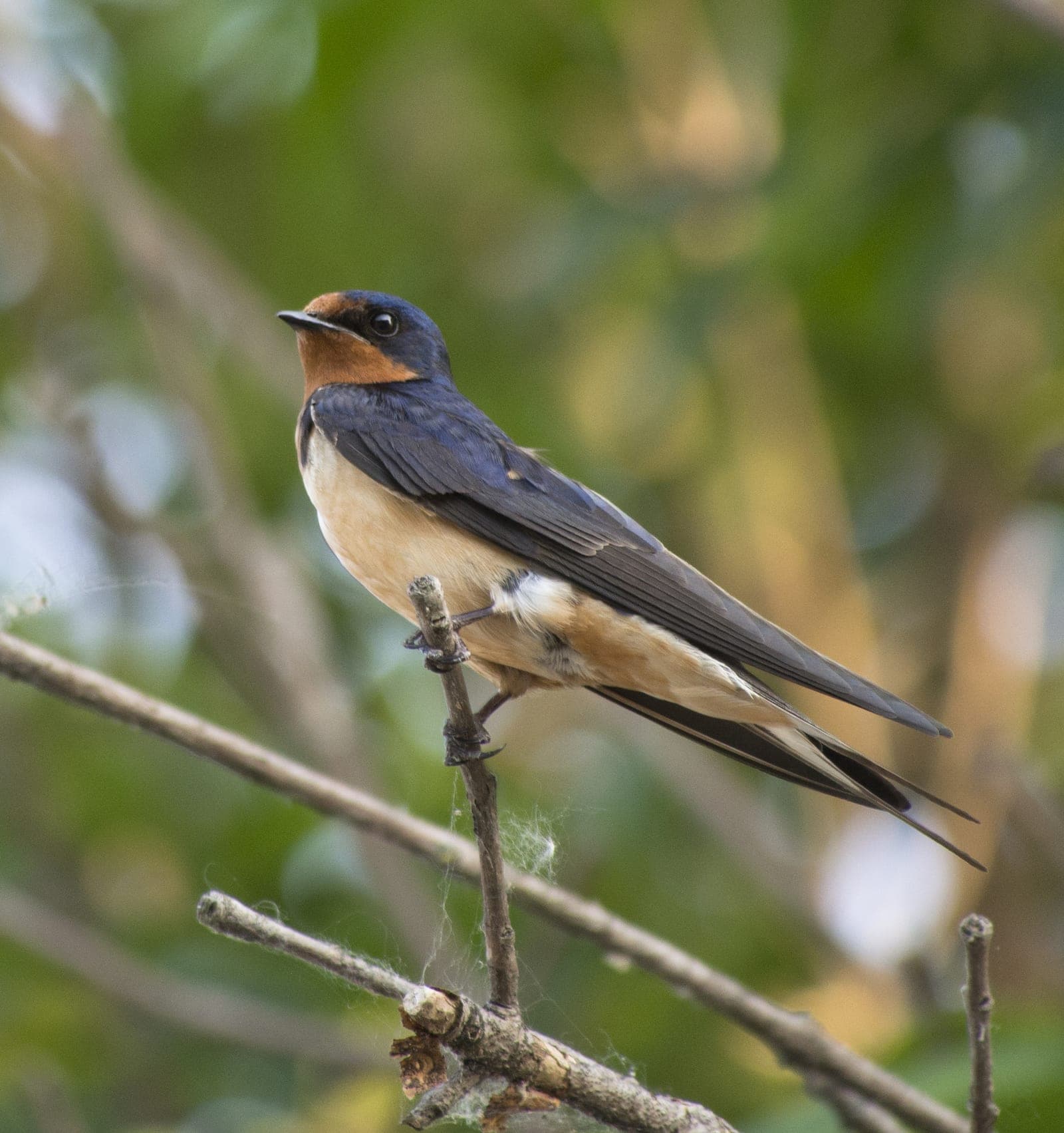
Barn Swallow
Barn Swallows have a long, deeply forked tail, a rusty throat and forehead, and buff to cinnamon underparts. They build mud nests on buildings, while Tree Swallows use cavities and boxes.
Full comparison →Violet-green Swallow
A western swallow. The white of the face extends up and behind the eye, and white patches on the sides of the rump nearly meet over the tail, showing from above. Tree Swallows have a dark cheek to the eye and an all-dark rump.
Bank Swallow
Bank Swallows are smaller and brown above, with a crisp brown band across a white breast. Young Tree Swallows have only a soft, smudgy gray-brown wash across the chest, not a sharply defined band.
Range & habitat
Tree Swallows breed across Alaska and Canada north to the tree line, and south through the northern half of the United States to roughly Tennessee in the East, Kansas in the center and California and New Mexico in the West, with scattered nesting farther south. They winter farther north than any other North American swallow: along the coasts from California and southeastern Virginia south around the Gulf of Mexico, through Florida and Mexico to Central America, the Caribbean and the northwestern coast of South America.
Tree Swallows breed in open country near water: marshes, beaver ponds with standing dead trees, lakeshores, wet meadows and fields with nest boxes. They nest in old woodpecker holes and other tree cavities, and nest boxes have let them spread into farmland and open land far from woods. Outside the breeding season they roost by the thousands in reed and cane beds over water and feed over marshes, coastal dunes and bayberry thickets.
Through the seasons
Spring
Tree Swallows migrate north early in spring, before most other swallows, and males arrive first to claim nest holes. On cold days they hunt low over open water or eat berries until insects return.
Summer
Eggs are laid from early May to mid-June, and young fledge from mid-June into July. Pairs nest singly or in loose groups, and a small share of males, up to about 8 percent, take two mates.
Fall
Southbound migration starts as early as July and peaks in early fall. Swallows travel in daytime flocks, stopping for weeks at a time, and huge roosts swirl into marshes at dusk.
Winter
Wintering flocks feed over marshes and coastal thickets from the southern U.S. to Central America. Bayberries and other fruit carry them through cold snaps that would starve other swallows.
How to find and attract Tree Swallows
Tree Swallows take to nest boxes readily, so an open spot near water with a box on a pole is the surest way to host them. To see them in numbers, visit marshes and ponds in early spring or coastal marshes in fall.
- Use a box with a 1 3/8-inch entrance hole and an inside depth of about 9 inches.
- Mount it 5 to 6 feet up on a pole in the open, facing south or east, with a predator guard.
- Space Tree Swallow boxes about 35 feet apart, as NestWatch recommends.
- If bluebirds compete for the box, put a second box 20 to 25 feet away so each species gets one.
- Keep boxes away from barns and feeders that draw House Sparrows and starlings, which compete for cavities.
- Scan ponds and marshes on cold early-spring days, when swallows gather low over open water.
- Plant bayberry or wax myrtle in coastal areas; it is the main winter food of Tree Swallows.
Diet & life cycle
What it eats
Tree Swallows are aerial insect hunters. In North America flies make up about 40 percent of the diet, with beetles, ants and many other flying insects, plus spiders and small snails. Insects with aquatic larvae supply omega-3 fatty acids that the birds cannot make in large enough amounts. Unlike other swallows, they also eat plant food, up to about a fifth of the yearly diet and mostly in winter: bayberries and wax myrtle above all, plus other berries and seeds. On the coast they even take sand fleas.
Life cycle
Males arrive first and show females possible nest holes, and birds often take new mates each year. The female builds a cup of grass, weeds, pine needles and other plant material inside the cavity and lines it with feathers from other birds, adding most of them after she starts laying. She lays four to seven pure white eggs, sometimes two to eight, and incubates them for about 14 to 15 days. Both parents feed the nestlings, which leave 18 to 22 days after hatching. Extra-pair mating is common: in studied populations, roughly 38 to 69 percent of nestlings were sired by a male other than the social father.
Oldest on record
The oldest Tree Swallow in the USGS Bird Banding Laboratory longevity table was at least 12 years and 1 month old. It was banded as a nestling in Ontario in June 1986 and recaptured and released there in July 1998.
SourceAttracting & watching
Nest boxes are the best way to attract Tree Swallows: a 1 3/8-inch hole, a pole in the open near water, and a predator guard. They do not visit feeders, but bayberry and wax myrtle feed them in winter, and ponds and wetlands supply insects. Watch for them over marshes in early spring and in big swirling roosts in late summer and fall. They are protected under the Migratory Bird Treaty Act and Canada's Migratory Birds Convention Act.
Conservation
Least Concern (IUCN). With about 20 million birds, Tree Swallows are common, and nest boxes have helped their range spread south. Even so, the Breeding Bird Survey shows a decline of about 30 percent between 1966 and 2019. Loss of marshes and forest, acidified lakes that offer little calcium-rich food for chicks, pesticides and other pollutants all weigh on them.