How to identify a ruby-throated hummingbird
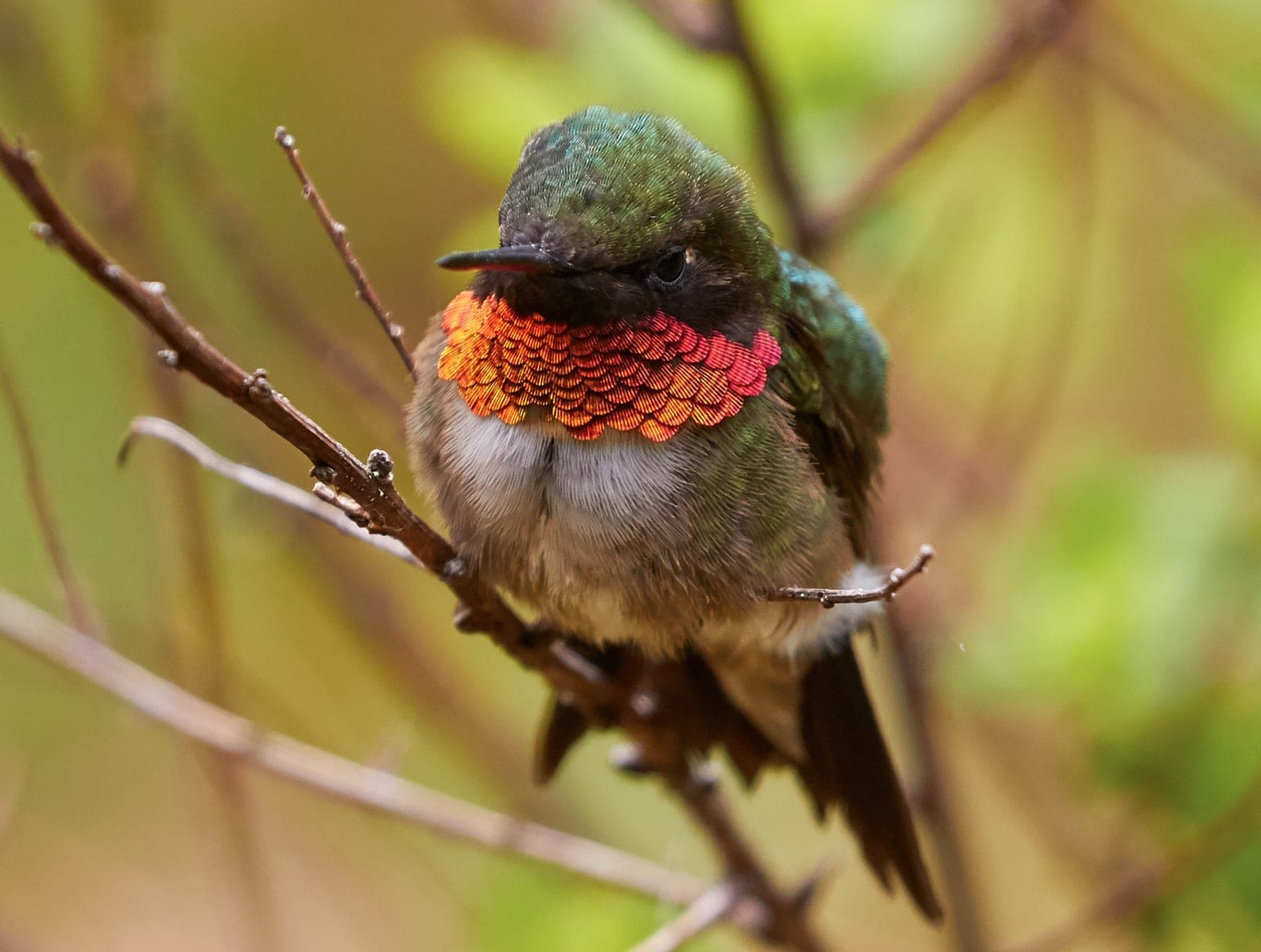
Ruby-throats are tiny, with a long, straight, needle-like bill, metallic green upperparts and grayish-white underparts. The adult male's throat, called a gorget, is iridescent ruby-red, but the color depends on the light: from many angles it looks black. Males also have greenish sides, a thin black line along the top of the gorget and a forked, dark tail. Females lack the red throat; they are green above and whitish below, sometimes with faint dusky streaks on the throat, and their tail has white tips on the outer feathers. Young males look like females, often with heavier throat markings. In most of the East, any hummingbird seen from spring to early fall is almost certainly this species, so range is the best clue.
- Male: iridescent ruby gorget that can look black
- Metallic green back; whitish to gray underparts
- Male tail forked and dark; female tail with white tips
- Female: plain whitish throat, sometimes lightly streaked
- The only breeding hummingbird in the East
Look-alikes
Black-chinned Hummingbird
The western counterpart, reaching into central Texas. The male's throat is velvety black with a thin violet band at the bottom instead of ruby-red. Females of the two are very similar and are best separated by range.
Rufous Hummingbird
A western hummingbird with rusty-orange sides, back and tail; males have a coppery-orange throat. A few wander east in fall and winter, so a late-season hummingbird in the East deserves a careful look.
Anna's Hummingbird
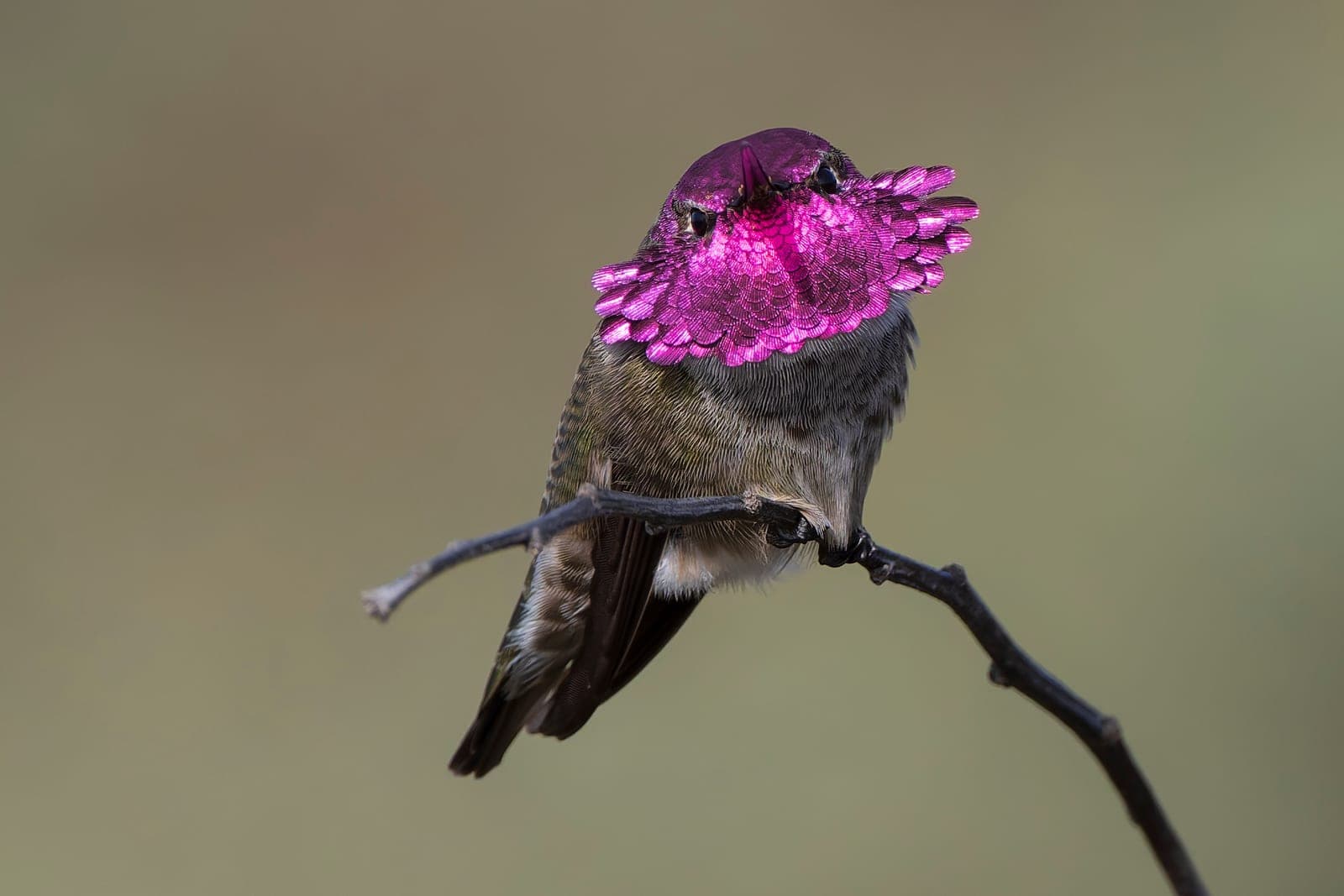
A larger, stockier, grayer West Coast species. The male's rose-pink color covers the whole crown as well as the throat, and females often show a central patch of red spots on a gray throat.
Full comparison →Hummingbird clearwing and sphinx moths
Day-flying moths that hover at flowers at dusk or in daylight. Look for antennae, a curled tongue instead of a bill, a fuzzy body and an insect-like flight; hummingbirds have a stiff bill and feathers.
Range & habitat
Ruby-throats breed across the eastern United States, roughly east of the 100th meridian, and in southern Canada from the Prairie Provinces through Ontario and Quebec to the Maritimes; no other U.S. hummingbird has a larger breeding range. Nearly all leave North America in fall and winter from southern Mexico to Costa Rica and western Panama, with smaller numbers in Florida, along the Gulf Coast and in the West Indies.
In summer they use semi-open country with flowers: open woods, forest clearings and edges, orchards, gardens, parks and yards. Females tuck their nests into deciduous or pine trees, usually well hidden by leaves. In winter they favor rather open, dry tropical scrub rather than rainforest, and on migration they stop in almost any spot with blooming flowers.
Through the seasons
Spring
Ruby-throats push north from Central America in spring, many crossing the Gulf of Mexico and landing first along the coasts of Louisiana and Florida. Males travel ahead of females, so the first birds at feeders are usually males.
Summer
Females nest alone and raise one or two broods, sometimes three, with no help from males. Males defend flower patches and feeders and chase off other hummingbirds that come near.
Fall
Ruby-throats fatten up and head south; nearly all leave North America. Some cross the Gulf of Mexico nonstop, roughly 500 miles, while many follow the Texas coast around it.
Winter
Nearly the whole population winters from southern Mexico to Panama, where birds molt their feathers. Small numbers stay in Florida and along the Gulf Coast.
How to find and attract Ruby-throated Hummingbirds
A clean sugar-water feeder and a few red, tubular flowers will draw ruby-throats into almost any eastern yard. Make the nectar at home with plain white sugar, keep it fresh, and place the feeder safely away from cats and windows.
- Mix 1/4 cup refined white sugar in 1 cup boiling water (1 part sugar to 4 parts water), cool it and fill the feeder.
- Never use red food coloring or honey; the dye is unnecessary and could harm birds, and honey can promote dangerous fungal growth.
- Clean the feeder often and refill it with fresh nectar each time.
- Hang feeders out of reach of cats and away from windows, where birds can crash.
- Plant native nectar flowers such as cardinal flower and trumpet vine for a natural food supply.
- Watch for the male's U-shaped pendulum courtship flight in late spring and early summer.
- Males guard feeders fiercely, so a second feeder elsewhere in the yard gives other birds a turn.
Diet & life cycle
What it eats
Ruby-throats drink nectar while hovering at flowers, favoring red tubular blooms such as trumpet vine and cardinal flower, and they readily take sugar water from feeders. Nectar supplies energy, but they also need protein: they snap tiny insects out of the air, pick them off leaves, and even pluck spiders and trapped insects from spider webs.
Life cycle
In courtship the male swings back and forth in front of a female in a wide, U-shaped pendulum arc, making a whirring sound at the bottom of each dive. After mating he leaves, and the female does everything else. She builds a tiny cup of plant fibers and plant down bound with spider silk and covered outside with lichen and bits of leaf, usually 10 to 20 feet up on a horizontal or downward-sloping branch. She lays two white eggs, incubates them for 12 to 14 days, and feeds the young until they fly at about 20 to 22 days; the nest stretches as they grow. On cold nights, adults can drop into torpor to save energy.
Oldest on record
The oldest Ruby-throated Hummingbird in the USGS Bird Banding Laboratory longevity table was a female at least 11 years and 1 month old. She was banded as an adult in Illinois in June 2014 and recaptured and released there in July 2024.
SourceAttracting & watching
Sugar water made from one part refined white sugar to four parts water, with no dye and no honey, in a feeder that is cleaned often, is the classic way to attract them. Pair it with native red tubular flowers like cardinal flower and trumpet vine, and keep feeders away from cats and windows. Watch for them in gardens, wood edges and parks from spring through early fall. They are protected under the Migratory Bird Treaty Act.
Conservation
Least Concern (IUCN). Ruby-throats increased steadily after the Breeding Bird Survey began in 1966 and are common and widespread, with an estimated 34 to 36 million birds, the most numerous hummingbird in North America. Around homes, cats and window collisions are real hazards, which is why feeders belong away from both.