How to identify a barn swallow
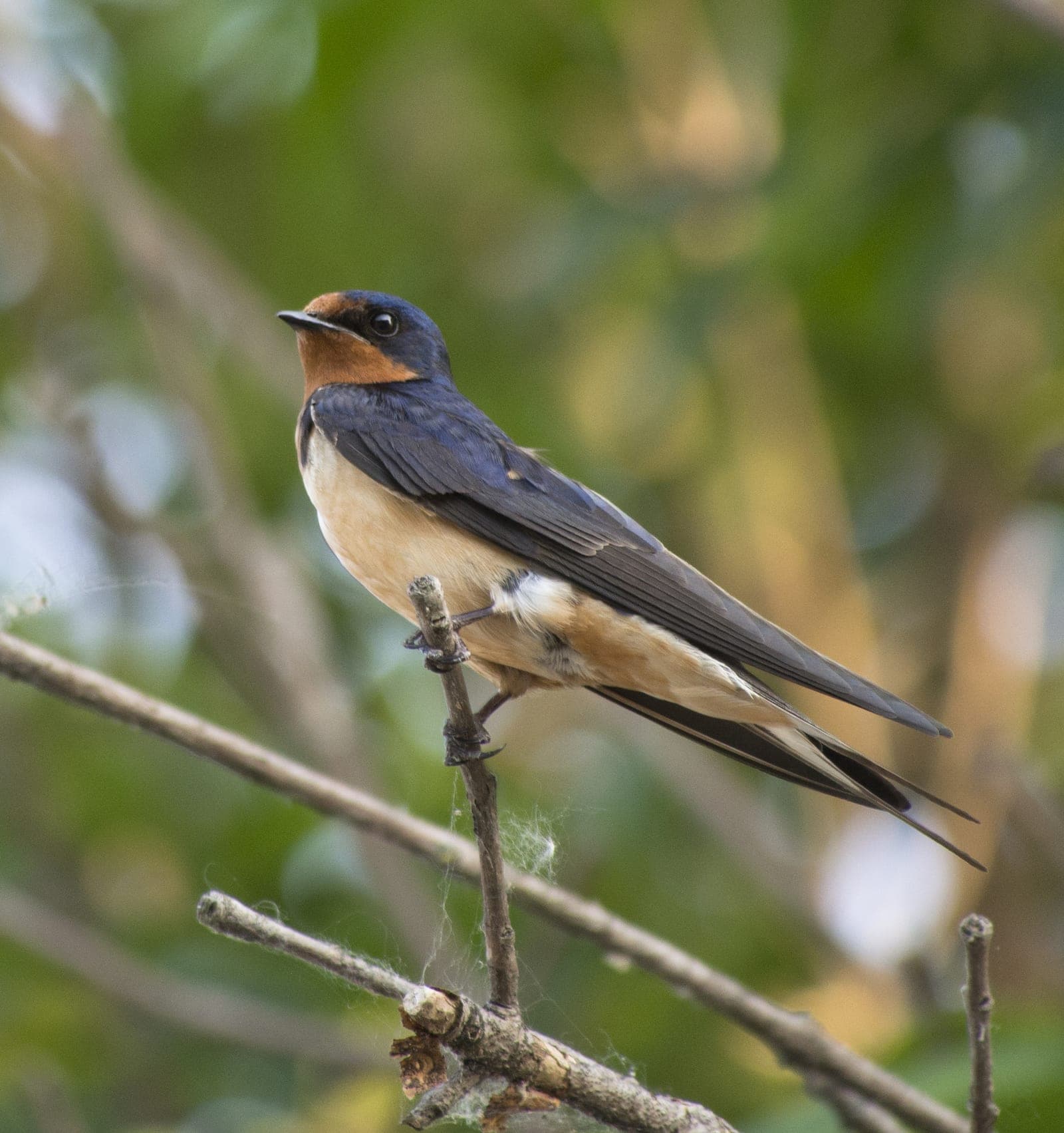
Barn Swallows are slender, long-winged birds with glossy steel-blue upperparts, a rusty-cinnamon forehead and throat, and buff to whitish underparts; many North American birds are a rich cinnamon below. The tail is the giveaway: deeply forked, with long outer streamers and a row of white spots that show when it fans. Males have longer streamers and glossier blue than females, and juveniles are paler with short tails, so a young bird can look short-forked in late summer. In flight they look pointed and swept-back and move with fluid, swooping turns, often just above the grass or water. Their voice is a steady, liquid twittering, with sharp 'witt' calls around the nest.
- Deeply forked tail with long outer streamers
- Steel-blue back and rusty-cinnamon throat and forehead
- Buff to cinnamon or whitish underparts
- White spots across the spread tail
- Mud-cup nest on a beam, ledge or wall under cover
Look-alikes
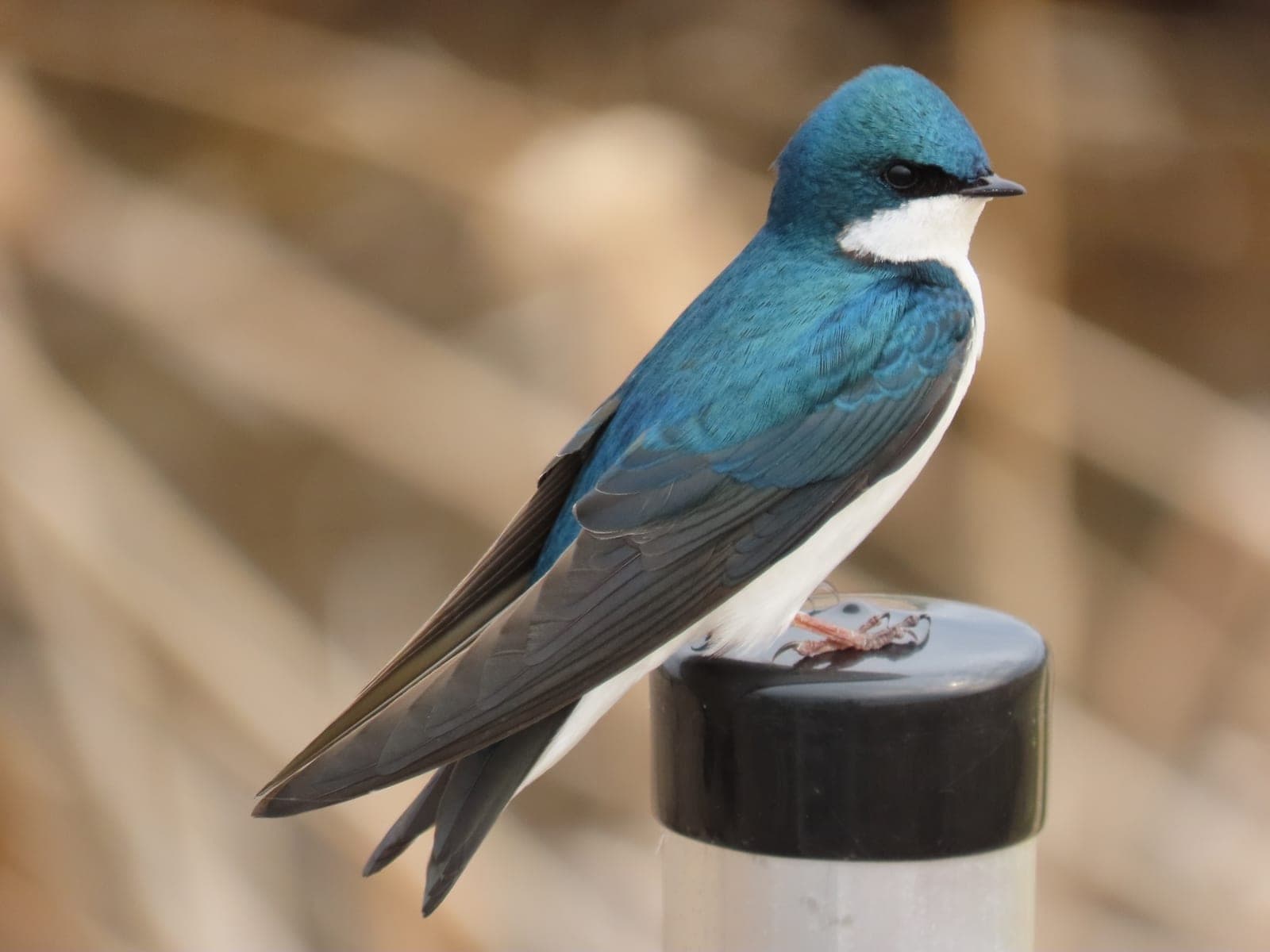
Tree Swallow
Tree Swallows are snowy white below with no rusty throat, and their tail is only slightly notched, not long and forked. They nest in tree holes and nest boxes rather than building mud cups on buildings.
Full comparison →Cliff Swallow
Cliff Swallows have a short, square tail, a pale buff rump patch and a pale forehead spot over a dark throat. They nest in crowded colonies of gourd-shaped mud nests under bridges and eaves.
Purple Martin
Martins are noticeably bigger and heavier. Adult males are glossy blue-black all over, females are grayish below, and the tail is forked but short, without long streamers. They nest in martin houses and gourds.
Range & habitat
Barn Swallows breed across nearly all of North America from Alaska and southern Canada to Mexico, avoiding only very dry desert country, unbroken forest and the far North. The same species nests across Europe and Asia and parts of North Africa. North American birds winter from southern Mexico and Central America through South America, some as far as Argentina, and individuals often return to the same wintering spot year after year.
Barn Swallows need open ground for feeding and a sheltered ledge for nesting. They hunt over fields, pastures, meadows, marshes, lakes and ponds, usually near water, and nest in barns, stables, garages, open sheds, porches, under bridges and docks, and in culverts. Before buildings, they nested on cliffs and in shallow caves, which is now rare. In winter they use almost any open country and gather in big roosts in reed beds and cane fields.
Through the seasons
Spring
Males return before females and claim a nest site, often an old nest from last year that they repair with fresh mud. Courtship is a flurry of aerial chases, and pairs perch side by side and preen each other.
Summer
Pairs raise one or two broods. Young from an early brood sometimes help feed their younger siblings. Look for swallows trailing tractors, mowers and cattle to snap up the insects they flush.
Fall
Families gather on wires and in reed-bed roosts in late summer. Southbound migration, mostly in daytime flocks, is well under way by mid-August, and swallows feed as they travel.
Winter
North American Barn Swallows winter in Central and South America, roosting together by the thousands in marshes, reed beds and sugarcane fields before returning north in spring.
How to find and attract Barn Swallows
Barn Swallows are easy to find around farms, marinas and bridges anywhere near open water. To host a pair, they need a roofed ledge to build on, mud to build with, and open ground full of flying insects nearby.
- Watch low over pastures, hayfields and ponds, especially behind tractors, mowers or grazing cattle.
- Leave an open-sided shed, barn bay or porch accessible through spring and summer.
- Mount a simple nest shelf 7 to 12 feet up under eaves or over a light fixture, away from busy doorways.
- Make sure there is mud nearby; a puddle kept wet with a garden hose works in dry spells.
- Skip insecticides around the yard and barn; swallows eat flying insects all day.
- Leave active nests alone; birds, eggs and active nests are protected by federal law.
Diet & life cycle
What it eats
Barn Swallows eat flying insects caught on the wing, usually low over fields or water. Flies, including house flies and horse flies, are a staple, along with beetles, wasps, wild bees, winged ants and true bugs, plus moths, damselflies and grasshoppers. They rarely eat berries or seeds, and in cold, rainy weather they may pick insects from the ground or plants.
Life cycle
Both sexes build the nest, carrying pellets of mud in their bills to shape a cup on a beam or against a wall, then lining it with grass and feathers. Several pairs may nest near each other, but not in dense colonies like Cliff Swallows. The female lays four or five white, brown-spotted eggs, sometimes two to seven, and does most of the incubating, though North American males may take up to a quarter of it. Eggs hatch after about 13 to 17 days, and the young fledge 18 to 23 days later and are fed by their parents for about another week. In some populations, females favor males with longer tail streamers.
Oldest on record
The oldest Barn Swallow in the USGS Bird Banding Laboratory's North American longevity table was a female at least 10 years old. She was banded in Maryland in May 2006 as an adult and recaptured and released there in June 2015.
SourceAttracting & watching
Barn Swallows never visit feeders, but they will nest close to people if given a sheltered ledge, a nest shelf under the eaves and a source of mud. Open fields, ponds and pastures nearby supply their insects. Farms, marinas, picnic shelters and bridges over slow water are the best places to watch them from spring to late summer. They are protected under the Migratory Bird Treaty Act in the U.S. and the Migratory Birds Convention Act in Canada.
Conservation
Least Concern (IUCN). Globally the Barn Swallow is abundant, with about 190 million birds, but North American numbers fell about 0.6 percent a year from 1966 to 2019, roughly 25 percent overall. Canada's population fell about 69 percent between 1970 and 2019 before leveling off in the 2010s; COSEWIC puts it at about 6.4 million adults, possibly an underestimate. COSEWIC assessed the species as Threatened in 2011 and, after a reassessment, as Special Concern in 2021; Canada updated its Species at Risk Act listing to Special Concern in September 2026.